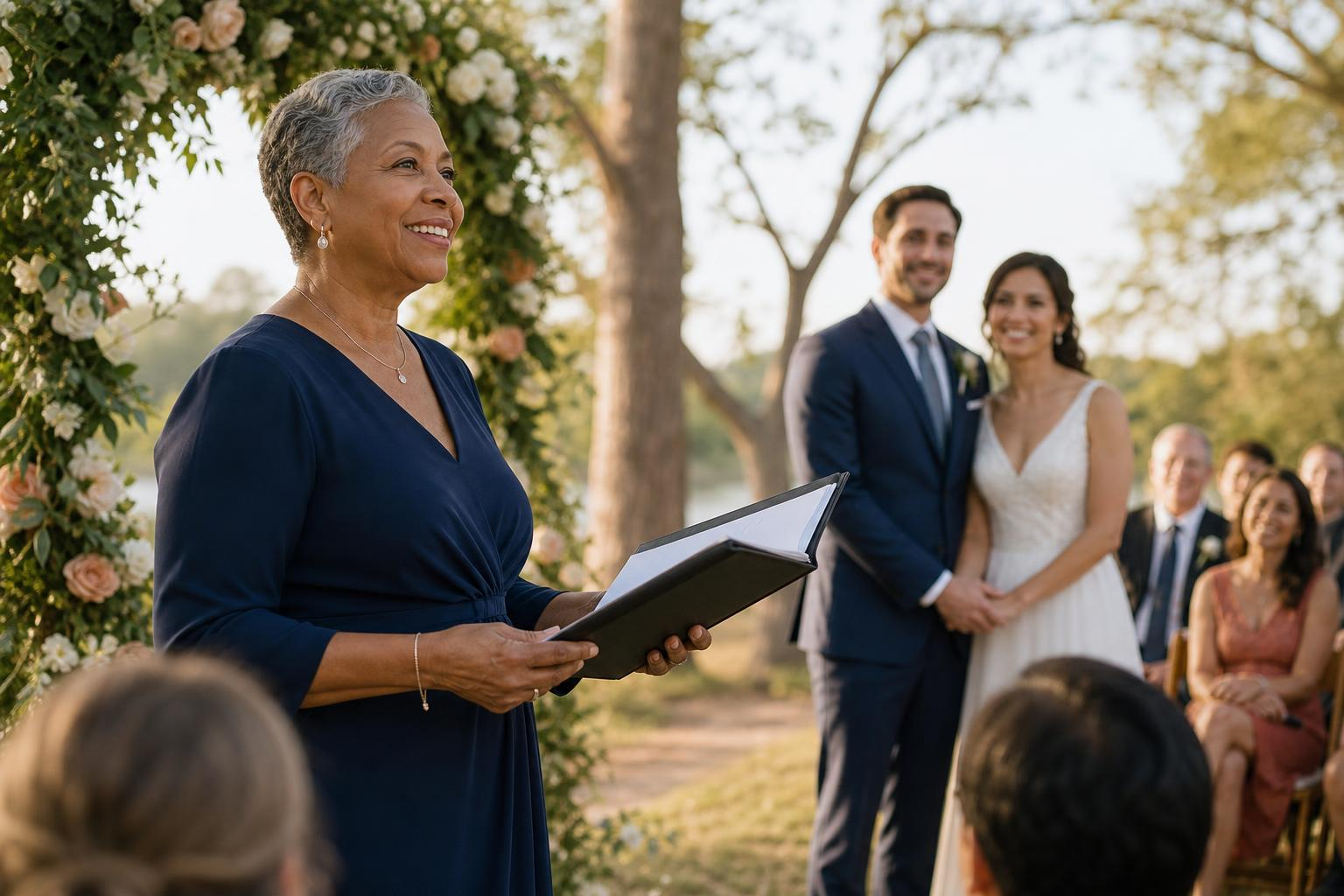
Wedding Ceremony Opening Words: 25 Original Examples
The first few sentences of a wedding ceremony do more than fill the silence. They welcome the guests, settle the couple, and give everyone a sense of what this gathering means. Good wedding ceremony opening words feel prepared without sounding stiff, personal without becoming private, and warm without taking attention away from the couple.
In many ceremonies, the opening is also called the welcome, introduction, or invocation. It usually begins the ceremony and helps establish its tone before the officiant moves into readings, reflections, vows, or other elements. The American Marriage Ministries and Universal Life Church guides both describe the opening as an important early part of the ceremony structure. AMM’s guide to wedding opening words and ULC’s officiant speech guide offer useful structural background.

What effective opening words should accomplish
A strong opening normally handles three jobs: it welcomes the people present, names the reason they have gathered, and prepares the room for the couple’s promises. You do not need to explain the entire relationship in the first minute. Save the longer story for the ceremony address or reflection.
Start with clarity. Say hello, identify the occasion, and acknowledge the couple. Guests should understand within a few sentences that the ceremony has begun.
Match the couple. A formal couple may appreciate measured language. A relaxed couple may prefer everyday words. If faith, family tradition, or a particular community is central to the couple, let that shape the wording only with their approval.
Keep the attention where it belongs. The officiant guides the room; the couple is the reason everyone is there. A personal story can help, but the opening should not become a monologue about the officiant.
Choose the right tone before you write
Before selecting words, ask: What should guests feel during the first minute—quietly moved, warmly included, joyfully energized, or reverently attentive?

Example: The couple wants a relaxed ceremony with heartfelt language, a few laughs, and no formal religious wording.
Short answer: Warm, modern, lightly humorous.
| Tone | Works well when | Opening approach | Watch for |
|---|---|---|---|
| Romantic | The couple values poetic, affectionate language | Begin with love as a daily choice | Overly grand or generic language |
| Modern | The ceremony is conversational and personal | Welcome guests in plain, direct words | Sounding like a social-media caption |
| Spiritual | Faith, gratitude, or blessing is meaningful | Use inclusive language approved by the couple | Assuming beliefs or traditions |
| Humorous | The couple enjoys light, respectful humor | Use one gentle observation before turning sincere | Embarrassing stories or private jokes |
| Intimate | The gathering is small or emotionally close | Acknowledge the people who made the day possible | Leaving out important family or friends |
| Formal | The setting or tradition calls for ceremony | Use dignified, measured phrasing | Becoming distant or excessively ornate |
25 original wedding ceremony opening words
Romantic opening words
- “Welcome, everyone. Today we gather to honor a love that has grown through ordinary days, difficult moments, laughter, and the quiet decision to keep choosing one another.”
- “We are here because two people have found in each other a home, a trusted companion, and a reason to look toward the future with hope.”
- “Love is not only the feeling that brings us to this moment. It is the promise to meet life together, with patience, courage, and a generous heart.”
- “Today, surrounded by the people who know and love them best, [Name] and [Name] begin a new chapter in a story they have already been writing together.”
- “There are moments that seem to gather all the meaning of the past and all the promise of the future. This is one of those moments for [Name] and [Name].”
Modern opening words
- “Hi, everyone, and welcome. We are here to celebrate [Name] and [Name], to hear the promises they have chosen, and to enjoy this moment with them.”
- “Thank you for showing up for this couple—not just today, but through the many steps that brought them here.”
- “Today is about a big promise, but it is also about the small things that make a life together: shared meals, honest conversations, inside jokes, and showing up.”
- “Welcome to a ceremony built around two people who know that a good marriage is less about perfection and more about partnership.”
Spiritual opening words
- “Welcome. We gather with gratitude for the love that has brought [Name] and [Name] to this day, and with hope for the life they will build together.”
- “May this ceremony be a peaceful pause in the middle of a busy world—a time to honor love, commitment, family, and the blessings of shared purpose.”
- “We gather in a spirit of gratitude, asking that this couple be strengthened by wisdom, patience, compassion, and the people who stand beside them.”
- “Today, love is being spoken aloud. May these words be received with open hearts and carried into the years ahead.”
Humorous opening words
- “Welcome, everyone. We are here to celebrate love, commitment, and the remarkable confidence it takes to let someone else choose the restaurant for the rest of your life.”
- “Today, [Name] and [Name] are making a serious promise: to keep choosing each other, even when one of them says, ‘I’m fine,’ in a tone that clearly means the opposite.”
- “Thank you all for being here. Your presence proves that [Name] and [Name] have excellent friends, supportive families, and at least a few people willing to sit through a ceremony before dinner.”
- “Marriage is a partnership, a friendship, and a long-term agreement to discuss what to watch next. Today, [Name] and [Name] are making that partnership official in the best possible way.”
Intimate opening words
- “To everyone gathered here: thank you for bringing your love, your memories, and your support to this small but meaningful circle.”
- “Today feels personal because it is personal. The people in this room have helped shape [Name] and [Name], and your presence is part of this story.”
- “In a gathering like this, we do not need many words to understand what matters. We can see it in the way [Name] and [Name] look at one another and in the people standing nearby.”
- “Welcome, dear friends and family. We have come close together today to witness a promise made by two people who know the value of being understood and loved as they are.”
Formal opening words
- “Dearly gathered guests, we welcome you to this ceremony honoring the commitment of [Name] and [Name].”
- “We are assembled today to witness and celebrate the union of [Name] and [Name], and to offer them our encouragement as they begin this new chapter.”
- “With gratitude for the families, friends, and communities represented here, we begin this ceremony in recognition of the commitment [Name] and [Name] are about to make.”
- “Let us join our attention and goodwill as [Name] and [Name] affirm their love, their partnership, and their intention to walk through life together.”
How to personalize an opening without making it awkward
Use details that reveal the couple’s values rather than details that merely prove you know their history. A reference to their teamwork, humor, hospitality, faith, or devotion to family usually serves the ceremony better than a long timeline of how they met.
Use their language. Ask the couple whether they prefer “marriage,” “partnership,” “union,” “commitment,” or another term. Also ask whether they want words such as “blessing,” “sacred,” or “spiritual.” The AMM notes that language with religious meaning should reflect the couple’s values, not the officiant’s assumptions. See AMM’s explanation of the invocation for more guidance.
Honor the guest list. If someone important cannot attend, ask the couple whether they want that person mentioned. Do not improvise sensitive family information at the microphone.
Borrow inspiration carefully. Poetry can help you find a mood or theme, but write your own words unless the couple has selected a reading and has permission to use it. The Poetry Foundation’s love-poem collection and its wedding poem guide can be useful starting points for exploring themes and readings.
Shape the opening for confident delivery
A beautiful sentence can still fall flat if it is difficult to say aloud. Read every draft out loud. Mark a pause after the welcome, after the couple’s names, and before the sentence that carries the emotional center.
- Print a clean working copy. Use large enough type, clear spacing, and visible placeholders for names.
- Practice the names. Confirm pronunciation, including family names, cultural names, and any chosen titles.
- Cut extra explanation. If a sentence needs several clauses to reach its point, divide it into two.
- Look up regularly. The couple and guests should feel addressed, not read to.
- Leave room for the moment. After the opening, pause before moving into the next part of the ceremony.
Final checks before the ceremony
Opening-words checklist
- Have I welcomed the guests clearly?
- Have I named the couple and the purpose of the gathering?
- Does the tone sound like them?
- Have I received approval for religious, cultural, or family references?
- Can I say every sentence naturally out loud?
- Have I removed private jokes and risky details?
- Do I know what comes immediately after the opening?
For any question about whether a ceremony, officiant, license, filing, or wording meets a particular jurisdiction’s requirements, check the applicable government authority and the couple’s venue or marriage-license instructions. This guide is writing and ceremony-planning help, not legal advice. OrdainedPro’s marriage requirements map may be a useful starting point for locating jurisdiction-specific information, but state and local requirements should be independently confirmed before publication or the ceremony.
Let the opening make the room feel ready
The best wedding ceremony opening words do not try to carry the whole ceremony. They simply open the door: they welcome the guests, steady the couple, and point everyone toward the promise about to be made. Choose a tone, write plainly, practice aloud, and give the couple the final say. That steady preparation is what allows the words to sound effortless when the moment arrives.
Frequently Asked Questions
What are wedding ceremony opening words?
Wedding ceremony opening words are the officiant's first welcome and introduction. They usually greet the guests, name the couple, explain why everyone has gathered, and establish the tone for the ceremony.
How long should wedding ceremony opening words be?
Keep the opening focused enough to welcome the room without taking over the ceremony. A short paragraph or a few brief paragraphs is usually easier to deliver than a long speech.
Should wedding ceremony opening words be religious?
Only when that language reflects the couple's beliefs and ceremony plans. Ask the couple before using words such as sacred, blessed, prayer, or God, and confirm any required religious wording with the appropriate authority.
Can a wedding officiant use humor in the opening?
Yes, if the humor is gentle, inclusive, and approved by the couple. Avoid jokes about sensitive subjects, private stories, former partners, money, appearance, or family conflict.
What should an officiant say first at a wedding?
A clear welcome is a reliable starting point, followed by the couple's names and a simple statement about the purpose of the gathering. From there, the officiant can transition into the ceremony's next element.
Where can an officiant find inspiration for wedding ceremony language?
Start with the couple's own values and vocabulary. Poetry collections, officiant-training resources, and ceremony templates can provide ideas, but the final wording should be original, appropriate, and approved by the couple.