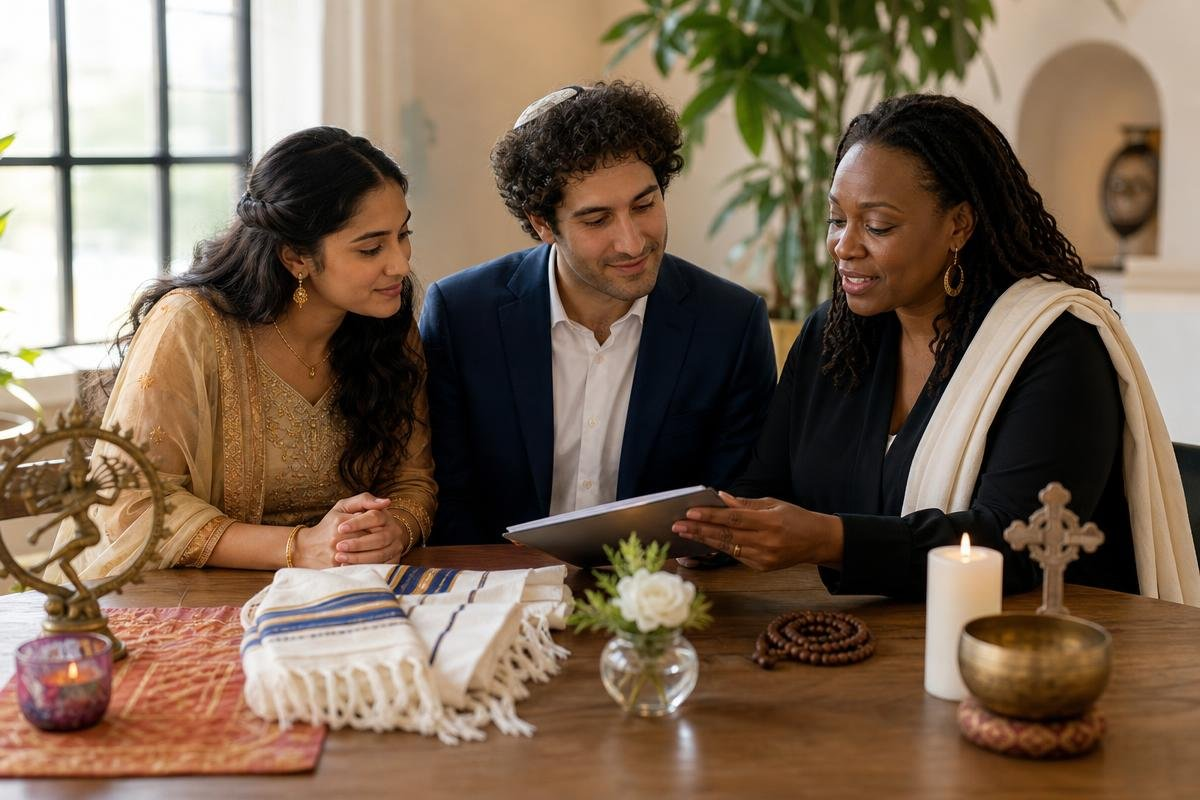
Interfaith wedding questions help an officiant do more than fill out a ceremony outline. They give the couple room to explain what matters, what feels sensitive, and what they want their guests to carry home. Your job is not to make two traditions identical. It is to help the couple build a ceremony that is honest, welcoming, and unmistakably theirs.
Interfaith work is strongest when it respects the distinctiveness of each tradition rather than flattening everything into vague language. That principle is reflected in guidance from Harvard University’s Pluralism Project. Relationship conversations also benefit from patience, curiosity, and clear communication, themes reflected in the American Psychological Association’s relationship resources.

Practical planning question: What do you want guests from both sides of the family to understand about your marriage after the ceremony?
Example: We want guests to see that our traditions remain meaningful while our marriage creates a shared home with room for both.
Short answer: Honor both, build together.
1. Start with the couple’s shared foundation
Before discussing rituals, learn how the couple describes their relationship. Two people may use the same religious label in very different ways, while a person who identifies as spiritual, cultural, secular, or questioning may still have deeply meaningful traditions.
- How do each of you describe your faith, spirituality, culture, or relationship to religion?
- What first drew you to one another across your different backgrounds?
- Which values do you most want the ceremony to express?
- Are there words you prefer—or words you do not want used—to describe your beliefs?
- What would make the ceremony feel authentic rather than merely balanced?
Listen for the difference between “including both religions” and “representing what both people actually believe.” A ceremony can contain fewer formal symbols and still honor the couple more truthfully.

2. Explore family, culture, and community expectations
Family concerns often arrive indirectly. A parent may not object to the marriage itself but may worry about losing a language, holiday, ritual, name, or connection to community. Give the couple a calm place to name those pressures before they become last-minute ceremony problems.
- Which family traditions feel joyful and important to include?
- Which expectations feel inherited but no longer fit your life together?
- Are there family members whose participation would carry special meaning?
- What concerns have relatives raised, and how would you like the ceremony to address—or avoid—those concerns?
Do not assume that the oldest relative, the most observant relative, or the loudest relative speaks for everyone. Ask the couple to identify their own decisions, then help them communicate those decisions respectfully.
Make room for language
- Would you like any part of the ceremony offered in another language?
- Who can provide accurate pronunciation, translation, or transliteration?
- Do you want guests to hear an explanation of the language or tradition, or should the moment stand on its own?
Confirm pronunciation early. A short phonetic guide, a recorded example, or a rehearsal with the person offering the reading can prevent avoidable embarrassment. If a phrase has a sacred or culturally specific meaning, ask someone connected to that tradition to review the wording.
3. Clarify readings, prayer, and sacred language
Readings and prayers can sound similar on paper while carrying very different theological weight. The officiant should know whether a passage is being used as scripture, poetry, family heritage, a blessing, or a personal reflection.
- Are there prayers, blessings, scriptures, poems, or songs that each of you hopes to include?
- What does each selected reading mean to you personally?
- Are there passages that one of you considers inappropriate, exclusive, or uncomfortable?
- Should the ceremony use God-language, sacred titles, universal language, or a mixture?
- Would you like a moment of silence for guests whose beliefs differ from yours?
Do not present yourself as the final authority on a tradition you do not belong to. If a couple wants a formal religious prayer or a specific rite, invite them to consult an appropriate religious leader or knowledgeable community member. Your role is to coordinate respectfully and represent the couple accurately.
4. Discuss rituals, sacred objects, and ceremony boundaries
Many couples want recognizable rituals, but they may not agree on whether those rituals should be performed, adapted, explained, or reserved for another setting. Treat every ritual as a conversation rather than a decorative choice.
- Are there rituals involving candles, rings, water, wine, bread, garments, flowers, or other objects?
- Which objects are sacred, and who should handle or present them?
- Are there rituals that should not be combined, modified, or performed outside a particular setting?
- Would you like a family member or faith leader to lead any portion of the ceremony?
- What should the officiant explain so guests understand the meaning without turning the ceremony into a lecture?
Ask for a simple “yes, no, maybe, and needs review” decision on each ritual. That keeps the planning practical and gives the couple a record of what has been settled.
| Planning choice | When it may fit | What to confirm |
|---|---|---|
| Include both traditions directly | Both partners feel comfortable with visible religious elements | Order, leadership, wording, and any community expectations |
| Adapt familiar symbols | The couple wants cultural meaning with less formal theology | Whether adaptation remains respectful and recognizable |
| Use shared values instead | The couple prefers a spiritual, secular, or broadly welcoming ceremony | Which values, stories, or promises feel specific to them |
| Keep religious rites separate | Each family or community has distinct requirements | Whether a second ceremony, blessing, or private ritual is desired |
5. Cover everyday culture: food, attire, holidays, and home life
The ceremony is one day, but the couple is building a life. These questions can reveal important expectations that may not belong in the ceremony itself but should still be acknowledged in the couple’s planning.
- Are there food practices, fasting traditions, allergies, or religious restrictions your guests or family should know about?
- Do attire, head coverings, jewelry, colors, or modesty expectations matter for the ceremony?
- Which holidays, sacred days, or seasonal traditions will shape your future home?
- Are there hopes or boundaries around children, names, education, worship, or religious community?
These topics can become emotionally charged, so do not force the couple to solve their entire future during ceremony planning. Your task is to notice what needs a fuller conversation and, when appropriate, encourage them to continue that conversation privately or with a qualified counselor or faith leader.
Example: If one partner expects children to attend religious school and the other has not considered it, do not turn that disagreement into a ceremony script. Note it as a separate relationship decision that deserves time and care.
Short answer: Notice it; do not solve it.
6. Turn answers into a welcoming ceremony
Once you have the couple’s answers, organize them into a ceremony plan. A useful outline usually includes the welcome, the couple’s story, readings or reflections, promises, vows, symbolic actions, the pronouncement, and any closing words. The structure should serve the couple—not force them into a template.
Officiant review checklist
- Both partners approved the wording and order.
- Pronunciations and translations were reviewed.
- Sacred objects and rituals have clear handlers.
- Family participants know what they are doing and when.
- Any sensitive language has been discussed privately first.
- The ceremony explains unfamiliar practices briefly and respectfully.
- Local marriage paperwork and officiant requirements are being confirmed with the proper government authority.
For state-specific marriage-law or officiant questions, use OrdainedPro’s state guide starting point, then verify the current requirements with the relevant government office. Requirements can vary by location, and this article is not legal advice.
Finally, read the ceremony aloud. Spoken language exposes problems that look fine on a screen: a phrase may sound too formal, a transition may imply agreement the couple does not share, or a ritual explanation may run too long. A steady, well-paced ceremony feels more inclusive than one overloaded with symbolic material.
Conclusion: Ask with curiosity, then serve the couple’s truth
The best interfaith wedding questions do not put the couple on trial. They help you learn what is sacred, what is cultural, what is negotiable, and what must be handled with care. Ask plainly, listen without ranking one tradition above another, verify details with knowledgeable people, and write only what the couple can honestly stand behind.
Your goal is simple: help two people make promises in a way that respects their histories while giving them room to build something shared.
Frequently Asked Questions
What are the most important interfaith wedding questions for an officiant?
Start with questions about the couple's beliefs, shared values, family expectations, desired rituals, sacred language, cultural traditions, and boundaries. Ask what they want guests to understand and what would make the ceremony feel authentic.
Should an officiant include both religions in an interfaith ceremony?
Not necessarily. Some couples want both traditions represented directly, while others prefer adapted symbols, shared values, or separate religious observances. The couple's beliefs and boundaries should guide the decision.
How should an officiant handle unfamiliar religious rituals?
Ask the couple what the ritual means, whether it may be adapted, who should lead it, and whether a knowledgeable member of that tradition should review the wording or procedure.
What should an officiant do if family members disagree with the ceremony?
Listen respectfully, but treat the couple as the decision-makers. Help them identify what they want communicated, what concerns can be acknowledged, and which boundaries need to remain firm.
Should an interfaith officiant ask about future children and religious upbringing?
It can be appropriate to ask whether those topics affect the ceremony, especially if the couple wants related promises or family participation. Do not pressure them to resolve complex life decisions during ceremony planning.
How can an officiant make an interfaith ceremony welcoming to guests?
Use clear language, explain unfamiliar rituals briefly, confirm pronunciation and translations, avoid stereotypes, and make room for guests with different beliefs without pretending every tradition means the same thing.