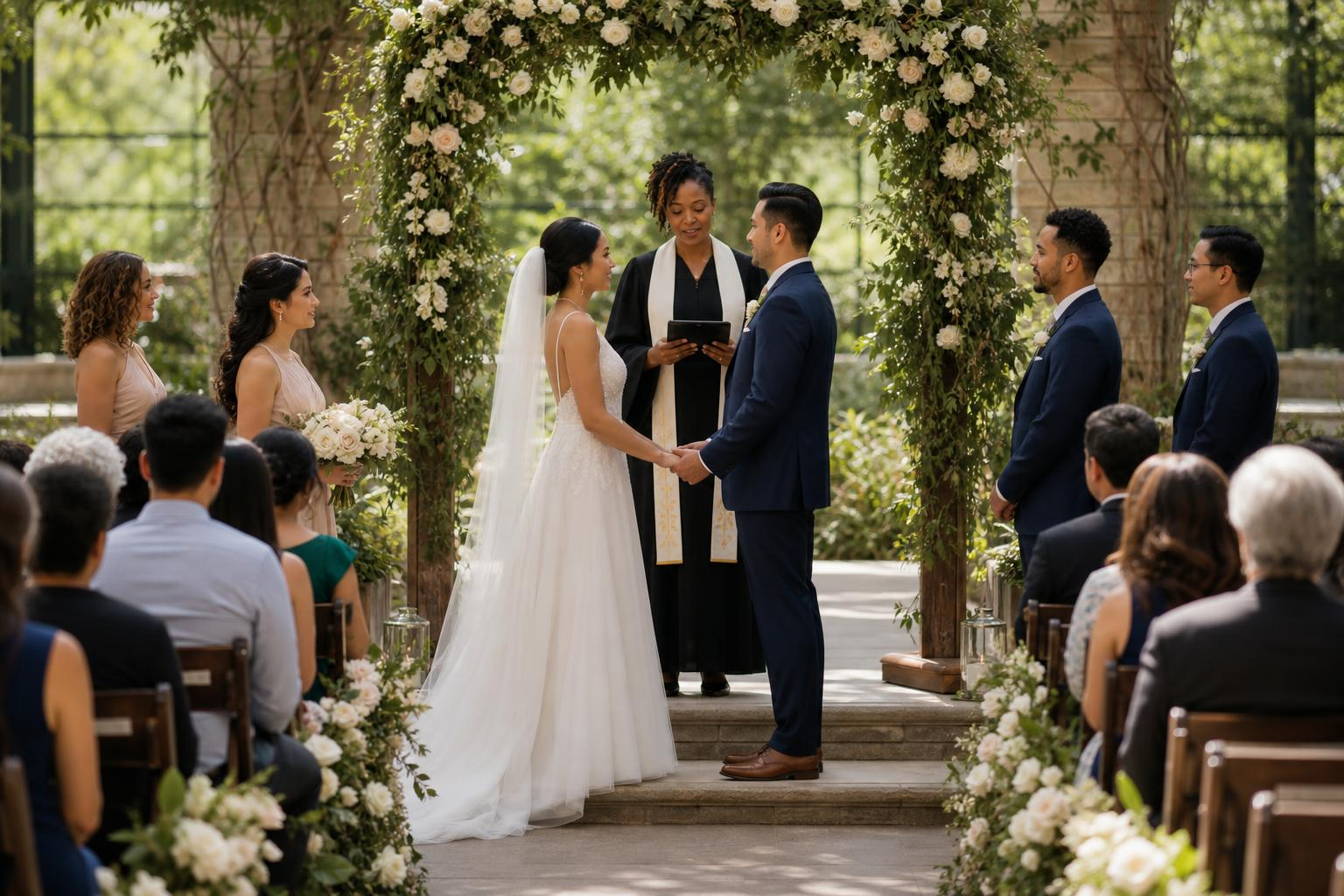
Wedding Ceremony Order: Every Part Explained
When you are officiating a wedding, the ceremony order is your steady handrail. It helps the couple know what to expect, gives the wedding party clear cues, and keeps the guests connected from the first entrance to the final applause.
There is no single script that fits every couple. A secular ceremony, a faith-based service, an interfaith celebration, and a short courthouse-style wedding may all use different elements. Still, most ceremonies follow a familiar path: the processional, welcome, readings or reflection, vows, rings, pronouncement, and recessional.

Planning question: What do you want guests to feel as they move through the ceremony?
Example: “We want the ceremony to feel warm, calm, and family-centered, with one reading and a short unity ritual.”
Short answer: Warm, calm, and family-centered.
This guide walks through each part of the wedding ceremony order so you can build a ceremony that feels organized without sounding stiff.
1. Begin with the processional
The processional is the entrance portion of the ceremony. It brings the officiant, family members, wedding party, and couple into place. In a common format, the officiant is already at the ceremony space, followed by one partner, the wedding party, honor attendants, children in the ceremony, and the final partner or partners.

That is only a starting point. Couples may walk together, enter from opposite sides, be escorted by parents or chosen loved ones, or make separate entrances. The important thing is not preserving an old pattern; it is making the entrance understandable and emotionally comfortable for the people involved.
Make every entrance cue clear
Before the wedding day, write the processional order by name. Do not rely on labels such as “bridesmaids” or “family.” Include who walks with whom, where each person stands, and what music cue begins each group.
If children are involved, give them a simple job and a backup plan. A ring bearer may carry an empty pillow while the actual rings stay with a trusted adult. A flower child may walk with an older attendant. Small adjustments like these prevent avoidable stress.
2. Welcome guests and frame the ceremony
Once everyone is in place, the officiant welcomes the guests and explains why they have gathered. This is often called the opening, invocation, or welcome.
A good opening does three jobs:
- It settles the room after the movement of the processional.
- It acknowledges the couple and the people who support them.
- It gives guests a clear sense of what the ceremony will include.
Keep this portion focused. You do not need to explain every upcoming line. A few grounded sentences are usually stronger than a long introduction. You might welcome the guests, recognize the importance of the day, and briefly describe marriage as the commitment the couple is choosing to make.
Handle family recognition with care
Some couples want a traditional “giving away” question. Others prefer language that honors family support without suggesting that one person is being transferred to another. You can ask who supports the couple, invite the guests to offer their encouragement, or simply recognize parents, children, friends, and chosen family in the opening remarks.
Ask the couple in advance which names, relationships, and cultural traditions should be included. Never assume that a familiar phrase feels meaningful to them.
3. Add readings, music, and reflections
Readings are optional, but they can give the ceremony a welcome change of pace. A reading may come from a religious text, poem, novel, song, family tradition, or another work that speaks to the couple. The Poetry Foundation’s collection of love poems can be a useful starting point for couples looking for literary selections.
Readings usually work well after the welcome and before the vows. That placement lets the reading prepare the room for the couple’s promises. If the ceremony includes several readings, consider spacing them apart with music or a short reflection rather than placing them all together.
Prepare the reader, not just the reading
Send the reader the final text early. Mark unfamiliar names, pauses, and pronunciation notes. Confirm whether the reader will use a printed copy, a lectern, or a microphone. If the selection is longer than a few paragraphs, ask whether it can be shortened while preserving its meaning.
Introduce the reader by name and tell guests what they are about to hear. After the reading, thank the reader and give the couple a moment before moving forward.
4. Guide the declarations and vows
The vow portion is usually the emotional center of the ceremony. It may include a declaration of intent, personal vows, traditional promises, or a combination.
The declaration of intent is the direct statement in which each partner affirms the choice to marry. Personal vows are more expressive: they may describe the couple’s relationship, hopes, promises, and responsibilities. Some couples use only personal vows, while others prefer a short formal response followed by more personal words.
Help the couple choose a comfortable format
Offer practical choices:
- Repeat-after-me vows: helpful when nerves are high or the couple wants a guided rhythm.
- Read-from-the-page vows: useful for personal wording and reliable pacing.
- Memorized vows: intimate, but more demanding under pressure.
- Shared vows: a single set of promises spoken by both partners.
Review the final wording before the ceremony. Check names, pronouns, repeated phrases, and any promise the couple may not understand. Encourage them to print vows in large type and use separate copies if they will be standing several feet apart.
As the officiant, your job is to create space. Speak the cue, pause, and let the couple own the moment. Do not rush to fill every silence.
5. Exchange rings and include a unity ceremony
Ring exchange commonly follows the vows or declaration of intent. The officiant may explain the meaning the couple gives the rings, invite each partner to place a ring, and guide a short ring promise.
Keep ring wording simple enough to remember. A ring exchange can be as brief as a name, a promise, and “with this ring.” It can also include a longer explanation if that meaning is important to the couple.
Place unity ceremonies where they support the story
A unity ceremony is a symbolic action that represents connection, shared purpose, or the joining of families. Common examples include a unity candle, sand ceremony, tree planting, handfasting, wine blending, or a family ritual.
Many ceremonies place the unity ritual after readings and before or after the vows. The best location depends on its meaning. If it represents preparation for marriage, place it before the vows. If it represents the couple’s newly joined life, place it after the vows and rings.
| Ceremony element | Common placement | Best use | Planning note |
|---|---|---|---|
| Reading or poem | After the welcome | Sets a reflective tone | Confirm length, reader, and microphone needs |
| Unity ceremony | Near readings, vows, or rings | Adds a visible symbol of connection | Explain the meaning before the action |
| Personal vows | Before or after formal intent | Shares the couple’s individual promises | Agree on order and approximate length |
| Ring exchange | Usually near the vows | Creates a physical symbol of commitment | Assign one trusted person to hold the rings |
| Announcements | Near the closing | Directs guests to the next part of the day | Keep instructions short and specific |
6. Pronouncement, kiss, and closing announcements
After the couple has completed the intended promises and symbolic elements, the officiant gives the pronouncement. This is the point where you formally present the couple according to the ceremony wording they approved.
Pause before the pronouncement so the room can catch up. Then speak clearly, face the guests, and leave enough space for the couple’s kiss or chosen closing gesture. Not every couple wants a kiss, and not every ceremony needs one. A joyful embrace, hand squeeze, or shared smile can be just as meaningful.
Use announcements as a service, not a speech
Announcements may include directions to the reception, instructions about a group photo, a reminder to keep an aisle clear, or a note about an unplugged ceremony. Place them near the end so they do not interrupt the emotional center of the service.
Write these instructions in the script. Even familiar details can disappear when the officiant is managing a microphone, a happy couple, and a room full of guests.
7. Finish confidently with the recessional
The recessional is the couple’s exit from the ceremony. In many formats, the newly married couple leaves first, followed by the wedding party and family members. Other couples choose a different order, exit together with children, or remain in place while guests depart.
Before announcing the recessional, make sure the aisle is clear and the musicians know the cue. Give the couple a moment to turn toward the aisle before the music begins. If there will be petals, bubbles, confetti, or a receiving line, confirm the venue’s instructions ahead of time.
Officiant ceremony-order checklist
- Confirm the processional order and music cues.
- Review every name, pronunciation, and pronoun.
- Place readings and unity rituals in the approved script.
- Confirm who holds the rings and printed vows.
- Mark the declaration, vows, rings, pronouncement, and recessional cues.
- Share closing announcements with the coordinator.
- Walk through the ceremony once with the people who have speaking or movement roles.
A simple ceremony order you can adapt
For many secular or personalized ceremonies, this sequence is a dependable starting point:
- Prelude music and guest seating
- Processional
- Welcome and opening remarks
- Family or community acknowledgment
- Reading, poem, or musical selection
- Officiant reflection or couple’s story
- Declaration of intent
- Personal or traditional vows
- Ring exchange
- Unity ceremony, if included
- Pronouncement and closing gesture
- Announcements
- Recessional
Faith-based ceremonies may follow a different order or include required prayers, blessings, readings, or rituals. The United States Conference of Catholic Bishops’ matrimony resource is one example of why religious ceremonies should be planned with the relevant faith authority rather than copied from a general outline.
Conclusion: Make the order serve the couple
A strong wedding ceremony order does more than move people down an aisle. It gives each moment a purpose, gives the couple room to be present, and gives guests a clear way to participate.
Build the outline with the couple, confirm every cue, and keep the final script close at hand. When the order is prepared carefully, you can be flexible on the day without losing your footing—and that calm is one of the best gifts an officiant can give.
Frequently Asked Questions
What is the typical wedding ceremony order?
A common order is the processional, welcome, readings or reflection, declaration of intent, vows, ring exchange, optional unity ceremony, pronouncement, announcements, and recessional. Couples may rearrange or remove elements to fit their relationship, culture, or faith tradition.
Do readings come before or after vows?
Readings commonly come before the vows because they help establish a reflective tone. They can also be placed elsewhere when the couple wants a different emotional flow.
Where does a unity ceremony belong?
A unity ceremony often appears near the readings, vows, or rings. Place it where its meaning supports the ceremony story: before the vows if it represents preparation, or after the vows if it symbolizes the couple’s joined life.
What is the difference between vows and the declaration of intent?
The declaration of intent is a direct affirmation that each partner chooses to marry the other. Vows are the promises the couple makes, whether traditional, personal, repeated after the officiant, or read from prepared notes.
Who walks out first during the recessional?
Many ceremonies have the couple leave first, followed by the wedding party and family. The couple may choose another order, especially when children, cultural traditions, or accessibility needs are involved.
How can an officiant keep the ceremony from feeling disorganized?
Use a complete script, write every name and cue clearly, confirm the processional and recessional with the coordinator and musicians, assign someone to hold the rings, and walk through the movement before the ceremony begins.