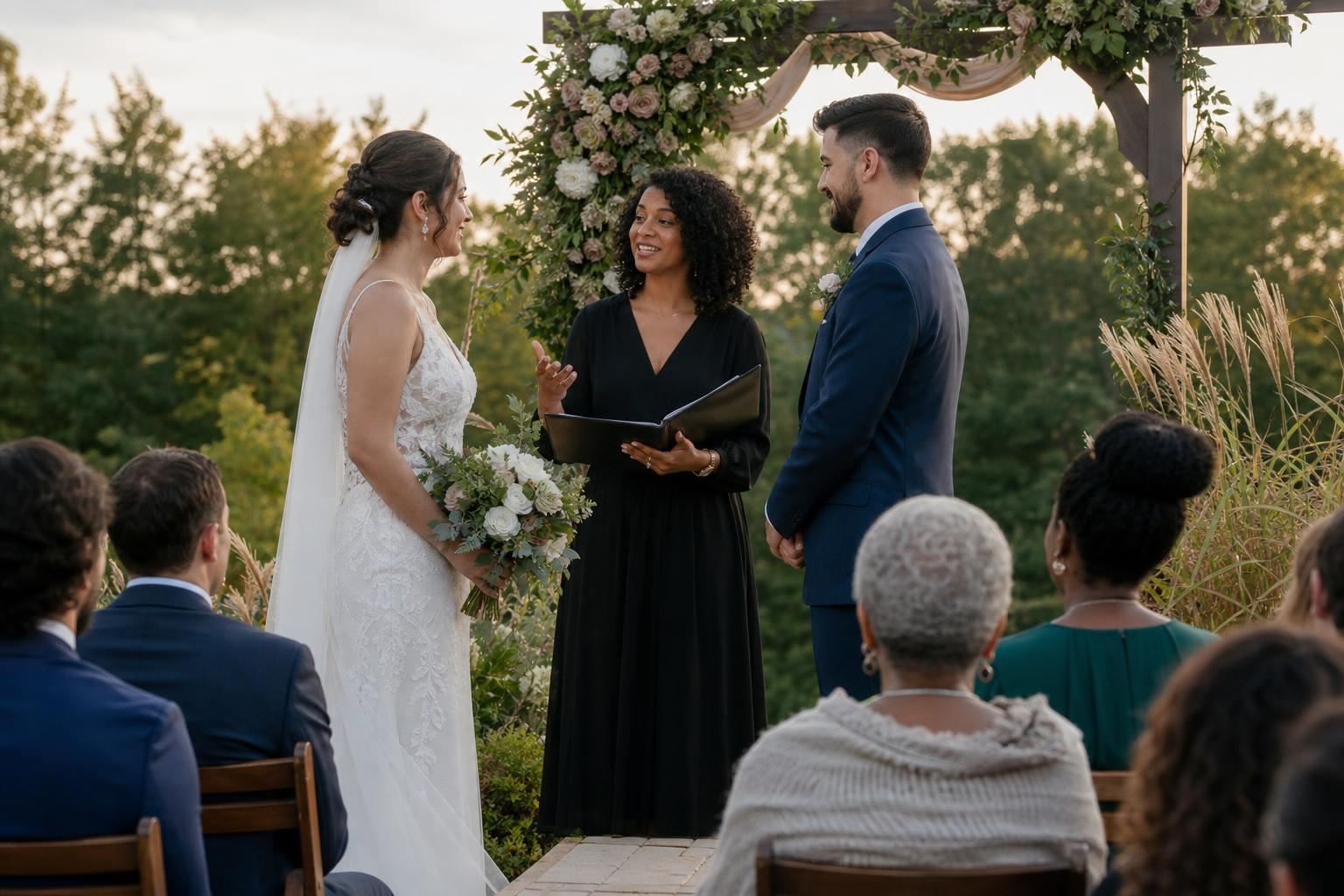
How long should a wedding ceremony be? For many couples, the comfortable answer is about 15 to 45 minutes. A simple elopement may take only a few minutes, while a religious, cultural, or highly personalized ceremony may last an hour or longer.
The right length is not about chasing a magic number. It is about giving the couple enough room to make meaningful promises without making guests wonder whether the ceremony has lost its shape. As an officiant, your job is to help the couple choose a pace that feels personal, organized, and respectful of the day’s larger schedule.

This guide compares elopement, short, standard, and extended ceremonies, then explains what actually changes the run time.
Quick answer: most ceremonies fit within 15 to 45 minutes
Wedding professionals commonly describe modern secular ceremonies as lasting roughly 15 to 30 minutes, while a broader general range runs from about 30 to 45 minutes. Religious ceremonies and ceremonies with substantial cultural traditions may take closer to an hour or more. The Knot also notes that some ceremonies last as little as five minutes, while others reach an hour or longer.
Those ranges are useful for planning, but they are not rules. A ten-minute ceremony can feel complete when every word has a purpose. A 45-minute ceremony can feel rushed if the couple has too many readings, speakers, or transitions packed into it.
The Knot’s ceremony-planning guidance identifies religious or cultural customs and the number of people participating as major factors in ceremony length. WeddingWire’s timeline guidance similarly treats about 30 minutes as a common planning point while allowing extra time for religious services.
Four useful ceremony-length categories
These categories give you a calm way to talk through expectations with a couple. They are planning labels, not rigid definitions.

| Ceremony type | Planning range | Usually includes | Best fit |
|---|---|---|---|
| Elopement or legal-style ceremony | About 5–15 minutes | Welcome, declaration of intent, vows, rings if desired, pronouncement, and closing | Private ceremonies, courthouse-style gatherings, or couples who want simplicity |
| Short ceremony | About 10–20 minutes | Brief welcome, personal remarks, concise vows, ring exchange, and pronouncement | Small weddings, casual celebrations, and tight venue schedules |
| Standard ceremony | About 30–45 minutes | Processional, welcome, couple story, readings, vows, rings, pronouncement, and recessional | Most traditional or secular weddings with several meaningful elements |
| Extended ceremony | About 45–60 minutes or longer | Multiple readings, prayers, rituals, music, family participation, or formal religious structure | Religious, cultural, interfaith, or highly ceremonial weddings |
The shorter ranges reflect examples described by The Knot, including ceremonies that may last five minutes, secular ceremonies of roughly 15 to 20 minutes, and general ceremonies of about 30 to 45 minutes. The longer category is appropriate when the couple’s chosen structure includes additional formal elements.
What changes the run time?
The processional and recessional
The ceremony clock starts before the first spoken word. A couple walking in alone may need only a minute or two. A processional with parents, attendants, children, musicians, and a long aisle can take noticeably longer.
Music matters as well. The Knot reports that processional music commonly lasts around three to ten minutes, depending on the size of the procession and the venue. If the couple wants a dramatic entrance, plan for it honestly rather than squeezing it into an unrealistically short schedule.
The officiant’s welcome and reflection
A welcome can be a few sentences or a full message about marriage, commitment, family, and the couple’s story. This is often where ceremonies become longer than expected.
Encourage the couple to choose one clear purpose for the reflection. A warm, focused message usually lands better than a long speech that repeats the vows. If the couple has written a detailed love story, consider turning the strongest parts into a short narrative rather than reading every detail.
Readings, prayers, and musical selections
Every reading has a performance time, and every performance has a transition. A poem may take two minutes to read, but the reader also needs time to approach the ceremony space, receive the microphone, settle, and return to their seat.
The same is true for songs, hymns, prayers, and moments of silence. Ask for the actual selection in advance and read it aloud with a timer. Do not estimate from the page alone.
Personal vows and ring exchanges
Personal vows are one of the most meaningful parts of a ceremony, but they are also one of the least predictable. A couple may promise to keep vows under two minutes and then discover that their final drafts take five minutes each.
Give the couple a gentle target rather than a harsh rule. Two to three minutes per person is often manageable for a standard ceremony, but the emotional tone matters more than perfect symmetry. If one partner writes much more, help them identify the essential promises and save additional memories for private letters.
Unity rituals and family participation
Candle lighting, handfasting, sand blending, wine ceremonies, tree planting, cultural blessings, and similar rituals can add beauty. They can also add instructions, movement, setup, and cleanup.
Walk through each ritual physically. Who brings the materials? Where do they stand? Does the couple move, or does someone bring the items to them? A ritual that looks like two minutes on paper may take five or six minutes in the room.
Religious or cultural structure
Some ceremonies follow a formal order that the couple should not casually shorten. Religious services may include prayers, readings, blessings, hymns, communion, or other established elements. Cultural ceremonies may include several family customs or symbolic actions.
The officiant should ask the couple which elements are essential, which are optional, and who has authority to approve changes. For a religious ceremony, coordinate with the relevant religious leader or institution instead of making assumptions. The Church of England’s service overview, for example, shows how music, declarations, vows, rings, paperwork, prayers, blessings, and the exit can all be part of one structured service.
How to build a ceremony that feels full but not long
A good ceremony has a beginning, a meaningful center, and a clear ending. The couple does not need to include every possible tradition to make the service feel substantial.
- Start with the non-negotiables. Identify the vows, ring exchange, pronouncement, required religious elements, and any family traditions the couple considers essential.
- Choose one main reflection. Decide whether the officiant’s message will focus on the couple’s story, marriage advice, faith, family, or another central theme.
- Limit repeated ideas. If the welcome discusses commitment, the reading discusses commitment, and the vows discuss commitment, the ceremony may feel longer without feeling deeper.
- Plan transitions. Write down who moves, who speaks, where the rings are located, and when music begins or ends.
- Read it aloud. Time the ceremony with natural pauses, laughter, applause, music cues, and movement included.
- Protect breathing room. A ceremony scheduled for exactly 30 minutes may run over when someone becomes emotional or a microphone needs adjustment.
Ask the couple: What do you want guests to remember when the ceremony ends?
Example: “We want people to remember that our marriage is grounded in faith, friendship, and the support of our families.”
Short answer: Faith, friendship, family support.
Timing guidance for each type of wedding
Elopements
Elopements often work best when the ceremony stays focused. A short welcome, a few personal words, vows, rings, and a pronouncement may be enough. If photographs are important, remember that the ceremony itself may be brief even though the overall appointment lasts much longer.
Short and casual weddings
For a backyard wedding, courthouse-style gathering, or small ceremony, 10 to 20 minutes can feel just right. The key is to avoid adding formal elements simply because they appear in sample scripts. A concise ceremony can still include a personal welcome and meaningful vows.
Standard weddings
A 30- to 45-minute ceremony gives most couples room for a processional, welcome, short reflection, one or two readings, personal or traditional vows, rings, and a recessional. This is often the easiest format to fit into a larger wedding-day timeline.
Extended ceremonies
An hour-long ceremony can be entirely appropriate when the structure calls for it. Tell guests what to expect through the invitation, wedding website, ceremony program, or a brief note from the couple. Seating, shade, temperature, accessibility, and restroom access matter more when guests will be seated for an extended period.
How ceremony length affects the rest of the day
The ceremony does not exist by itself. Its length affects photography, transportation, cocktail hour, meal service, sunset portraits, venue access, and vendor schedules. WeddingWire recommends discussing ceremony length with the officiant as part of the overall timeline, while The Knot advises building breathing room into the day rather than scheduling every transition with no margin.
If the ceremony ends at 4:00 p.m., guests may still need time to exit, greet the couple, move to another area, or find refreshments. A 30-minute ceremony may therefore require a larger 45- to 60-minute block on the master timeline.
Officiant timing checklist
- Confirm whether the stated length includes the processional and recessional.
- Collect the final vows, readings, and ritual instructions.
- Time every spoken and musical element aloud.
- Identify who handles rings, microphones, candles, documents, or other materials.
- Add transition time for entrances, exits, readings, and family participation.
- Share the final estimated length with the couple and planner.
- Build a small buffer before the next scheduled event.
The best ceremony length is the one that serves the couple
So, how long should a wedding ceremony be? Start with 15 to 45 minutes for a typical secular or lightly traditional ceremony, then adjust based on the couple’s priorities. Elopements may be much shorter. Religious, cultural, and highly personalized services may be longer.
Your steady guidance can make the decision easier. Help the couple protect what matters, remove repetition, rehearse the transitions, and leave enough room for real human moments. When the ceremony has a clear purpose and a well-tested script, its length usually takes care of itself.
Next step: Ask for the complete ceremony outline, time it aloud, and revise from there. A well-paced ceremony does not feel rushed or dragged out—it feels like it belongs to the couple.
Planning note: Ceremony timing is separate from local marriage-license, officiant-qualification, filing, and other legal requirements. Confirm those requirements with the appropriate government or marriage authority before the ceremony.
Frequently Asked Questions
How long is a typical wedding ceremony?
Many modern secular ceremonies last about 15 to 30 minutes, while a broader standard planning range is approximately 30 to 45 minutes. Religious, cultural, or highly personalized ceremonies may last an hour or longer.
Can a wedding ceremony be only 10 minutes long?
Yes. A concise ceremony can include a welcome, declaration of intent, vows, ring exchange, pronouncement, and closing. The ceremony should feel complete and intentional rather than simply short.
How long should an elopement ceremony be?
Many elopement ceremonies are brief, often around 5 to 15 minutes, although the couple may choose a longer service with personal vows, readings, or rituals.
Do processional and recessional music count toward ceremony length?
They should count toward the ceremony block on the master timeline. A large wedding party or long aisle can add several minutes before and after the spoken portion.
What makes a wedding ceremony longer?
The most common factors are the size of the processional, the length of the officiant’s message, personal vows, readings, prayers, music, unity rituals, family participation, and religious or cultural traditions.
How can an officiant shorten a ceremony without making it feel rushed?
Keep one clear theme, remove repeated ideas, limit readings, set a reasonable target for personal vows, simplify transitions, and rehearse the complete ceremony aloud.