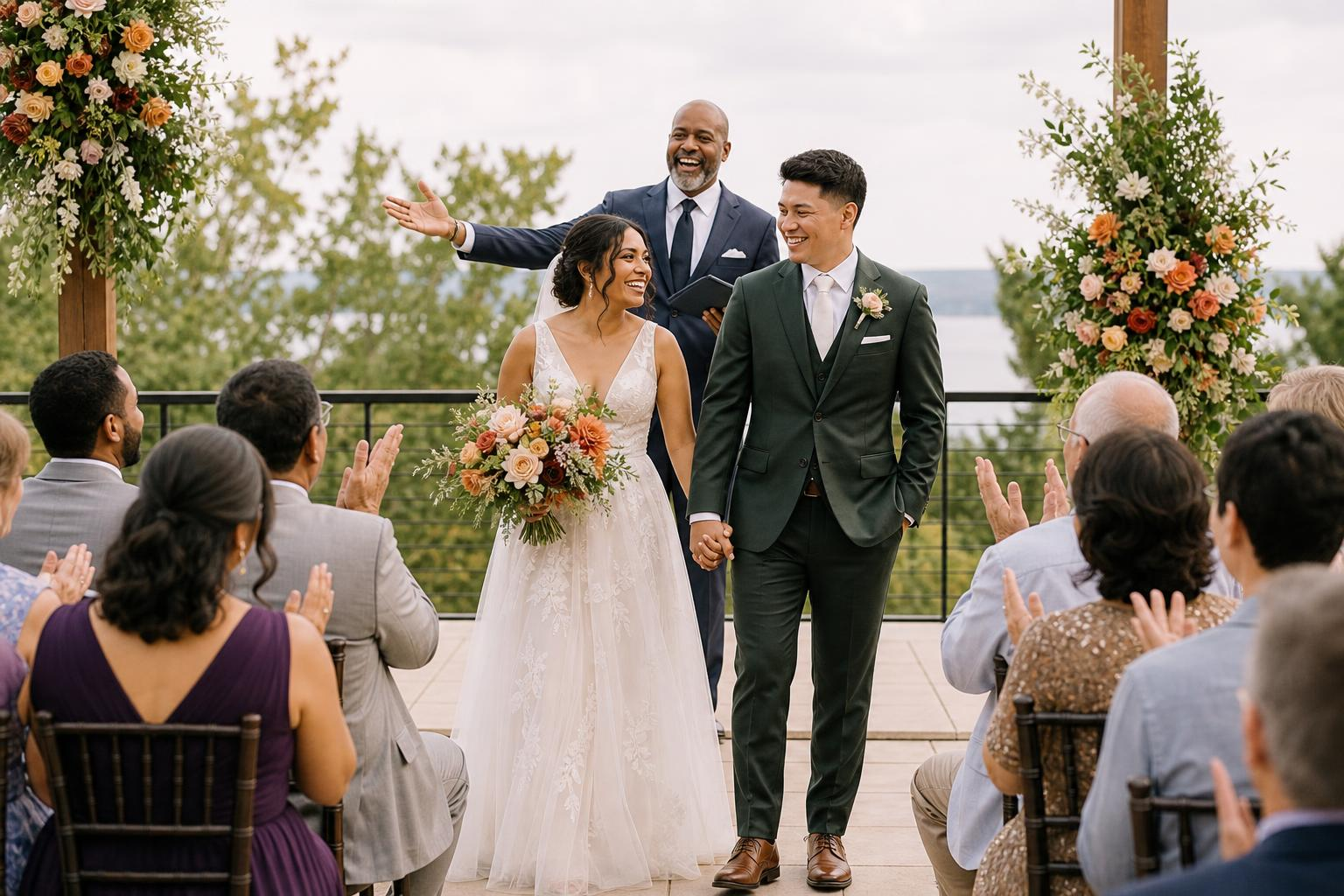
Introducing the couple is the final spoken moment of the wedding ceremony—and it deserves a little care. A good announcement is brief, clear, joyful, and accurate. It tells guests what has just happened, gives the couple a moment to celebrate, and leads naturally into the recessional.
If you are wondering how to introduce newlyweds without sounding stiff or making assumptions about names, titles, or family traditions, the answer is simple: confirm the couple’s preferences, choose wording that fits their ceremony, and practice the sentence until it feels natural in your voice.

1. Confirm what the couple wants to be called
The first job is not choosing a clever phrase. It is finding out how the couple wants to be introduced.
Some couples want “the newlyweds.” Others prefer “the married couple,” “the happy couple,” or simply their first names. Some want a shared surname announced. Others keep their original names, use different surnames, hyphenate, or do not want a surname mentioned at all.
Do not guess based on tradition, invitations, clothing, or what you think the couple will do after the wedding. Ask directly and record the answer in the final script.
What name, title, or description would make the couple feel seen rather than placed into a tradition they did not choose?
Example: “We would like to be introduced by our first names only, without ‘husband and wife,’ and we want the announcement to feel warm but not overly formal.”

Short answer: Use their words, not assumptions.
For a writing reference, the Associated Press explains that “husband” and “wife” may be used for people in legally recognized marriages, while “spouse” or “partner” may be used when requested. In a ceremony, however, the couple’s own preference should guide your wording. See the Associated Press guidance on husband, wife, spouse, and partner.
2. Match the announcement to the ceremony’s tone
Your last sentence should sound like it belongs to the ceremony that came before it. A formal religious ceremony may call for a traditional announcement. A small backyard ceremony may feel better with simple, conversational language. A playful couple may welcome a light touch, but the announcement should still be easy for every guest to understand.
Formal and traditional
“It is my honor to present the newly married couple, Maria Elena Rodriguez and Daniel James Lee.”
“Please join me in welcoming the newlyweds, Dr. Aisha Patel and Jordan Williams.”
Warm and modern
“Family and friends, it is my great joy to introduce you to the newlyweds, Elena and Marcus!”
“With full hearts and a room full of love, please welcome the married couple, Priya and Sam.”
Simple and low-key
“Everyone, please welcome Alex and Taylor as they begin this next chapter together.”
“It is my pleasure to introduce Jamie and Morgan.”
Joyful and energetic
“Let’s hear it for the newlyweds, Naomi Carter and Luis Hernandez!”
“One more round of applause for the happy couple, Riley and Cameron!”
Keep the style consistent. If the ceremony has been calm and intimate, a sudden theatrical announcement may feel out of place. If the couple has invited guests to celebrate loudly, give your voice permission to rise with the room.
3. Choose whether to use names, titles, or surnames
Names are where many otherwise careful officiants get into trouble. Confirm pronunciation, order, honorifics, professional titles, and whether a surname should be included.
If one or both people use a professional, academic, military, religious, or cultural title, ask whether they want it spoken. A title may be meaningful in one setting and unnecessary in another. Do not add “Mr.,” “Mrs.,” “Dr.,” “Reverend,” or another title simply because it seems customary.
The same care applies to name order. Some couples have a strong preference about whose name comes first. Others do not care. The easiest solution is to ask and write the answer down.
Examples with different name choices
- First names only: “Please welcome Sofia and June, the newlyweds!”
- Full names: “It is my pleasure to introduce Benjamin Lee Carter and Omar James Reed.”
- Different surnames: “Please welcome the newlyweds, Avery Brooks and Jordan Nguyen.”
- Hyphenated surname: “Let’s celebrate Casey Morgan and Drew Morgan-Santos.”
- Shared surname: “Please welcome the newlyweds, Taylor and Morgan Bennett.”
- Professional title included by request: “Please welcome Professor Amara Singh and Renee Parker.”
4. Use a reliable structure for the final announcement
You do not need to reinvent the wheel. Most strong introductions contain three parts:
- A transition: Signal that the ceremony is reaching its close.
- The introduction: Say who the couple is and how they wish to be described.
- A celebration cue: Invite applause, a kiss, or the beginning of the recessional.
A dependable template is:
“Family and friends, it is my [honor/pleasure/joy] to introduce [preferred description or names]. Please welcome them with your applause.”
You can also connect the announcement directly to the next event:
“It is my joy to introduce the newlyweds, Hannah and Elise. Please rise, if you are able, and celebrate them as they make their way back down the aisle.”
Wedding-ceremony scripts can be flexible, and the final announcement commonly follows the vows, rings, and pronouncement. The Universal Life Church’s wedding officiant training guide offers a useful overview of ceremony structure and the role of the officiant’s spoken transitions.
| Couple’s preference | Useful wording | Best delivery |
|---|---|---|
| Traditional and formal | “The newly married couple” | Measured, polished, warm |
| Modern and inclusive | “The newlyweds” or their first names | Natural, welcoming |
| Private about surnames | First names only | Simple and confident |
| High-energy celebration | “Let’s hear it for…” | Bright, energetic, clearly projected |
| Intimate or quiet ceremony | “It is my pleasure to introduce…” | Gentle, sincere, unhurried |
5. Write original examples instead of relying on one script
A few adaptable examples can help you prepare without making every ceremony sound identical.
For a couple using first names only
“Friends and family, please celebrate this beautiful moment with Maya and Chris, the newlyweds!”
For a couple keeping different surnames
“It is my honor to introduce the married couple, Jordan Ellis and Avery Thompson. Let’s welcome them with a round of applause.”
For a couple using a shared surname
“Please welcome the newlyweds, Natalie and Priya Morgan!”
For a couple who prefers ‘partners’
“With great joy, I introduce your newly married partners, Alex Rivera and Devon Clarke.”
For a religious ceremony
“Having made these promises before God and their loved ones, please welcome the newly married couple, Leah and Miriam.”
Use religious language only when it belongs to the couple’s ceremony and has been approved by the appropriate couple, faith leader, or ceremony planner. Religious customs and authority can vary, so do not present one tradition as universal.
For a blended or family-centered celebration
“Please welcome not only the newlyweds, Chris and Andre, but this family as it begins a new chapter together.”
That last option can be meaningful when children, stepchildren, chosen family, or other loved ones have been intentionally included. Ask before naming family relationships publicly.
6. Coordinate the pause, applause, and recessional
A beautiful sentence can still fall flat if the timing is unclear. Before the ceremony, confirm who controls the music and what the couple will do immediately after the announcement.
Will the couple kiss first? Will they walk straight down the aisle? Will the wedding party follow? Should guests stand? Will the photographer need a clear moment for applause and portraits?
Practice the sequence with the planner, DJ, musicians, or venue coordinator. Your goal is not to make the moment mechanical. It is to prevent the couple from standing at the front while everyone waits for a cue.
Final announcement checklist
- Confirm each name and pronunciation.
- Confirm name order.
- Confirm titles or first-name-only wording.
- Ask whether surnames should be included.
- Choose the tone: formal, warm, simple, or energetic.
- Mark the music and applause cue.
- Practice the sentence aloud at least twice.
Rehearse the transition, not just the words. Stand where you will officiate, look toward the couple, deliver the introduction, pause for the room, and then give the next cue. That small rehearsal usually does more for your confidence than rewriting the sentence ten times.
7. Deliver it with confidence and restraint
At the end of the ceremony, your job is to make space for the couple. Speak clearly, smile, and let the announcement land. You do not need to add a long joke, explain every name choice, or summarize the entire ceremony again.
Take one breath before you begin. Look at the couple rather than reading only from the page. Pronounce their names carefully. Leave a clean pause after the introduction so guests know when to applaud.
If you make a small mistake, correct it calmly and continue. A simple “Let me say that again correctly” is better than rushing or pretending the error did not happen.
How should the final moment feel in the room: reverent, tender, joyful, or celebratory?
Example: “The ceremony has been intimate and reflective, so the couple wants a warm introduction followed by gentle applause and a slow recessional.”
Short answer: Let the ceremony set the volume.
Conclusion: Make the introduction accurate, joyful, and theirs
The best answer to how to introduce newlyweds is not one perfect phrase. It is a thoughtful process: ask what the couple wants, confirm every name and title, match the tone, coordinate the next cue, and deliver the words with genuine warmth.
Write the final announcement into your script, review it with the couple, and practice it aloud. When the moment arrives, keep your voice steady and your attention on the two people everyone came to celebrate.
Frequently Asked Questions
What is the best way to introduce newlyweds at the end of a ceremony?
Use the couple’s preferred names and description, keep the announcement brief, and invite guests to celebrate. A dependable format is: “It is my joy to introduce [names or preferred description]. Please welcome them with your applause.”
Should an officiant say “husband and wife”?
Only if that wording reflects the couple’s preference and the ceremony’s language. Couples may prefer “newlyweds,” “married couple,” “partners,” or their first names instead.
Should the officiant announce a new surname?
Not unless the couple has specifically approved that wording. Never assume that either person is changing, combining, or sharing a surname.
Should the couple’s full names be used?
Full names can sound formal and ceremonial, but first names may feel warmer or more natural. Ask the couple which approach they prefer and confirm pronunciation before the wedding.
How long should the final wedding announcement be?
Usually one or two sentences is enough. The announcement should identify the couple, create a celebratory moment, and give a clear cue for applause, music, or the recessional.
What should happen immediately after the couple is introduced?
The couple may kiss, receive applause, begin the recessional, or follow another planned cue. Coordinate the sequence with the couple, planner, DJ, musicians, and photographer before the ceremony.