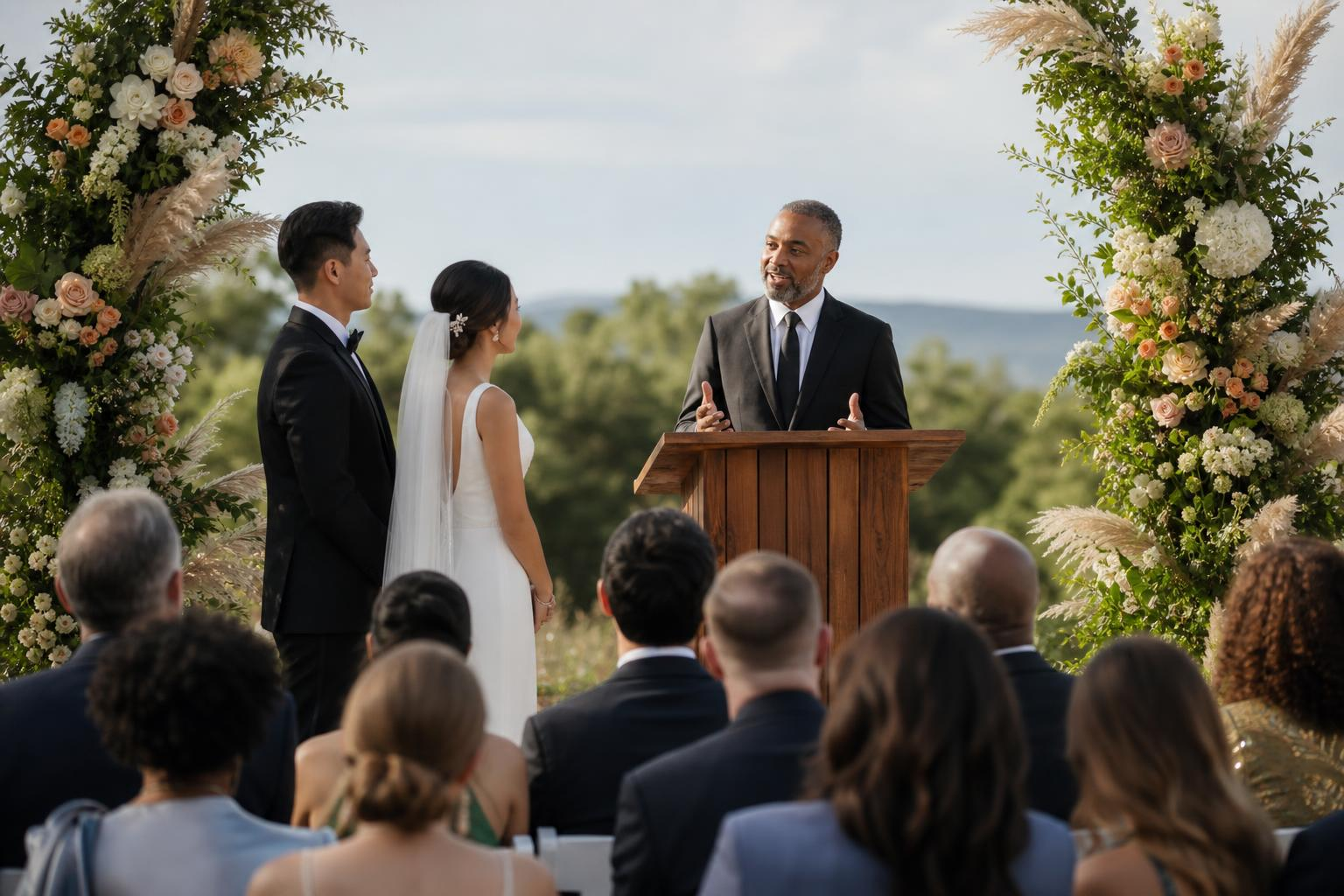
A wedding welcome speech gives you the first real opportunity to settle the room, honor the couple, and help every guest feel included. Done well, it is warm without being wordy, personal without becoming private, and polished without sounding stiff.
For an officiant, the welcome is not the place to tell the couple’s entire life story. Your job is to open the door to the ceremony: acknowledge the people who gathered, recognize the meaning of the day, and guide everyone gently toward the vows.

The ideas below will help you write a welcome that sounds natural and gives the couple exactly the kind of ceremony they asked for.
Start by Understanding the Welcome’s Job
A welcome speech is usually brief, but it carries several responsibilities. It should make guests feel seen, establish the tone of the ceremony, introduce the couple’s purpose for gathering, and create a smooth transition into the next part of the service.
Wedding-industry guidance commonly places welcoming remarks near the beginning of the ceremony, after the processional and before the ceremony’s main reflections, readings, or vows. The Knot also notes that a professional officiant may focus on welcoming guests while briefly introducing the couple’s story and the spirit of the day. See ceremony script guidance from The Knot.
A dependable opening has three movements:
- Welcome the guests.
- Name what the gathering is about.
- Connect the room to the couple’s commitment.
That may sound simple, and that is the point. A steady opening gives everyone a place to land before you ask them to listen closely.

Use a Simple Structure You Can Trust
When nerves show up, structure is your friend. You do not need to reinvent the form every time. Start with a basic framework, then add only the details that help guests understand and appreciate the couple.
1. Offer a genuine welcome
Begin with language that sounds like you. “Welcome, everyone,” “Good afternoon,” or “Friends and family, thank you for being here” are all perfectly serviceable. The warmth comes from your delivery and from what follows.
2. Acknowledge the effort behind the gathering
If guests have traveled, say so. If the couple has created a meaningful setting, recognize it. A short sentence can honor the people who rearranged work, crossed time zones, or made room in a busy season to attend.
3. State the purpose of the ceremony
Tell guests why they are gathered: to celebrate the couple, witness their promises, and support the life they are building together. Keep this concrete rather than overly grand.
4. Introduce the couple’s tone
Use one or two qualities that fit the couple: playful, thoughtful, adventurous, deeply rooted, generous, curious, or quietly devoted. Choose words the couple recognizes as true.
5. Lead into the next element
End the welcome with a bridge such as, “Let us begin,” “We will now hear a reading,” or “With that spirit in mind, let us turn to the promises they have written for one another.”
Example: “Welcome, everyone. Thank you for being here to celebrate Jordan and Casey. Some of you traveled a long way, and others came from just down the road, but every person here has helped shape the lives they share. Today, we are here to witness their promises and offer them our support as they begin this next chapter together.”
Short answer: Welcome, acknowledge, purpose, transition.
Ways to Acknowledge Guests Without Reading a Roll Call
Many officiants want to thank guests but worry about leaving someone out. The safest approach is to acknowledge groups rather than naming every individual. You can recognize travel, family, friendship, community, and the people who could not attend without turning the welcome into a long list.
Consider these categories:
- Travel: “We are grateful to those who traveled from near and far.”
- Family: “We welcome the families and loved ones who have supported these two.”
- Community: “We are thankful for the friends, mentors, neighbors, and coworkers who helped them become who they are.”
- Absent loved ones: “We also hold close those who could not be here in person but remain part of this family’s story.”
- Venue and setting: “This beautiful place gives us room to gather, reflect, and celebrate.”
Be careful with jokes about who traveled the farthest, who arrived late, or who helped pay for the wedding. Even a harmless line can land awkwardly when people are emotional or the family dynamics are complicated.
Original Wedding Welcome Speech Examples
Use these examples as starting points, not scripts to copy word for word. Replace general phrases with details that sound like the couple and match the ceremony they planned.
Warm and traditional
“Welcome, family and friends. Thank you for joining Morgan and Taylor on this meaningful day. Your presence is a gift, and your support has helped bring them to this moment. We are gathered to celebrate their love, to witness the promises they are about to make, and to remind them that marriage is strengthened by the people who stand beside it.”
Relaxed and conversational
“Hi, everyone, and welcome. It is wonderful to see so many of the people Morgan and Taylor love in one place. Some of you have known them since childhood, some met them along the way, and some are just getting to know one half of this team. Today gives all of us a chance to celebrate what they have built and the life they are choosing together.”
For a destination or travel-heavy wedding
“Welcome, everyone. We know that being here required planning, time, and more than a few travel details, and Morgan and Taylor are deeply grateful that you made the journey. This gathering is about more than a beautiful setting. It is about bringing their people together to witness a promise that will continue long after everyone heads home.”
For a small, intimate ceremony
“Welcome to this close circle gathered for Morgan and Taylor. There is something special about a small ceremony: every person here has a meaningful place in their lives, and every presence can be felt. Thank you for standing with them as they speak honestly, listen carefully, and promise to keep choosing one another.”
For a lighthearted couple
“Welcome, everyone. Morgan and Taylor have gathered the people who know their best qualities, their odd habits, and at least a few stories they hope will not be repeated tonight. We are here to celebrate the laughter, loyalty, and everyday partnership that brought them to this moment—and to witness the promises that will carry them forward.”
How to Honor the Venue and the Couple’s Wishes
The setting can help you create a sense of place, but it should support the couple rather than compete with them. Mention the venue when it adds meaning: a family home, a shoreline, a garden, a historic building, or a place connected to the couple’s story.
Keep the reference specific and brief. Instead of saying the venue is “magical,” explain what makes it useful to the day: it brought everyone outdoors, gave the couple a quiet place to gather, or connects to a family tradition.
Before writing, ask the couple what they want guests to feel during the first minute of the ceremony.
Example: “We want people to feel relaxed, included, and aware that this ceremony is about partnership rather than performance. We do not want a formal or overly religious tone.”
Short answer: Relaxed, inclusive, partnership-focused.
That answer should guide your word choices. If the couple wants a spiritual ceremony, ask which terms and traditions feel welcome. If they want a secular ceremony, do not add religious language simply because it sounds familiar. If they want humor, agree on the boundaries before the wedding day.
The Poetry Foundation’s wedding collections can also provide inspiration for a short reading or a poetic image, especially when the couple wants language that feels reflective rather than conventional. Browse the Poetry Foundation’s love-poem collection or its wedding poem guide.
Keep the Speech Comfortable to Hear
A welcome can be beautifully written and still feel difficult if it is too dense, too quiet, or too long. Read it aloud several times. Mark places to pause, slow down, or look at the couple.
Use short sentences. Spoken language needs more room than written language. If a sentence has several clauses, divide it.
Choose familiar words. “Support,” “joy,” “trust,” and “future” are useful when they are connected to the couple. Do not bury a sincere thought under elaborate language.
Leave space for emotion. A pause after thanking guests or naming the couple’s commitment may feel long to you but natural to everyone listening.
Practice the names. Confirm pronunciation for the couple, parents, family members, readers, and anyone else you will mention. This is one small detail that communicates real care.
Prepare for the room. Outdoor ceremonies may have wind, traffic, or uneven sound. Indoor ceremonies may have music, a high ceiling, or guests seated farther away than expected. Bring a printed copy with large type, and coordinate with the planner or sound technician.
| Welcome style | Best fit | Helpful emphasis | Watch for |
|---|---|---|---|
| Traditional | Formal or family-centered ceremony | Gratitude, witness, commitment | Sounding generic |
| Conversational | Relaxed or modern ceremony | Belonging, personality, ease | Over-familiar jokes |
| Travel-focused | Destination or multi-city gathering | Effort, journey, shared occasion | Making local guests feel overlooked |
| Intimate | Small ceremony or elopement-style gathering | Closeness, trust, presence | Overstating private details |
| Lighthearted | Couple who welcomes humor | Warmth, recognizable quirks | Embarrassing stories or inside jokes |
A Final Review Before the Wedding Day
Set the welcome aside for a day, then read it again with a practical eye. Does every sentence help the room understand the purpose of the gathering? Does the speech sound like the couple’s ceremony, or like a speech borrowed from somewhere else?
- Use the couple’s correct names and pronunciation.
- Thank guests without creating a long roll call.
- Acknowledge travel or the venue when it adds meaning.
- Confirm any mention of absent loved ones with the couple.
- Match the couple’s requested religious or secular tone.
- Keep the language easy to hear aloud.
- End with a clear transition to the next ceremony element.
- Print a backup copy and mark your pauses.
One more good practice: send the draft to the couple before the ceremony. They do not need to edit every comma, but they should recognize themselves in the words and have a chance to remove anything too personal.
Conclusion: Welcome the Room, Then Make Space for the Couple
The best wedding welcome speech does not try to be the most memorable speech of the day. It helps people settle, listen, and feel grateful to be present. Thank the guests, name the meaning of the gathering, honor the couple’s wishes, and move confidently into the ceremony.
Keep your language honest, your details approved, and your delivery unhurried. When the welcome is doing its job, the room feels ready—not because you performed perfectly, but because you helped everyone arrive together.
Frequently Asked Questions
How long should a wedding welcome speech be for an officiant?
A welcome is usually best kept brief enough to open the ceremony without delaying the main elements. Focus on welcoming guests, acknowledging the gathering, and transitioning into the ceremony rather than telling the couple’s complete story.
What should an officiant say first in a wedding welcome speech?
Begin with a simple, genuine welcome such as “Welcome, everyone,” followed by thanks for the guests’ presence. Then name the couple and explain why everyone has gathered.
Should a wedding officiant thank guests for traveling?
Yes, when travel is a meaningful part of the gathering. A brief acknowledgment of guests who came from near and far can make people feel seen without requiring you to list every location or guest.
Can an officiant include humor in the welcome speech?
Yes, if the couple has asked for a lighthearted tone and the humor is affectionate rather than embarrassing. Avoid jokes about family conflict, money, previous relationships, appearance, or private matters.
Should the officiant mention loved ones who could not attend?
Only after confirming with the couple. A brief remembrance can be meaningful, but the couple should decide whether it belongs in the ceremony and how specific the wording should be.
Can an officiant include a poem in the wedding welcome?
A short poem or poetic passage may fit when it matches the couple’s wishes and ceremony style. Confirm any religious or cultural guidelines that apply to the ceremony before recommending a reading.