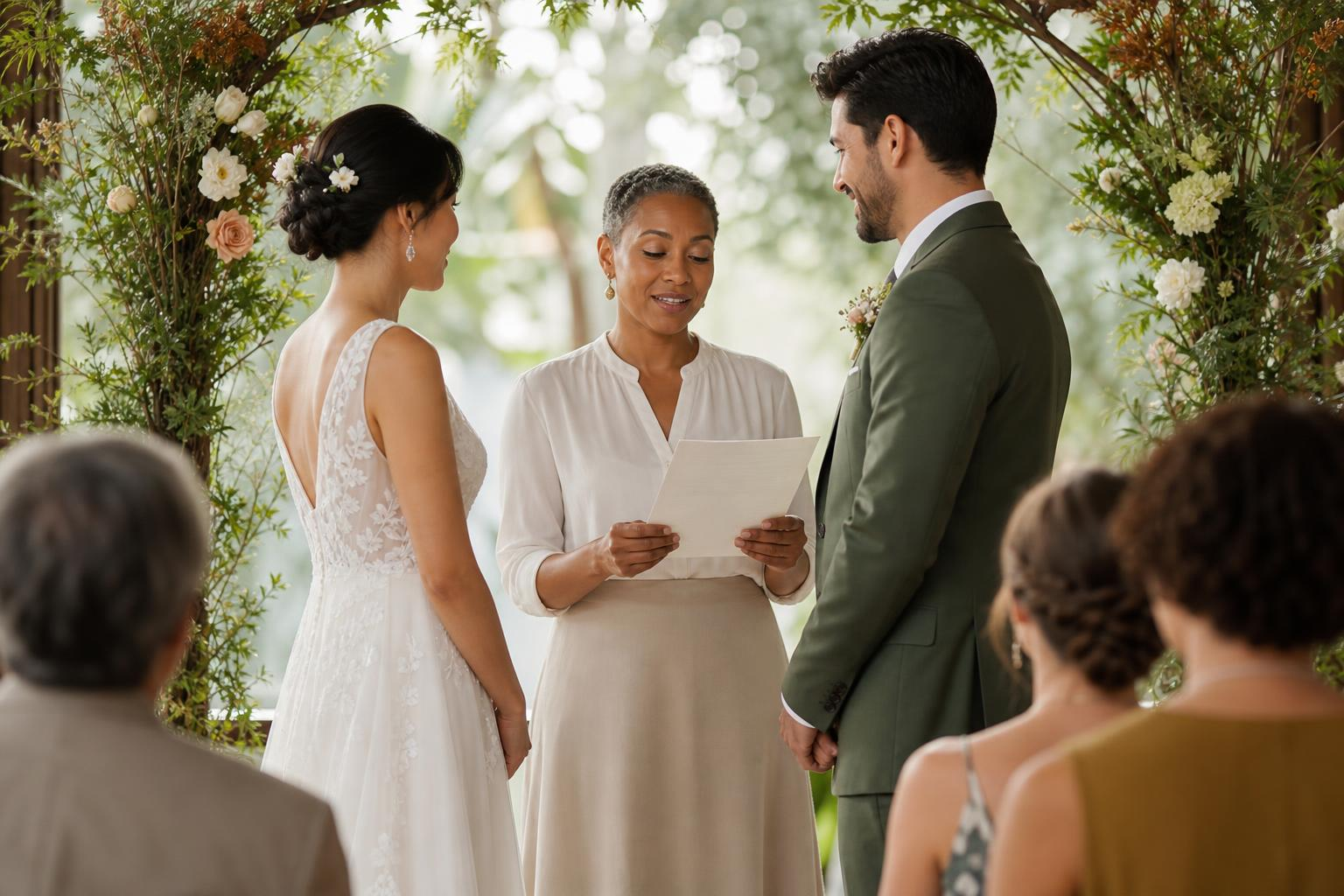
Wedding Readings About Love: How to Choose the Right One
Choosing wedding readings about love sounds simple until you are sorting through poems, scripture, novels, song lyrics, family favorites, and a dozen different opinions. As the officiant, your job is not to find the one universally perfect reading. It is to help the couple choose words that sound like them, fit the ceremony, and can be delivered comfortably in the room.
A good reading gives the ceremony a little breathing space. It can name the couple’s values, honor their community, or express something they feel but cannot quite phrase themselves. The guidance below will help you make that choice calmly and practically.

Start with the couple, not the reading list
Before recommending titles, learn what the couple wants the reading to accomplish. A reading may celebrate tenderness, friendship, commitment, humor, faith, resilience, or the everyday work of building a life together. Those are different jobs, and each calls for a different kind of text.
Ask a planning question that gives the couple something useful to consider: What do you want guests to feel or understand during this part of the ceremony?
Example: “We want guests to feel that marriage is joyful, grounded, and built on choosing each other in ordinary moments.”
Short answer: Joyful, grounded, everyday commitment.
That answer points you toward a warm, accessible reading rather than something overly dramatic or abstract. If the couple wants guests to laugh, look for gentle humor. If they want a quiet emotional pause, choose language with room for reflection. If they want their cultural or spiritual background represented, ask what traditions feel genuinely meaningful rather than simply familiar.

Match the reading to the ceremony’s tone
The strongest wedding readings about love feel as though they belong in that particular ceremony. A beautiful poem can still feel wrong if its mood, length, or vocabulary clashes with the couple’s plans.
Consider these tone questions
- Formal or relaxed? A formal ceremony may welcome elevated language, while a casual outdoor ceremony may suit conversational prose.
- Traditional or contemporary? Classic poetry can work beautifully, but modern language may feel more natural for some couples.
- Religious, spiritual, secular, or mixed? Make sure the reading welcomes the full room and fits the couple’s stated beliefs.
- Serious or lightly humorous? Humor can be lovely when it reveals affection, but avoid anything that sounds like a roast or a warning about marriage.
- Brief or central? A short reading may act as a transition. A longer selection may become one of the ceremony’s emotional centerpieces.
The Poetry Foundation’s love-poem collection and its wedding-poem guide can help you explore different voices and approaches without assuming every couple wants the same kind of romance. Use those resources as a starting point, then read each candidate aloud before presenting it.
Choose meaning over famous lines
Familiar words can be comforting, but a famous passage is not automatically a good ceremony reading. Some well-known love poems include grief, jealousy, separation, possessiveness, or a view of romance that does not fit the couple. Read the entire work, not just the line that appears in a quotation graphic online.
Look for a clear connection. The couple should be able to explain why the reading belongs in their ceremony. Perhaps it reflects their friendship, their shared humor, their commitment through difficulty, or their hope for the future.
Check the emotional direction. Does the selection move toward welcome, commitment, gratitude, or connection? If it ends in doubt or despair, make sure that is intentional rather than accidental.
Listen for natural language. A passage can be meaningful on the page but awkward when spoken. Long sentences, unfamiliar names, dense imagery, and heavy punctuation may challenge a nervous reader.
Respect the couple’s story. Avoid readings that assume a particular gender role, family structure, religious belief, or relationship history unless the couple has specifically chosen that perspective for themselves.
Quick reading checklist
- Does the message fit the couple?
- Does the tone fit the ceremony?
- Can a guest understand it on first hearing?
- Does the complete work support the excerpt?
- Has the source and usage permission been checked?
Use this decision guide when comparing options
When several readings seem promising, compare them by function instead of arguing over which one is “best.” The following guide can help you and the couple make a steady decision.
| If the couple wants… | Look for… | Watch for… |
|---|---|---|
| Warmth and tenderness | Specific images of care, trust, home, or companionship | Language that becomes overly sentimental when spoken aloud |
| Reflection and depth | Thoughtful ideas about time, change, or shared growth | Abstract passages guests may struggle to follow |
| Light humor | Playful observations that still respect marriage | Jokes about divorce, infidelity, in-laws, or marital misery |
| Inclusivity | Language that welcomes different families, identities, and paths | Assumptions about gender, religion, or family roles |
| A classic feel | Older works with clear relevance to the couple’s values | Archaic wording or historical context that changes the meaning |
A useful test is to have someone who does not know the selection listen to it once. Ask what they think the reading was about. If their answer is far from the couple’s intention, the passage may need more explanation or a different choice.
Make the reading work in the room
Even excellent words can lose their effect if the practical details are ignored. Help the couple and reader prepare for the setting, sound system, and pace of the ceremony.
Prepare the reader
- Choose the reader early. Consider their relationship to the couple, comfort with public speaking, and ability to attend the rehearsal or receive clear instructions.
- Provide a clean copy. Use large type, clear line breaks, phonetic notes for difficult names, and page numbers if the selection spans more than one page.
- Mark the beginning and ending. The reader should know exactly when to step forward, where to stand, and whether to say the title and author.
- Practice aloud. Encourage a measured pace and natural pauses. Most nervous readers benefit from slowing down more than they expect.
- Plan for sound. At an outdoor or large ceremony, confirm whether the microphone will be handheld, on a stand, or shared with the officiant.
Keep the audience in mind. Guests may be standing, seated at a distance, hearing through a sound system, or listening in a language that is not their first. Shorter sentences and concrete images usually carry well.
Source poems and passages responsibly
Finding a text online does not automatically mean you may reproduce or distribute it. For a ceremony program, printed handout, website, livestream, or recording, usage questions can matter. The U.S. Copyright Office explains that copyright protects creative works and that public-domain status depends on factors such as when and where a work was created or published. Its copyright overview and copyright-duration guidance are useful starting points, but they are not a substitute for legal advice.
Public-domain collections can be helpful when you want older poems or prose. Project Gutenberg offers a broad catalog of digitized works, including public-domain and freely available eBooks. Still, check the specific edition, country of use, text, and any permissions information attached to the work. A public-domain original may be accompanied by a modern translation, adaptation, annotation, or recording that carries separate rights.
For contemporary works, consider asking the copyright holder or publisher about permission, selecting a properly licensed version, or choosing an original reading written specifically for the couple. Do not copy a full poem into a blog post or ceremony guide simply because it appears on a public website. A title, author, brief description, and link to the authorized source may be the better approach.
Keep a simple record. Note the author, title, source edition, permission status, and any limits on printing, recording, or online publication. That small habit saves confusion later, especially when the ceremony will be photographed, filmed, or livestreamed.
Coordinate the reading with the rest of the ceremony
A reading should not feel dropped into the ceremony like an unrelated item on a checklist. Place it where it supports the larger movement of the service. It may work after the welcome, before vows, after a brief reflection, or during a transition between ceremony elements.
Build a smooth introduction
The officiant usually needs only one or two sentences. Name the reader, identify the selection, and offer a reason it was chosen. For example: “Jordan’s sister, Maya, will now read a poem about the friendship and patience that help love grow over time.” Keep the introduction shorter than the reading itself.
Afterward, allow a small pause before moving on. Do not rush immediately into the next sentence. A breath gives the couple and guests time to receive what they have heard.
If the reading is in another language, decide whether a translation will be printed, spoken, or briefly summarized. If multiple readings are included, vary their tone and length so the ceremony has rhythm rather than a long unbroken block of text.
Example: A couple chooses one short poem about companionship before the vows and asks a grandparent to read it. The selection feels personal, gives the grandparent a meaningful role, and leaves the ceremony’s central promises with the couple.
Short answer: Personal, balanced, and well placed.
Know when to recommend an original reading
Sometimes the right answer is not a published poem. A friend, sibling, parent, or member of the couple may be able to write a short reflection that speaks directly to the relationship. This can be especially effective when the couple wants humor, family history, cultural detail, or a reference to a shared experience that no famous poem could capture.
Encourage original writing to stay focused. One clear memory, a few qualities the couple admires, and a hopeful closing can be enough. The writer does not need to summarize the couple’s entire relationship or deliver a second wedding sermon.
As officiant, review the draft for tone and length while preserving the writer’s voice. Remove private details that could embarrass the couple, inside jokes that leave guests confused, or wording that sounds like a toast rather than a ceremony reading. With kindness and a little editing, an original piece can become one of the most memorable parts of the day.
Frequently Asked Questions
How long should a wedding reading about love be?
There is no single required length, but a concise reading is often easier for guests to follow and easier for a nervous reader to deliver. Judge the selection by its clarity, emotional purpose, and place in the ceremony rather than by word count alone.
Can we use a modern poem in a wedding ceremony?
Often, but you should check whether the poem is still protected by copyright and whether permission is needed for printing, recording, livestreaming, or other planned uses. Consider an authorized license, a properly licensed edition, or a public-domain alternative.
What makes a good wedding reading about love?
A good reading fits the couple’s values, matches the ceremony’s tone, can be understood when heard aloud, and gives the audience a meaningful way to connect with the couple’s commitment.
Should the officiant choose the wedding reading?
The officiant can offer options and explain how each selection may work, but the couple should make the final choice. The reading should represent their relationship and beliefs rather than the officiant’s personal taste.
Can a family member write an original wedding reading?
Yes. An original reading can be warm and personal, especially when it focuses on a few specific qualities, memories, or hopes for the couple. Review it aloud beforehand to confirm that the tone and length suit the ceremony.