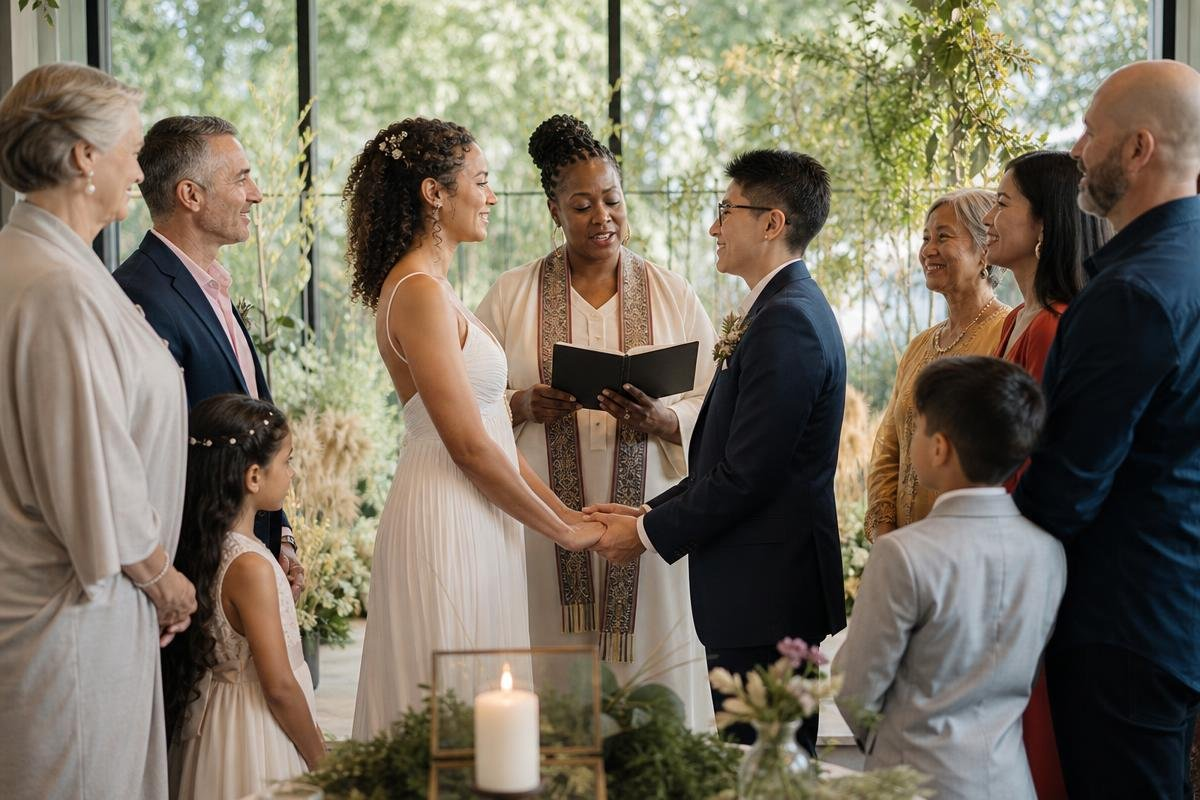
Writing a wedding ceremony for people with different beliefs is less about finding one perfect vocabulary and more about listening carefully. The right words should sound like the couple, welcome the people gathered, and leave room for faith, spirituality, doubt, tradition, or no religious belief at all.
For an officiant, that can feel like a lot to balance. Take it one decision at a time. Start with the couple’s meaning, then choose language that supports it without quietly adding beliefs they did not ask for.

Planning question: What do the couple want guests to understand about their commitment when the ceremony is over?
Example: “We want our families to hear that our marriage is grounded in love, honesty, mutual respect, and the support of our community. We would like room for prayer, but we do not want the ceremony to assume every guest shares the same faith.”
Short answer: Honor their values first.
Begin with the couple’s own definition of meaning
Inclusive wedding ceremony language should begin with a conversation, not a template. Ask each partner what words feel natural, what words feel uncomfortable, and which traditions they hope to include or avoid.
Some couples want direct references to God, prayer, scripture, or a particular religious tradition. Others prefer words such as “the divine,” “blessing,” “sacred,” or “spirit.” Some couples understand their commitment through human love, shared values, family, nature, or a sense of wonder. Others prefer no spiritual language at all.

None of these choices needs to be treated as a compromise or a deficiency. The Harvard Pluralism Project describes pluralism as more than simple tolerance: it involves genuine engagement with different commitments. That is a useful mindset for officiants. Your job is not to flatten the couple’s differences. Your job is to help them express those differences with care.
Use a language inventory
Before drafting, ask the couple to sort words into three groups:
- Use freely: words that feel like home, such as “God,” “beloved,” “community,” “nature,” “promise,” or “husband.”
- Use carefully: words that may be acceptable in one part of the ceremony but not another, such as “blessing,” “worship,” “soul,” or “sacred.”
- Do not use: words or phrases that feel inaccurate, gendered, exclusive, culturally inappropriate, or connected to a difficult religious experience.
This small exercise prevents a common mistake: assuming that a couple who wants a spiritual ceremony wants every familiar religious phrase included.
Choose a ceremony frame that can hold both faith and nonbelief
An inclusive ceremony does not have to be spiritually neutral in every sentence. It does need to be honest about whose beliefs are being expressed and how guests are being invited to participate.
For example, a couple may choose an opening that welcomes everyone without making a religious assumption:
“We gather today with gratitude for the people, experiences, and values that have brought these two people to this moment.”
That opening can be followed by a more specific reading, prayer, blessing, or reflection chosen by the couple. Another couple may prefer an explicitly religious welcome:
“In the presence of God and surrounded by the people who love them, we gather to witness the promises Alex and Jordan make today.”
Both approaches can be inclusive when they accurately reflect the couple’s wishes and do not misrepresent the ceremony to guests.
Think in layers instead of forcing one shared belief
When partners have different traditions, use layers of meaning:
- Shared layer: love, commitment, trust, responsibility, family, friendship, or service.
- Personal layer: each partner’s religious, spiritual, cultural, or philosophical language.
- Community layer: a welcome, reading, blessing, or promise that recognizes the people supporting the marriage.
This approach gives each partner room without requiring the officiant to declare that all beliefs are identical. The Pluralism Project’s interfaith resources are helpful background for understanding that meaningful engagement can include both common ground and real difference.
Write original wording for different belief preferences
Original wording is often safer and kinder than borrowing a familiar sentence that carries assumptions. The following examples are starting points, not fixed scripts. Change names, tone, pronouns, and theological language to match the couple.
For couples who want God-centered language
“May your marriage be strengthened by faith, guided by compassion, and surrounded by a community that encourages you to love with patience and courage.”
If the couple belongs to a specific tradition, ask whether they want the language to reflect that tradition’s own vocabulary. Do not present yourself as an authority on a faith tradition you do not represent. When a couple requests scripture, liturgy, or a formal blessing, encourage them to review the wording with a trusted leader from that tradition.
For couples who prefer broad spiritual language
“May the mystery and beauty of life remind you that your marriage is part of something larger than either of you, while your daily choices give that marriage its shape.”
Words such as “spirit,” “blessing,” “sacred,” and “wonder” can be meaningful, but they are not automatically neutral. Ask what each word means to the couple before using it.
For couples who want nature-based language
“As the seasons change and the living world continues its steady work, may you keep learning how to grow together, make room for change, and return to what gives your life strength.”
Nature language works best when it connects to the couple’s actual values rather than serving as decorative poetry. A couple who loves gardening, hiking, conservation, or quiet outdoor time may appreciate this frame.
For humanist or nonreligious couples
“Today is not a promise made by fate or guaranteed by tradition. It is a promise you choose to make, with open eyes, steady hearts, and the support of the people who know and love you.”
The Humanist Canada wedding guidance emphasizes that humanist ceremonies can be built around the couple’s values, personalities, and commitments without prescribed wording. That flexibility can be useful when writing a ceremony centered on human responsibility, mutual care, and shared purpose.
Make participation welcoming without pressuring guests
Inclusive language applies to the audience as well as the couple. Guests may hold different beliefs, may be questioning their beliefs, or may have painful experiences with religious communities. Give people a clear way to participate—or a respectful way to remain quiet.
Instead of saying, “Let us all pray,” consider:
“If prayer is part of your practice, you are invited to pray. If not, you may join us in a moment of quiet reflection and goodwill for this couple.”
For a blessing, you might say:
“Those who wish may offer a silent blessing, prayer, or good wish for their marriage.”
For a community promise, make the response understandable:
“Will you support them with honesty, kindness, and practical care as they build their life together?”
That kind of wording welcomes religious and nonreligious guests without pretending that everyone uses the same spiritual vocabulary.
Handle names, roles, and family language with care
Many exclusions are hidden in ordinary wedding phrases. Review the ceremony for assumptions about gender, family structure, sexuality, parenthood, and who is responsible for supporting whom.
| Instead of assuming | Consider asking | Possible inclusive wording |
|---|---|---|
| Bride and groom | Which titles feel right? | “The couple,” names, “partners,” or chosen titles |
| Giving one partner away | How should family support be described? | “Who offers their love and support to this marriage?” |
| Both sets of parents | Who should be acknowledged? | “The family and friends who helped shape their lives” |
| Husband and wife | What marital language do they prefer? | “Spouses,” “married partners,” or their chosen terms |
| Traditional family roles | What promises reflect their real life? | “To share work, decisions, care, and joy” |
Use the names and pronouns the couple provides, and confirm pronunciation before the ceremony. If family members have different expectations, the couple’s stated preferences should guide the script.
Honor LGBTQ+ couples without making them explain themselves
Inclusive language should not turn an LGBTQ+ couple into a teaching moment unless they specifically want that. The Human Rights Campaign’s Religion & Faith resources document ways faith communities can become more welcoming and affirming. For an officiant, the practical lesson is straightforward: use respectful language, avoid assumptions, and allow the couple to define their relationship in their own words.
Do not add a statement about inclusion merely to signal that you are progressive. If the couple wants a welcoming statement, make it relevant to the ceremony:
“Every person gathered here is invited to celebrate this marriage with honesty, warmth, and respect for the lives and beliefs represented in this room.”
Review the script before the rehearsal
A good review process catches awkward wording before the couple is standing in front of everyone. Send the complete draft, including readings, announcements, vows, pronouncement, and audience responses. Do not assume that a small change is harmless simply because it sounds traditional.
Inclusive ceremony review checklist
- Confirm names, pronouns, titles, and pronunciation.
- Mark every religious or spiritual reference for couple approval.
- Remove gendered or family-role assumptions that do not fit.
- Explain unfamiliar rituals in one or two clear sentences.
- Offer guests participation choices without pressure.
- Verify any required legal wording with the appropriate local authority.
- Read the full script aloud and time the transitions.
If the ceremony includes a religious ritual, ask whether a qualified leader from that tradition should review or lead it. The Humanist Society’s ethical guidance also illustrates an important boundary: a celebrant should represent the ceremony honestly and should not present another tradition’s prayers or sacred elements as though they were part of the celebrant’s own religious authority.
For marriage-license, officiant, witness, filing, or ceremony requirements, use OrdainedPro’s state marriage requirements map as a starting point, then confirm details with the relevant government office. This article is practical writing guidance, not legal advice, and requirements can vary by jurisdiction.
Close with a promise that sounds like them
The final words should gather the ceremony’s themes without becoming a generic summary. If the couple values faith, name it. If they value chosen family, name that. If they value curiosity, service, humor, or resilience, let those qualities appear in the closing.
For example:
“May you keep choosing one another with honesty. May your home make room for both conviction and questions. May the people who love you continue to find a place in your life, and may your marriage become a steady source of courage, laughter, and care.”
That closing does not require every guest to share one belief. It gives everyone something real to recognize.
Conclusion: Let the couple’s truth lead
Inclusive wedding ceremony language is not bland language. It is precise, attentive language that makes room for the couple’s faith, nonbelief, culture, identity, family, and hopes. Listen first, draft second, and review every meaningful phrase with the people getting married.
When you are unsure, return to the simplest question: “Would these words feel honest if the couple spoke them themselves?” If the answer is yes, you are probably on the right path.
Frequently Asked Questions
What is inclusive wedding ceremony language?
Inclusive wedding ceremony language reflects the couple's beliefs, identities, family structure, and preferred relationship terms without assuming that every guest shares the same religion, gender roles, or traditions.
Can a ceremony include religious and nonreligious language together?
Yes. Many couples use shared language about love, commitment, community, or values alongside a prayer, blessing, spiritual reflection, or nonreligious reading. The key is to confirm that each element represents the couple accurately.
How can an officiant include guests who have different beliefs?
Offer optional participation. For example, invite guests to pray, reflect silently, or offer a personal good wish rather than requiring one form of spiritual participation.
What should an officiant do when a couple has different religious traditions?
Identify shared values, preserve meaningful differences, explain unfamiliar rituals briefly, and ask trusted representatives of the relevant traditions to review specific religious wording when appropriate.
How can wedding ceremony language be more inclusive for LGBTQ+ couples?
Use the couple's names, pronouns, titles, and preferred relationship terms. Avoid assumptions about gender, family roles, sexuality, or who is being given away, and do not turn the couple into a lesson unless they request that.
Does inclusive ceremony wording affect whether a marriage is legally valid?
Legal requirements vary by location and may involve the officiant, license, witnesses, declarations, filing, or required wording. Check the relevant government authority before finalizing the ceremony; this article is not legal advice.