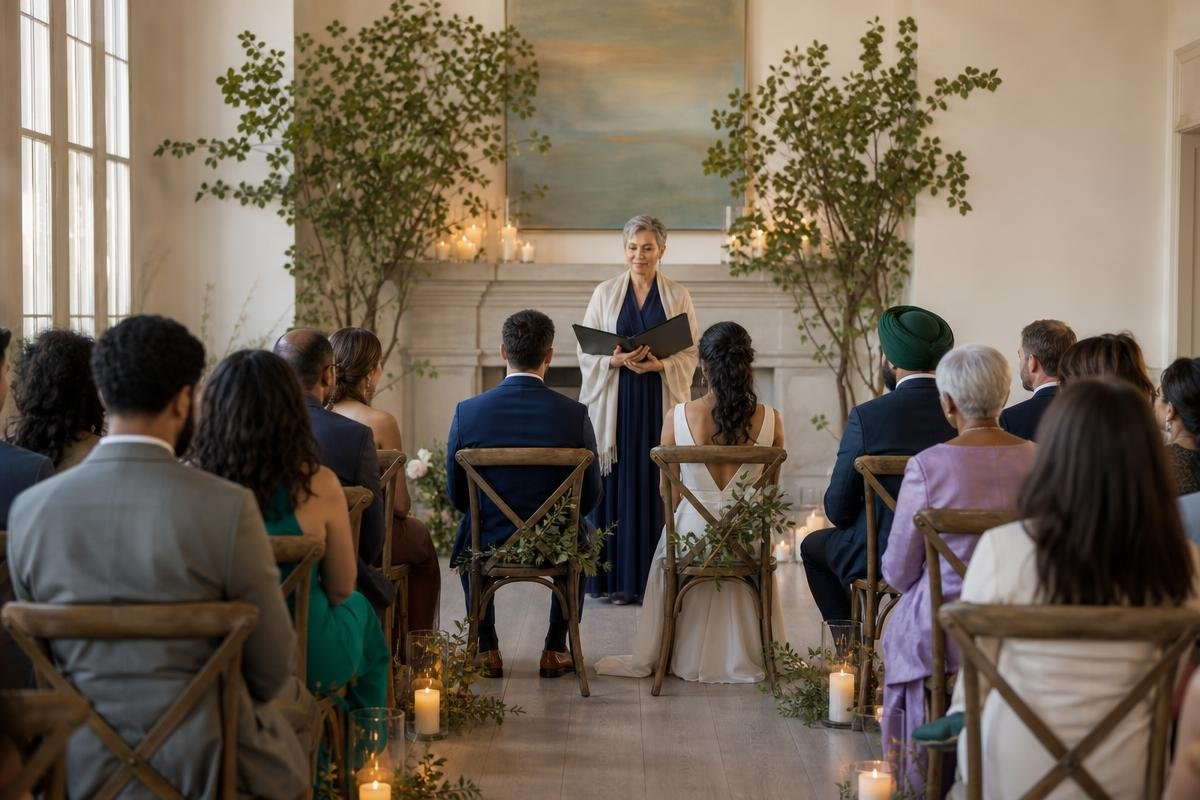
A ceremony pause can bring everyone into the same moment—but only if guests are not asked to pretend they share the same beliefs. As an officiant, your job is not to make every person use the same spiritual language. Your job is to create a clear, gracious invitation that allows people to participate according to conscience.
That may mean a traditional prayer, a guided meditation, a moment of silence, reflective music, a shared intention, or no spiritual pause at all. The best choice usually comes from listening carefully to the couple and naming the moment honestly.

Start with the couple’s real intention
Before choosing words, find out what the couple hopes this moment will do. They may want to honor a particular faith, acknowledge loved ones who could not attend, invite calm before the vows, or simply help everyone become present.
Ask: What should guests feel or understand during this pause?
Example: “We want a brief moment that recognizes our Jewish and Christian backgrounds, while also welcoming family members who are secular or follow other traditions.”
Short answer: Honor roots without requiring agreement.
That distinction matters. A couple may sincerely want prayer, but “prayer” can mean very different things across traditions. The Pluralism Project describes prayer as potentially vocal or silent, using fixed words, spontaneous words, or wordless rest. That gives you room to discuss the couple’s meaning instead of assuming a single universal format. Read more in The Pluralism Project’s overview of prayer.

Also ask whether the couple wants guests to listen, respond, stand, bow, close their eyes, or simply remain present. Do not make participation more public than necessary. A guest should not have to identify their beliefs in front of a room full of relatives.
Choose the right kind of ceremony moment
There is no single “most inclusive” option. Each format has strengths and possible pressure points. Use the couple’s goal, guest community, and officiating style to make the decision.
| Format | Works well when | Watch for | Sample invitation |
|---|---|---|---|
| Traditional prayer | The couple wants to name a specific faith or religious relationship. | Guests may not share the prayer’s theology or response. | “Those who pray are invited to join in prayer; everyone else is welcome to hold a personal reflection.” |
| Guided meditation | The couple wants calm, presence, and a gentle transition. | Some guests may dislike being told how to sit, breathe, or close their eyes. | “You are welcome to soften your gaze, breathe comfortably, or simply listen.” |
| Silent intention | The group includes varied faiths, spiritual paths, and nonreligious guests. | Silence can feel vague if the purpose is not explained. | “Please use this quiet moment in whatever way feels meaningful to you.” |
| Reflective music | The couple wants an emotional pause without spoken theology. | Lyrics may carry religious or cultural meaning guests do not expect. | “As the music plays, you may reflect on love, commitment, and the people who shaped this couple.” |
| No spiritual pause | The couple wants the ceremony to remain secular or tightly focused. | Family members may expect a prayer and need clear communication beforehand. | Move directly into a reading, story, vow explanation, or the next ceremony element. |
The goal is not to flatten every tradition into generic language. The Pluralism Project notes that interfaith gatherings can raise real questions about whether people are praying together, praying alongside one another, or simply sharing a respectful space. Those distinctions are worth discussing with the couple before the rehearsal. See Sharing Prayers, Sharing Space for background on these planning questions.
Write an invitation instead of a test
Inclusive wording gives guests permission to participate authentically. It does not suggest that one response is morally better than another.
Use language such as:
- “You are invited to join in prayer, meditation, or quiet reflection according to your own tradition.”
- “Those who wish may offer a silent prayer or intention for this marriage.”
- “Whether you pray, reflect, or simply share in the quiet, we invite you to be present for this moment.”
- “Please receive these words in the way that is most meaningful to you.”
- “No response is required; your presence is enough.”
Avoid language such as:
- “Everyone, please pray with us,” when the couple has not discussed religious differences.
- “Let us all agree,” if agreement is not actually possible or appropriate.
- “Even if you do not believe, please say the words,” which pressures guests to perform a belief.
- “We all worship the same way,” which can erase meaningful differences.
A good invitation is specific enough to guide the room and open enough to leave conscience alone. You do not need to apologize for the couple’s faith, and you do not need to pretend every guest interprets the moment identically.
Handle specific traditions with humility
If the couple wants a prayer, blessing, reading, chant, or ritual from a particular tradition, ask who has the authority and experience to provide it. A wedding officiant can help shape the ceremony, but should not casually speak on behalf of a tradition they do not understand.
Confirm four things:
- Meaning: What does this prayer or ritual mean to the couple?
- Source: Is the wording traditional, family-written, translated, or newly composed?
- Participation: Are guests listening, responding, standing, singing, or observing?
- Permission: Is the practice appropriate to share in a wedding ceremony, and has the couple consulted a knowledgeable representative when needed?
This is especially important when the couple mentions an Indigenous, diasporic, or minority tradition. Do not treat a sacred practice as a decorative theme or borrow a phrase because it “sounds meaningful.” Ask the couple to identify a trusted cultural or religious guide when the practice is unfamiliar to you.
If the couple wants several distinct prayers, let each contributor speak from their own tradition rather than asking them to create a vague blend. The Pluralism Project describes this as one possible form of authenticity: people may contribute in language distinctive to their own tradition while listening respectfully to others. That approach requires careful pacing and clear introductions, but it can be deeply meaningful.
Rehearse the moment like any other ceremony element
A beautiful idea can become awkward if guests do not know what is happening. Rehearse the transition, the length, and the physical cues.
Inclusive moment checklist
- Confirm the purpose in one sentence.
- Decide whether guests sit, stand, or remain as they are.
- Write the invitation exactly as it will be spoken.
- Clarify whether there is a spoken response.
- Time the silence, music, or reading during rehearsal.
- Tell musicians, readers, and family participants their cues.
- Prepare a simple transition back into the ceremony.
For silence, choose a length that feels intentional rather than accidental. You do not need to announce a precise duration to guests, but you should know how you will end it. A gentle phrase such as “May we carry that love with us as we continue” can close the pause without breaking its tone.
For music, confirm the lyrics and the recording or live arrangement. A song that sounds nonreligious to one person may be devotional to another. If the couple wants music without a strong theological message, instrumental music may be the safer choice.
For a guided reflection, keep the language invitational. “You may” is usually better than “you must.” Offer alternatives for guests who do not want to close their eyes, regulate their breathing, or use spiritual language.
Make room for guests without making them perform
Inclusive ceremonies are not created by naming every possible identity from the microphone. They are created by reducing unnecessary pressure.
Do not ask guests to raise hands, repeat a phrase, kneel, bow, or come forward unless the couple has carefully considered how that will feel for people with different beliefs, bodies, abilities, or personal histories. A guest may be grieving, recovering from religious harm, or simply unfamiliar with the practice.
Try this framing: “Some of you may pray. Some may reflect on the promises being made. Some may remember loved ones. Some may simply enjoy a quiet breath together. All of those responses are welcome.”
This kind of wording does not claim that all responses are the same. It gives the room a shared purpose while leaving the inner experience personal.
URI describes interfaith work as an opportunity to recognize both common ground and significant differences. That is a useful standard for officiants: make room for connection without demanding sameness. You can review URI’s practical guidance in its Interfaith Peacebuilding Guide.
Use a simple script you can adapt
Here is a flexible script for an inclusive wedding prayer or reflection:
“Before we continue, we invite everyone into a brief moment of reflection for [Couple’s names] and the life they are beginning together. Those who pray may offer a prayer in the tradition that is meaningful to them. Others may hold a quiet intention, remember someone they love, or simply share in this moment of stillness. There is no required response. Let us take this moment together.”
For a more explicitly religious ceremony, name the tradition clearly:
“The couple has asked for a Christian prayer of blessing. You are welcome to join in prayer if that is meaningful to you; guests who do not share this tradition are invited to listen respectfully or use this moment for their own reflection.”
For a fully secular ceremony, try:
“Let us pause to recognize the care, friendship, and family support that have brought these two people here. You may use this quiet moment to reflect in whatever way feels right to you.”
Each script tells the truth about the moment. That is the heart of inclusive officiating: clear expectations, honest language, and enough room for every guest to remain sincere.
Finish with a clear transition
After the prayer, silence, meditation, or music, guide the room forward. A transition keeps the ceremony from feeling unfinished.
Consider:
- “Thank you. May that spirit of care accompany [names] into their vows.”
- “With those intentions held in our hearts, let us turn now to the promises they will make.”
- “May the love and support represented here continue to surround them. We now come to the vows.”
Then move confidently into the next element. Do not explain or defend the moment after it has ended. If you gave guests a genuine choice, you have already done the important work.
Conclusion: Design for honesty and welcome
An inclusive wedding prayer is not a watered-down prayer, and it is not a performance of universal agreement. It is a carefully framed invitation that respects the couple’s convictions while allowing guests to participate—or remain quietly present—in good faith.
Listen first, choose the format that matches the couple’s purpose, consult knowledgeable tradition-bearers when needed, and rehearse the wording until it feels natural. A short, honest moment will serve the ceremony better than an impressive passage that asks people to pretend.
Frequently Asked Questions
What is an inclusive wedding prayer?
An inclusive wedding prayer is a prayer or reflective moment framed so guests may participate according to their own beliefs. It can invite prayer, meditation, silent intention, listening, or quiet reflection without suggesting that everyone shares the same theology.
Is a moment of silence more inclusive than prayer?
Not always. A moment of silence can give guests more personal freedom, but it may feel unclear unless the officiant explains its purpose. A specific prayer can be appropriate when the couple wants to honor a particular faith and the invitation makes space for guests who do not share it.
How can an officiant include guests who are nonreligious?
Use language such as “prayer, reflection, or quiet intention,” and make clear that no spoken response is required. Invite guests to think about love, commitment, family, gratitude, or the couple’s future in whatever way feels authentic.
Should every guest be asked to stand or close their eyes?
No. Physical instructions can create unnecessary pressure or exclude guests with different beliefs, abilities, or personal boundaries. If the couple wants a posture or gesture, explain it as an invitation rather than a requirement whenever possible.
Can an officiant combine prayers from multiple religions?
Only with care and appropriate guidance. It is usually better to let each contributor speak from their own tradition than to blend sacred language casually. The couple should consult knowledgeable representatives when a practice is unfamiliar or culturally specific.
What should an officiant say before a silent reflection?
Try: “You may use this quiet moment for prayer, meditation, remembrance, gratitude, or simply to be present with the couple. There is no required response.” Then close the pause with a short transition into the next ceremony element.