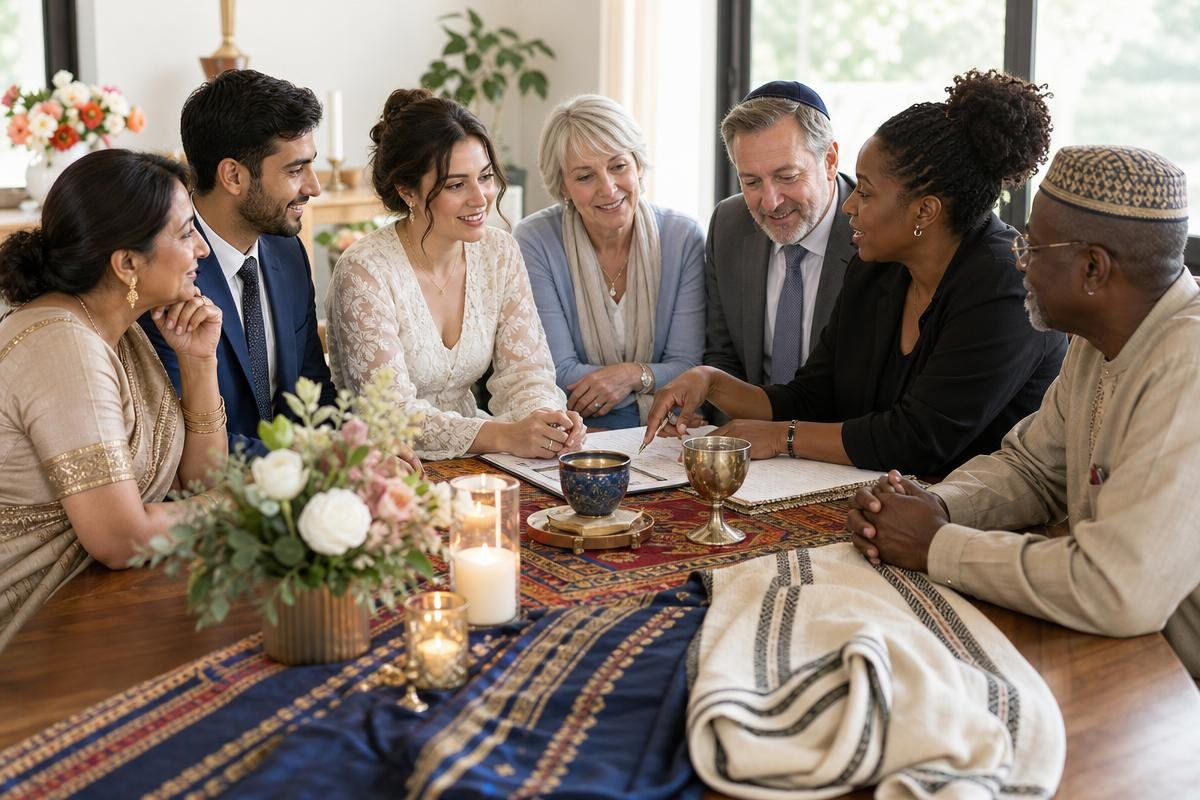
Managing interfaith wedding family expectations takes patience, clarity, and a steady hand. Relatives may be excited, worried, confused, or carrying strong hopes about which traditions should appear. The couple may also be sorting through questions about ceremony language, religious symbols, future holidays, and how each family will be represented.
An officiant does not need to solve every family disagreement. Your job is to help the couple make thoughtful decisions, communicate them kindly, and build a ceremony that reflects their shared promises. Interfaith and interreligious work is generally rooted in dialogue, understanding, cooperation, and respect for the distinctiveness of each tradition—not in creating a new faith. The Pluralism Project at Harvard University explains this distinction clearly.

Start with the couple’s nonnegotiables
Family conversations go more smoothly when the couple has already agreed on its priorities. Without that agreement, an officiant can accidentally become the person who decides whose tradition matters most.
Separate values from visible details
Ask the couple to name what they want guests to feel and what they want the ceremony to say about their marriage. A family may ask for a particular prayer, reading, ritual object, or blessing, but the deeper request may be about belonging, continuity, respect, or reassurance.
Help the couple sort decisions into three groups:
- Nonnegotiable: A choice that expresses the couple’s identity, promise, or religious commitment.
- Flexible: A choice that could be adapted in wording, placement, or format.
- Optional: A meaningful idea that can be included only if it fits the ceremony naturally.
Which parts of the ceremony would feel genuinely wrong to remove, and which parts would simply be nice to include?
Example: “We need a Christian reading about love, a Jewish blessing for the home, and language that does not suggest either of us converted. We are flexible about who presents each reading.”

Short answer: Protect meaning, flex on logistics.
Put the decisions in writing
A short shared planning note can prevent the same debate from returning in five different conversations. It might include the ceremony’s tone, faith references, music, readings, rituals, family roles, and any topics the couple does not want discussed during the wedding.
This is not a legal contract. It is simply a clear working document for the couple, officiant, musicians, readers, and anyone else helping shape the service.
Explain choices kindly without negotiating every detail
Relatives often respond better when they understand the reason behind a choice. The Union for Reform Judaism’s guidance on welcoming interfaith couples emphasizes explaining unfamiliar rituals, making space for questions, and avoiding assumptions about what guests already know. Its practical recommendations can help officiants make ceremonies more accessible.
Use the “meaning, choice, invitation” method
When a family member asks why a tradition was changed or omitted, try this three-part response:
- Meaning: Explain what the tradition represents to the family or faith community.
- Choice: State what the couple decided and why it fits their marriage.
- Invitation: Offer a way for the relative to participate that does not override the couple’s decision.
For example: “The unity candle represents the joining of two families. The couple chose a shared blessing instead because it reflects both of their traditions. We would love for you to offer the closing family welcome.”
Notice the difference between explaining and defending. Explaining leaves room for dignity. Defending often turns the conversation into a courtroom, with everyone trying to prove that their preference is the only respectful one.
Give guests a simple guide
If the ceremony includes unfamiliar words, movements, symbols, or prayers, add a brief explanation to the program or have the officiant introduce the moment. A guest should not have to guess whether they are watching a blessing, a vow, a remembrance, or a cultural custom.
Keep explanations brief and welcoming. Avoid presenting one tradition as the default and the other as an unusual addition. The goal is not to teach a full religious studies course during the ceremony. It is to help guests participate with understanding.
Involve relatives with purpose, not pressure
Family involvement can be a wonderful bridge, especially when relatives are given roles that match their comfort and abilities. It can also become overwhelming if every relative expects a speaking part or a vote on the ceremony.
Match roles to the person
Consider asking relatives to:
- Read a short passage, blessing, or poem.
- Carry or display a meaningful family object.
- Offer a welcome at the reception.
- Prepare a family recipe or cultural display.
- Participate in a private pre-ceremony ritual.
- Sign a family blessing or marriage keepsake.
- Serve as ushers who help guests understand the flow of the ceremony.
Do not assume that a person who feels strongly about tradition wants to speak publicly. Some relatives would rather contribute through food, music, hospitality, or quiet support.
Use boundaries as a form of care
A boundary is not a punishment. It tells people how they can stay connected without taking over. The couple might say, “We want your ideas, but we will make the final ceremony decisions,” or, “We are happy to include one reading from each tradition, but we are not adding additional rituals.”
Build a ceremony that honors both traditions thoughtfully
There is no single formula for an interfaith wedding. Some couples combine elements within one ceremony. Others keep the ceremony broadly spiritual and honor traditions through music, readings, attire, food, family roles, or separate celebrations.
Recent reporting on interfaith weddings describes couples combining traditions through shared canopies, family textiles, readings, blessings, food, and roles for relatives from different religious backgrounds. It also notes that clergy participation and co-officiation policies can vary. Those examples are useful as inspiration, not as a template.
Choose rituals by meaning and consent
Before including a religious or cultural ritual, ask:
- What does this ritual mean within its tradition?
- Who has the authority or experience to explain it accurately?
- Does the couple want to perform it, receive it, or simply acknowledge it?
- Could guests misunderstand it as a conversion, formal religious commitment, or endorsement?
- Is the ritual being used respectfully, or only because it looks beautiful in photographs?
When a practice comes from a living religious or cultural community, consultation matters. Ask an appropriate faith leader, cultural teacher, or knowledgeable family member to help the couple understand the ritual. Do not borrow sacred objects or gestures casually, and do not flatten a complex tradition into a decorative “theme.”
Let the couple’s shared life be the center
The ceremony should not feel like two competing presentations. Look for shared values that can connect the sections: compassion, hospitality, service, family, gratitude, courage, or commitment. Then allow each tradition to speak in its own voice rather than forcing every element into identical language.
| Planning choice | When it may work well | What to clarify first |
|---|---|---|
| One officiant with blended readings | The couple wants a unified ceremony and both traditions can be represented through approved texts. | Which readings are appropriate, who may present them, and how they will be explained. |
| Two officiants or faith representatives | Each partner wants direct participation from their religious community. | Whether the representatives may co-officiate, share a platform, or offer separate roles. |
| One ceremony with cultural elements | The couple wants to honor heritage without presenting a formal religious service. | Whether the element is religious, cultural, family-based, or all three. |
| Separate religious celebrations | The couple wants to meet distinct family or community expectations on different occasions. | How the events relate to one another and whether either is understood as the legal marriage ceremony. |
Prepare for the harder conversations
Some family expectations cannot be satisfied completely. A relative may want a conversion, a particular officiant, a single-faith ceremony, or a promise about how future children will be raised. The couple may not be ready to answer every long-term question, and that is different from avoiding the conversation.
Keep future topics separate from wedding decisions
Questions about holidays, children, religious education, names, ceremonies, and community membership may deserve serious discussion between the couple. They do not all need to be settled publicly during wedding planning.
Encourage the couple to say, “We are discussing that together, and we are not making it part of the wedding ceremony right now.” That answer is honest without inviting a family referendum.
Respond to disappointment without surrendering the plan
A relative may feel hurt even after receiving a thoughtful explanation. Acknowledge the feeling without agreeing that the couple made the wrong decision: “I understand that this tradition matters deeply to you. We are grateful you told us. We have made a different choice for our ceremony, and we hope you will still share the day with us.”
This is often the steady middle ground. The couple can respect a family member’s faith and history without handing over authority for the ceremony.
Keep legal and religious responsibilities distinct
Officiants should be careful not to assume that a religious ceremony automatically satisfies marriage-law requirements. License procedures, officiant eligibility, filing duties, waiting periods, and ceremony rules can vary by location. For a starting point, couples can review the OrdainedPro state marriage-law map and confirm details with the relevant government marriage authority.
Likewise, an officiant should not promise that a ceremony will be recognized by a particular religious institution unless that institution has confirmed its requirements. A couple may need to speak directly with a rabbi, priest, minister, imam, pandit, humanist celebrant, or other authorized representative about religious recognition, required preparation, approved language, or participation rules.
Final planning checklist
- The couple has identified its nonnegotiables.
- Each requested ritual has a clear meaning and an appropriate source of guidance.
- Family roles are specific, realistic, and approved by the couple.
- Unfamiliar ceremony elements will be explained to guests.
- Future family questions are not being forced into the wedding script.
- Legal and religious requirements have been checked with the proper authorities.
- The final ceremony sounds like the couple, not like a compromise assembled by committee.
Bring the focus back to the marriage
When family expectations grow loud, return to the simplest question: What promises are these two people making to one another, and how can the ceremony help everyone hear them?
A good interfaith wedding does not require every guest to agree with every choice. It requires the couple to make those choices honestly, the officiant to guide the process with care, and the family to be invited into the celebration without being placed in charge of it. Set the priorities early, explain decisions generously, and let the ceremony reflect a marriage built with room for both people.
Frequently Asked Questions
How can couples manage family expectations in an interfaith wedding?
They should first agree on their nonnegotiables, then explain those decisions kindly and offer relatives meaningful roles that do not override the couple’s authority. A short written ceremony plan can keep conversations focused.
Should both religions be included in an interfaith wedding ceremony?
Not necessarily. Some couples include readings, blessings, rituals, or cultural elements from both traditions, while others prefer a broadly spiritual ceremony or separate religious celebrations. The right choice is the one that accurately reflects the couple’s beliefs and commitments.
How should an officiant handle a family member who objects to the ceremony plan?
Acknowledge the person’s feelings, explain the couple’s reasoning, and restate the boundary calmly. For example: “We understand why this matters to you. The couple has chosen a different approach, and we hope you will still participate in the day.”
Can an officiant combine religious rituals from different faiths?
Possibly, but the officiant should not improvise or treat sacred practices as decoration. The couple should learn what each ritual means and consult an appropriate religious or cultural authority when needed. Participation and recognition requirements may vary by tradition.
How can families participate without taking over the wedding?
Give relatives defined roles such as readings, music, hospitality, family blessings, food, or displaying meaningful objects. Make clear that the couple welcomes support but retains final authority over the ceremony.
Does an interfaith wedding ceremony automatically meet legal marriage requirements?
No assumption should be made. Marriage-license procedures, officiant rules, filing duties, and ceremony requirements vary by location. Couples should check their local government authority and use the OrdainedPro state marriage-law map as a starting point.