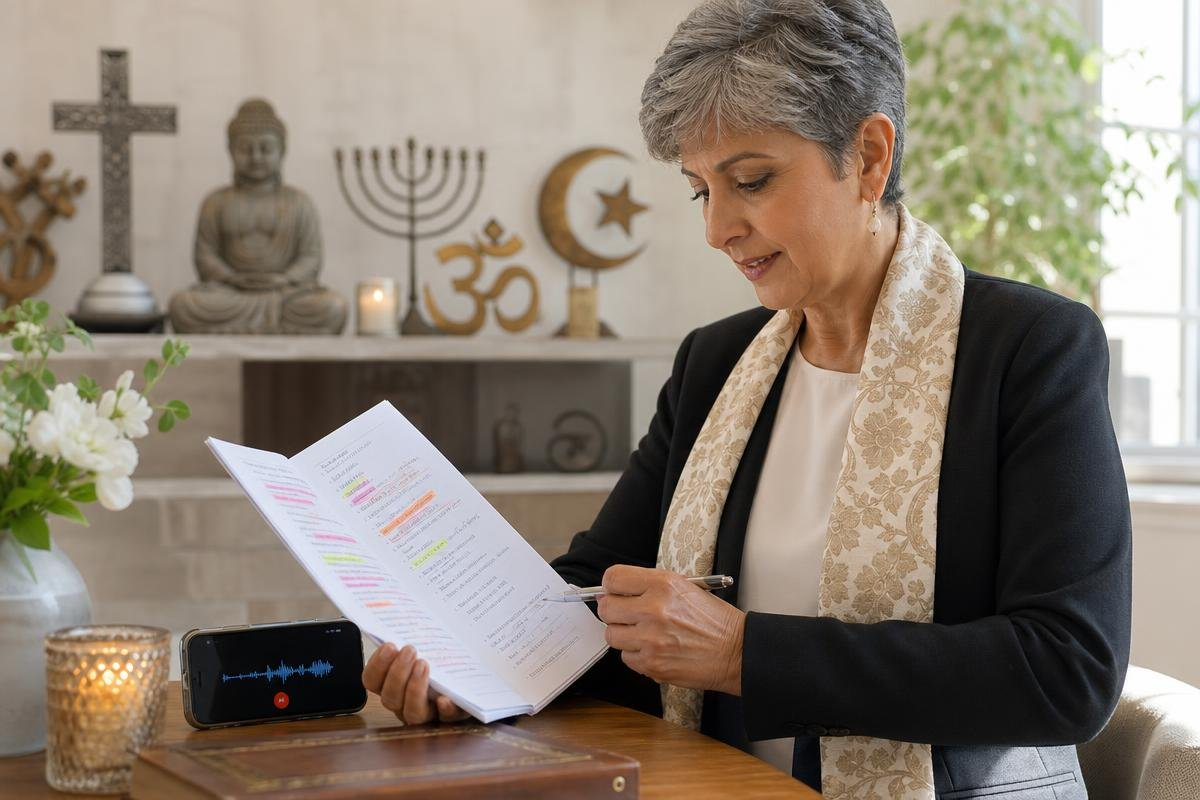
Getting a name or sacred word right is one of the simplest ways an officiant can show care. It tells the couple, their families, and their community that you prepared instead of guessing.
This wedding officiant pronunciation checklist gives you a repeatable rehearsal system for names, titles, prayers, languages, sacred terms, and family relationships. You do not need to sound like a native speaker of every language. You do need to ask, listen, practice, and use the pronunciation the people involved recognize as right.

1. Start with the couple’s preferred pronunciation
Ask the people themselves first. A spelling, a family tradition, or a pronunciation guide can help, but the person’s own preference should be your starting point. Names may have several accepted pronunciations, and families sometimes use a version that differs from what a general reference source suggests.
Send the couple a short request several weeks before the ceremony. Ask them to identify every person whose name you will say aloud, including the couple, parents, grandparents, attendants, readers, musicians, and anyone mentioned in a blessing or remembrance.
Then request audio recordings. A voice memo is often more useful than a written pronunciation because it captures rhythm, emphasis, and sounds that are difficult to represent with English spelling.
Useful planning question: Which names, titles, or words would feel especially meaningful for us to hear pronounced correctly during the ceremony?
Example: “Our grandmother’s name and the Hebrew blessing matter deeply to us, and we would like our cousin Maya to provide the recordings.”

Short answer: Identify the meaningful words early.
What to record
- Each partner’s full name and preferred form of address.
- Parents’ and grandparents’ names.
- Names of readers, witnesses, attendants, and honored guests.
- Religious or cultural titles.
- Prayers, blessings, vows, poems, and sacred terms.
- Names of places, ancestors, or organizations included in the ceremony.
2. Build a pronunciation sheet that someone else can use
A good pronunciation sheet is not a private collection of guesses. It is a shared working document that another officiant, coordinator, or sound technician could understand at a glance.
Use the spelling exactly as it should appear in the program or script, then add a simple pronunciation guide. Break longer names into syllables, capitalize the stressed syllable, and use familiar sound comparisons sparingly. If a sound does not have a close English equivalent, write a note such as “listen to recording” instead of pretending the spelling is exact.
| Item | What to record | Best confirmation method |
|---|---|---|
| Personal name | Exact spelling, preferred form, syllable breaks, stress | Audio from the person or close family member |
| Title or honorific | Full title, shortened form, and who may use it | Couple plus the relevant community member |
| Prayer or blessing | Original wording, language, translation, and pauses | Qualified reader or community representative |
| Sacred term | Pronunciation, meaning in context, and whether it should be translated | Tradition-specific adviser or the couple’s chosen teacher |
| Family relationship | Correct relationship and preferred description | Couple or immediate family |
The Library of Congress Say How pronunciation guide demonstrates one useful principle: pronunciation needs a consistent system for showing stress and sound. You can borrow that idea without trying to turn your ceremony notes into a formal dictionary.
For names or words written in a non-Latin script, do not assume that a Roman-letter spelling tells you exactly how to say the word. The Library of Congress and American Library Association romanization tables are reference tools for representing many writing systems, but a community member’s recording remains the better guide for a live ceremony.
3. Rehearse names, titles, and family relationships separately
Many officiants practice the ceremony as one long performance. That can hide small accuracy problems. Instead, rehearse names, titles, and relationships as their own section before practicing the full script.
Use a three-pass rehearsal
- Recognition pass: Read each name silently and listen to the recording.
- Speaking pass: Say the name aloud several times at a natural pace.
- Ceremony pass: Use the name in the full sentence, with the correct pause and eye contact.
Practice the names in different sentence positions. A name can sound comfortable by itself but become awkward after “please welcome,” “the parents of,” or “in the presence of.” Also rehearse the transition between names. The goal is not to rush through a list; it is to make each person feel properly acknowledged.
Watch for relationship errors. “The bride’s father,” “the couple’s parents,” “their chosen family,” and “their families” may not mean the same thing. Ask the couple what language they want used. Do not infer family structure from surnames, appearance, age, or wedding customs.
4. Handle prayers and sacred words with humility
Sacred language deserves more than a quick internet search. A prayer may be familiar across communities but pronounced differently by region, denomination, family, or congregation. A transliteration may also represent spelling rather than sound.
Ask who should guide you. Depending on the ceremony, that may be the couple, a family member, a clergy person, a cantor, a rabbi, an imam, a priest, a monk, a community elder, a language teacher, or another qualified person chosen by the couple. If no adviser is available, ask whether the couple would prefer to read the passage themselves.
The Pluralism Project at Harvard University describes pluralism as more than simple tolerance and emphasizes genuine encounter across differences. For an officiant, that means approaching a tradition as something to learn from the people who practice it, not as a decorative set of words to reproduce from memory.
Confirm four details
- Text: Is this the exact wording the couple wants?
- Language: Should the original language, an English translation, or both be used?
- Pronunciation: Who has approved the way you are saying it?
- Meaning: Is there a short explanation the couple wants guests to hear?
Do not add an explanation simply because you think guests need one. Some couples want a translation; others want the sacred words to stand on their own. Your job is to follow the couple’s plan and the guidance of the person they trust.
5. Use recordings without becoming dependent on them
Audio is an excellent rehearsal tool, but it should support your preparation rather than replace it. Listen until you understand the rhythm. Then practice away from the recording so you can speak naturally while looking at the couple and guests.
Use this audio routine:
- Listen once without repeating.
- Listen again while marking syllable breaks and stress.
- Repeat along with the speaker at a slower pace.
- Record yourself and compare the rhythm, not just individual sounds.
- Ask the original speaker or adviser for one final confirmation.
If you are still struggling, do not hide it. Ask whether there is a simpler introduction, an alternate title, or a way for a family member to speak the word. A respectful adjustment is better than a confident mistake.
Keep a backup. Save the approved audio and written notes in the same ceremony folder, but do not play a recording during the ceremony unless the couple has specifically planned that. Technology can fail, and a live ceremony should not depend on a phone notification or an internet connection.
6. Practice the ceremony-day details
Accuracy includes more than pronunciation. Think about when you will say each name, where you will look, and whether the microphone will make the sound clear.
Final pronunciation checklist
- Confirm every name you will say aloud.
- Confirm titles, honorifics, and family descriptions.
- Mark stress and pauses in the printed script.
- Listen to approved recordings from the couple or adviser.
- Practice names inside the actual ceremony sentences.
- Ask whether any sacred words should be spoken only by a community member.
- Print a clean backup pronunciation sheet.
- Tell the coordinator or reader about any last-minute changes.
- Arrive early enough for one quiet microphone check.
During the ceremony, slow down slightly before a name or sacred phrase. Look up, breathe, and say it clearly. If you make a small mistake, correct it calmly and continue. A simple “I’m sorry—let me say that correctly” is usually more respectful than pretending nothing happened.
7. Know when not to improvise
Improvisation can make a ceremony warm, but it is not the right tool for uncertain names or sacred language. Do not invent a pronunciation, translate a prayer from memory, add a religious title, or explain a tradition you have not confirmed.
Use a referral instead. If a term is outside your knowledge, ask the couple to connect you with someone who can guide you. If the ceremony combines traditions, ask each tradition’s representative to review the section that concerns them. This is especially important when a word carries theological, cultural, or community-specific meaning.
Being careful does not make you less professional. It is the professional response when your role includes speaking for a couple in front of the people they love.
Conclusion: Prepare the words as carefully as the vows
A reliable pronunciation practice is simple: ask the right people, collect recordings, mark your script, rehearse in context, and confirm anything sacred or unfamiliar. The aim is not flawless performance. The aim is faithful attention.
Before the wedding, read through your pronunciation sheet one final time and place it with your ceremony script. When you speak each name and sacred word with care, you help create the kind of steady, welcoming ceremony couples remember for the right reasons.
Frequently Asked Questions
What should be included in a wedding officiant pronunciation checklist?
Include the couple’s full names, preferred forms of address, family and participant names, titles, prayers, blessings, sacred terms, languages, relationship descriptions, approved phonetic notes, and links or files for audio recordings.
Should a wedding officiant use a pronunciation website for someone’s name?
A pronunciation website can provide a starting point, but it should not replace confirmation from the person or the couple. Personal names may have family, regional, or personal pronunciations that general references do not capture.
How can an officiant practice a prayer in another language?
Request an audio recording from the couple or a qualified community member, mark syllable breaks and stress, practice slowly, record yourself, and ask for a final review before the ceremony.
What should an officiant do if they still cannot pronounce a sacred word confidently?
Ask the couple whether a community member should read it, whether an approved alternate wording is available, or whether the term can be omitted. Do not guess or improvise.
How should an officiant respond after mispronouncing a name?
Pause, acknowledge the mistake briefly, say the name correctly, and continue. A calm correction is generally better than ignoring the error or making a long explanation.