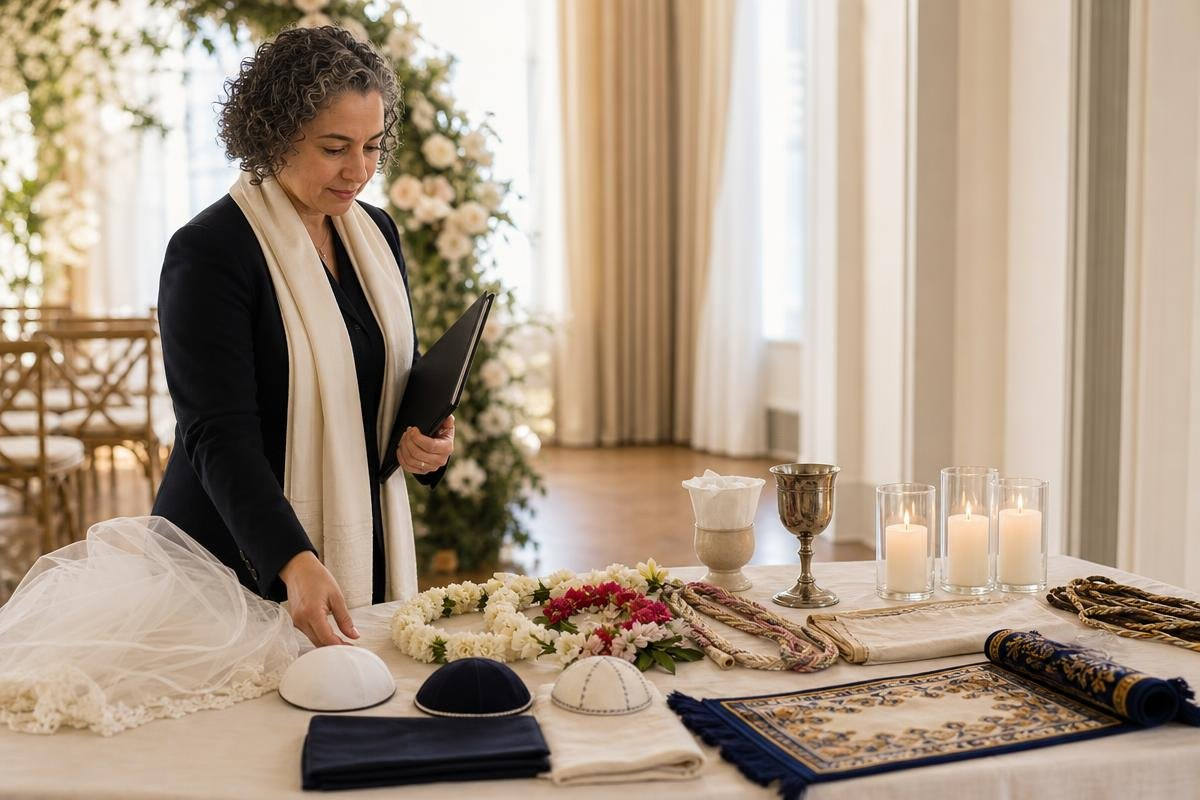
Religious wedding attire and sacred objects deserve more than a quick internet search or a last-minute question. A veil, turban, kippah, garland, ceremonial cup, candle, cord, prayer rug, or other ritual item may carry deep personal and communal meaning. As the officiant, your job is not to become an expert in every faith tradition. Your job is to prepare carefully, ask respectful questions, and make sure the couple’s choices are handled with dignity.
This guide offers a practical framework for working with couples whose wedding includes religious attire or sacred objects. Customs differ within every tradition, so treat the examples below as conversation starters—not universal rules.

Start with the couple, not your assumptions
The safest first step is a calm planning conversation. A couple may use a familiar religious item in a personal way, combine traditions from both families, follow a local community’s custom, or choose an adaptation that differs from what you have read online.
Ask what each item is called, who will handle it, when it appears in the ceremony, and what the couple wants guests to understand. Also ask whether a religious leader, family elder, cultural adviser, or community representative should be consulted. That referral is not a sign that you are unprepared. It is a sign that you know when the couple’s own community should lead.
Planning question: Which attire or objects are essential to the couple’s ceremony, and which are included mainly for family meaning or visual beauty?
Example: “The couple wants a family garland exchange, two candles representing their households, and a prayer rug used only during a private blessing before the public ceremony.”
Short answer: Identify meaning, timing, and responsibility.

Learn the difference between symbolic, customary, and sacred
Not every meaningful object has the same status. One couple may view a decorative garland as a joyful family custom. Another may treat a garland as part of a religious rite. A ceremonial cup may be heirloom tableware, while another cup may be reserved for a blessing and handled only by designated people.
Use the couple’s language. If they call something sacred, do not casually relabel it as a prop or decoration. If they describe an item as cultural, do not impose a religious interpretation. The goal is accurate, respectful preparation—not a more dramatic ceremony script.
Several broad principles are useful across traditions:
- Ask before touching. Do not move, adjust, wear, or demonstrate an item without permission.
- Keep sacred items separate from clutter. A clean, stable table is better than a crowded supply box or floor-level staging area.
- Follow the family’s handling instructions. The person who brings the item may know how it should be opened, covered, carried, or stored.
- Do not turn unfamiliar attire into a photo opportunity. A guest’s head covering or religious garment should never be treated as a costume or conversation piece without consent.
The Pluralism Project advises visitors to observe the host community, follow its practices when appropriate, and ask when unsure. That is a sound habit for officiants, especially when working in a house of worship or with a ceremony shaped by a particular community. Review the Pluralism Project’s research guidelines for a broader framework on respectful religious engagement.
Prepare thoughtfully for religious attire
Veils and face coverings
A veil may be a fashion choice, a family tradition, a modesty practice, or part of a specific ritual. Do not assume that a veil must cover the face, be lowered by a partner, or be removed before vows. Ask the couple who handles it and whether the moment should be explained aloud.
For example, Reform Judaism notes that Jewish couples may choose to wear a veil, place it in the hair without covering the face, or skip a veil altogether. That variation is a useful reminder: even within one religious tradition, couples may make different choices.
Turbans and other head coverings
A Sikh dastaar, or turban, is not simply a hat or wedding accessory. The Sikh Coalition describes the turban as an important part of Sikh identity and advises people not to touch someone’s turban or hair without permission. A wedding officiant should never ask a Sikh participant to remove or adjust a turban for photographs, venue rules, or convenience.
Kippot, yarmulkes, prayer shawls, hijabs, scarves, caps, and other head coverings also require context. Some guests may be invited to wear them; others may prefer not to. If the couple is offering head coverings, ask whether they should be available to everyone, only to certain participants, or only in a particular setting.
The Sikh Coalition’s FAQ explains several practical points about turbans and respectful interaction. For Jewish wedding planning, Reform Judaism’s wedding-day checklist discusses kippot and other ceremony items.
Create a reliable handling plan for sacred objects
Most ceremony-day problems are logistical, not theological. The item is left in a hot car, placed where guests step, handed to the wrong person, or packed away before the ritual is complete. A simple handling plan prevents those mistakes.
Use this five-step process
- Inventory the items. Make a complete list, including small pieces such as cords, pins, matches, cloths, rings, cups, trays, books, flowers, or coverings.
- Assign a custodian. Choose one trusted person—often a family member or designated attendant—to keep track of the items.
- Confirm the order. Write down when each object enters, who carries it, where it is placed, and when it leaves.
- Protect the setting. Check for wind, rain, open flames, uneven ground, crowded aisles, pets, children, and accessibility concerns.
- Plan the return. Ask whether the item goes home with the couple, returns to a worship community, is stored in a particular way, or should not be photographed.
Officiant’s ritual-item checklist
- Names and meanings confirmed with the couple
- Handling restrictions recorded
- Custodian assigned
- Placement and ceremony order confirmed
- Venue and safety concerns reviewed
- Photography permissions clarified
- Post-ceremony return or storage arranged
When a couple uses a chuppah, ceremonial cup, ketubah, or kippot, ask whether a religious leader or family member has additional instructions. Reform Judaism’s wedding resources describe how these items may function in Jewish ceremonies while also showing that contemporary couples adapt traditions in different ways.
Coordinate with the venue and ceremony team
An officiant may understand the couple’s wishes while the venue staff does not. Share only the information needed to protect the ceremony and avoid embarrassing the couple. For example, the venue may need to know that shoes come off in a particular space, that a prayer rug must remain clean, that candles need a stable surface, or that an item should not be moved once placed.
Be especially clear about photography. Ask whether the photographer may capture close-ups of religious attire, ritual objects, private blessings, or family members handling sacred items. A beautiful photograph is not automatically an appropriate photograph.
Also review sound, lighting, and sightlines. A ceremonial cup or candle should be visible enough for guests to follow the moment, but it should not be treated like a centerpiece. A prayer rug may need a quiet, clean location. A garland exchange may require enough aisle space for two people to approach comfortably.
If the ceremony takes place in a religious building, follow the host community’s instructions about dress, footwear, photography, food, music, and movement. The Pluralism Project recommends modest dress, attentive observation, and asking a member of the community when you are unsure about local practice.
| Planning concern | Ask the couple | Practical officiant response |
|---|---|---|
| Head covering | Who wears it, and may anyone touch or adjust it? | Assign a trusted helper; never adjust it yourself without permission. |
| Flame or candle | Is it ceremonial, devotional, symbolic, or all three? | Confirm venue approval, stable placement, lighting order, and extinguishing plan. |
| Garland or cord | Who exchanges or places it, and what does the action mean? | Rehearse movement without treating the item as a prop. |
| Cup or vessel | Who may carry, fill, bless, drink from, or clean it? | Use the couple’s designated custodian and plan secure storage. |
| Prayer rug or cloth | Where may it be placed, and how should it be folded afterward? | Keep the area clean, dry, accessible, and free from foot traffic. |
Use language that honors the couple without speaking for a faith
Your script should describe what the couple is doing, not make sweeping claims about what an entire religion believes. Instead of saying, “This object always represents…,” try, “For this couple, this object represents…” That small change is more accurate and gives the couple ownership of the meaning.
Avoid jokes about unfamiliar clothing, pronunciation contests, exoticizing language, or explanations that reduce a complex tradition to one sentence. You do not need to provide a mini-religion lecture. A brief, couple-approved explanation is usually enough.
Before the rehearsal, write the names of people, objects, languages, and ritual actions phonetically if the couple wants that support. Then practice privately. If you make a mistake during the ceremony, correct it plainly and continue. A sincere correction is better than pretending nothing happened.
Religious identity is personal, and the same visible item may carry different meaning for different people. The U.S. Commission on International Religious Freedom identifies religious attire and ritual objects as part of the ways people may manifest religion or belief. That does not tell you exactly how to conduct a particular ceremony, but it reinforces why consent, dignity, and careful preparation matter.
Know when to refer the couple to a religious authority
An independent officiant can coordinate a ceremony without claiming authority to define a tradition. Refer questions when they involve doctrine, required rites, eligibility to participate, sacred-language accuracy, clergy approval, ritual purity, or whether a particular marriage ceremony is recognized by a religious community.
Be candid about your role. You might say, “I can help you organize the ceremony and make sure the practical details are handled respectfully. For the religious requirements, let’s confirm with the clergy member or community adviser you trust.”
That approach also helps with interfaith ceremonies. One partner’s family may expect a ritual while the other partner’s community does not recognize it, or the same object may be welcomed in one setting and inappropriate in another. Your role is to help the couple make an informed plan—not to force a compromise that no one has approved.
For state marriage-law, officiant-authorization, license, or filing questions, begin with the OrdainedPro state marriage-law map and confirm requirements with the appropriate government office. This article is not legal advice, and religious approval is separate from civil marriage requirements.
Finish with a calm rehearsal and a written backup plan
At rehearsal, practice the movement of people and objects without turning sacred actions into a performance exercise. Confirm where everyone stands, who gives quiet cues, and what happens if an item is delayed or unavailable.
Have a backup for logistics, not for the meaning of the ritual. A replacement candle, clean cloth, extra tray, or weather-safe table may be sensible. Substituting an unfamiliar object for a sacred one without the couple’s approval is not.
Before the ceremony begins, take five minutes to review the item list with the custodian and venue contact. Then put the checklist away and be present. The couple should feel that their attire and objects are being protected, not inspected.
Frequently Asked Questions
Should an officiant touch a couple’s religious attire or sacred objects?
Only with clear permission and instructions from the couple or the person designated to handle the item. When in doubt, do not touch it. Assign a trusted custodian and confirm the correct handling plan before the ceremony.
Can I explain the meaning of a religious wedding object during the ceremony?
Yes, if the couple approves the wording. Use couple-specific language such as “For this couple, this object represents…” rather than making broad claims about an entire religion.
Are turbans, kippot, veils, and other head coverings interchangeable?
No. Head coverings can have different religious, cultural, customary, and personal meanings. Ask who may wear, touch, adjust, or remove each item, and avoid treating any of them as costumes or generic accessories.
What should I do if a venue has a rule that conflicts with religious attire or a sacred object?
Pause before making a change. Ask the couple, consult the venue manager, and involve a qualified religious or community adviser when appropriate. Document the agreed plan and do not make assumptions about legal rights or religious requirements.
Where can I check state-specific marriage or officiant requirements?
Use the OrdainedPro state marriage-law map as a starting point at https://portal.ordainedpro.com/map, then verify current requirements with the relevant government office. State rules can change, and this article is not legal advice.