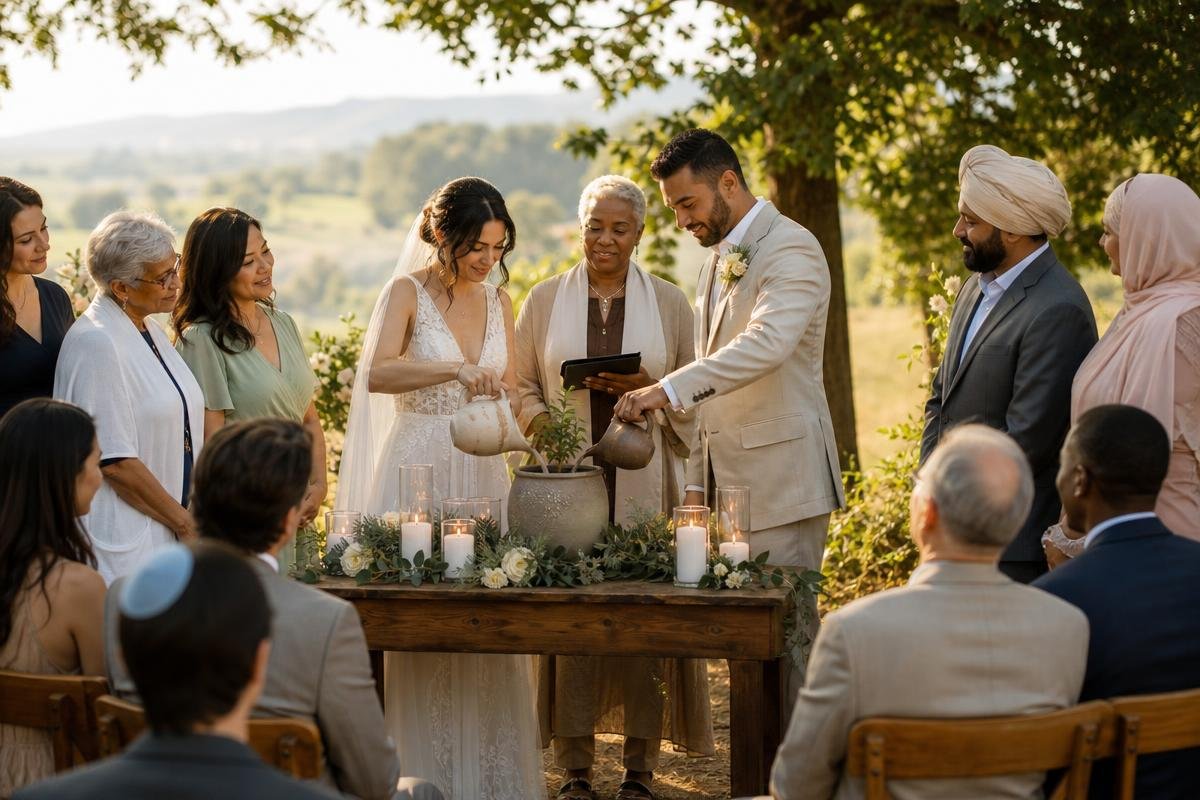
An interfaith wedding does not have to flatten two traditions into one or turn the ceremony into a rapid tour of religious symbols. The strongest interfaith unity ceremony ideas help both partners feel recognized while giving guests a clear, welcoming way to understand what they are witnessing.
As the officiant, your job is not to make every difference disappear. It is to help the couple choose a meaningful gesture, explain it plainly, and keep the ceremony centered on their promises. The guidance below offers adaptable ideas based on shared values, family, light, water, earth, letters, community, and service.

Start with meaning, not a menu of rituals
A unity ceremony works best when it answers a simple question: What are these two people choosing to build together? The physical action—lighting, pouring, planting, tying, writing, or serving—should make that answer visible.
Before suggesting an idea, ask the couple what they want guests to understand about their marriage. Do they want to emphasize shared values, family support, spiritual blessing, cultural continuity, or a promise to serve others?
Example: “We want our families to see that we are keeping our individual traditions while building a home shaped by kindness, curiosity, and mutual respect.” Short answer: Shared values, distinct identities.
That answer points toward a unity ritual that honors the couple’s common ground without claiming that every faith teaches the same thing. The Harvard Pluralism Project offers educational resources on many religious traditions, which can help an officiant learn enough to ask respectful questions rather than rely on assumptions.
Use shared values as the ceremony’s foundation
One of the safest and most flexible approaches is to build the unity moment around values the couple names themselves. Invite each partner to select one or two words, write them on cards, or speak them aloud. The cards can then be placed in a small box, displayed beneath a canopy, or attached to a keepsake that will remain in the couple’s home.

Possible value-based formats
- Two values, one promise: Each partner names a value they bring into the marriage, then together they name the promise that connects them.
- Family values circle: Parents, chosen family, or close friends each contribute one word such as patience, humor, generosity, or courage.
- Shared vow of practice: The couple promises not merely to believe in a value, but to practice it through listening, hospitality, repair, or service.
This approach is especially useful when one partner is religious and the other is secular, or when the partners come from traditions with different expectations about formal religious language. It creates room for sincerity without requiring the officiant to speak as an authority for either faith.
Interfaith unity ceremony ideas using family and community
Family participation can make the ceremony feel genuinely shared rather than divided into “one side” and “the other side.” Ask the couple which relatives, elders, friends, or chosen family members have helped shape their understanding of marriage.
Family blessing cards: Give each selected loved one a card with a prompt such as, “What quality do you hope this couple carries into married life?” The officiant can read a few responses during the ceremony, or the couple can keep them in a family box.
Two-family keepsake: Invite each family to contribute a small, appropriate item connected to home or family history. The items might be placed together on a table, beneath a canopy, or in a memory box. Explain what each item means to the couple, and avoid presenting either object as a universal religious symbol.
Community circle: The couple can ask guests to stand, place a hand over their heart, or simply offer silent support while the officiant names the community’s role in sustaining the marriage. Give guests clear instructions so no one is pressured to participate in a religious act that conflicts with their beliefs.
Guidance from the Union for Reform Judaism similarly emphasizes involving loved ones, explaining unfamiliar rituals, acknowledging both backgrounds, and choosing readings that are shared between traditions or not tied to a particular faith.
Light, water, earth, and other adaptable symbols
Natural elements can create a beautiful visual moment, but the meaning should come from the couple—not from an assumption that a symbol means the same thing in every religion.
| Unity format | How it can work | Planning question | Use caution |
|---|---|---|---|
| Light | Each partner lights a candle or lantern, then the couple lights a shared flame or places the lights together. | Does light represent hope, guidance, welcome, memory, or another value? | Check venue rules and any religious restrictions around flame. |
| Water | Partners pour two waters into one vessel, using water from meaningful places if appropriate. | What does the joining represent for this couple? | Do not describe it as a sacred rite unless an appropriate religious authority confirms that use. |
| Earth or planting | Partners add soil to a plant or tree that they will care for together. | What ongoing practice will this ritual remind them to maintain? | Choose a plant suited to the location and plan for safe transport. |
| Letters | Each partner writes a private letter or future promise and seals it to open on an anniversary. | What do they want to remember when married life becomes demanding? | Clarify whether the letters will be read aloud or remain private. |
| Service | The couple assembles a care package, makes a charitable commitment, or names a shared service practice. | How will their marriage contribute beyond the wedding day? | Avoid making unsupported financial or charitable claims. |
The United Religions Initiative’s account of an interfaith candle-lighting event describes a gathering that honored distinct traditions while highlighting shared values such as love, hope, friendship, generosity, and light. That is a useful model for tone: celebrate common ground without erasing difference.
Explain unfamiliar elements without turning the ceremony into a lecture
A ritual can feel welcoming to the couple and confusing to the guests if no one explains what is happening. The explanation does not need to be long. One or two clear sentences are usually enough.
A simple explanation formula
- Name the action: “Alex and Jordan will now place two waters into one vessel.”
- Give the couple’s meaning: “For them, this represents two life stories becoming one shared household while each person remains fully themselves.”
- Invite or release participation: “Guests are welcome to watch in silence, offer a private blessing, or simply hold the couple in their thoughts.”
If a prayer, blessing, reading, or phrase is offered in a language unfamiliar to many guests, provide a translation or a brief explanation. The ELCA’s guidelines for ministry in a multireligious world recommend careful planning, consultation with appropriate religious leaders, and clear instructions when unfamiliar rituals or forms of participation are included.
Know when to adapt, consult, or leave a ritual out
Some religious practices are open to explanation and adaptation. Others may be reserved for members of a community, require a trained religious leader, or carry obligations that do not fit a wedding unity moment. A familiar-looking object is not automatically a neutral wedding prop.
Ask three questions before including any tradition-specific element:
- Who has the authority to explain or lead this practice?
- Is the practice open to outsiders, or is it reserved for a particular community?
- Would adapting it change, trivialize, or misrepresent its meaning?
If the answer is unclear, choose an original ritual inspired by the couple’s values instead. For example, rather than borrowing a closed sacred ceremony, the couple might write a shared statement about hospitality and place it in a family keepsake box. They can honor their backgrounds through music, language, family participation, clothing, readings, or personal stories without imitating a rite they are not prepared or permitted to lead.
When the couple wants formal religious prayers or a tradition-specific marriage rite, encourage them to speak with an authorized leader from that tradition. The goal is not to make the ceremony less personal; it is to make the inclusion more honest and respectful.
Officiant checklist
- Confirm what each partner wants honored.
- Ask which words, symbols, or practices are off-limits.
- Write a one- or two-sentence explanation for every unfamiliar element.
- Provide translations for non-English readings or blessings.
- Clarify whether guests are invited to participate or observe.
- Confirm venue, flame, water, plant, and setup requirements.
- Review any religious questions with the appropriate faith leader.
Build the unity moment into a balanced ceremony
A unity ritual cannot carry the entire responsibility of representing two faiths. Give each partner room elsewhere in the ceremony through the welcome, readings, vows, music, family participation, language, or closing blessing.
A practical structure might look like this:
- Welcome: Acknowledge both families, traditions, and the couple’s freedom to shape a ceremony that reflects their relationship.
- Shared story: Describe the qualities and experiences that brought the couple together.
- Distinct voices: Include a reading, blessing, song, or reflection meaningful to each partner, with context where needed.
- Unity action: Use one carefully chosen ritual based on shared values.
- Promises: Let the couple’s vows remain the emotional center of the service.
- Community support: Invite guests to affirm their support in a way that does not require a religious declaration.
Keep the unity portion focused. One well-explained action is usually stronger than five rushed gestures. As the planning resource Interfaith Marriages puts it, the goal is not to include everything; it is to include what matters.
If the ceremony includes a civil marriage license, witnesses, or officiant requirements, check the rules for the ceremony’s location before making promises about legal effect. Requirements differ by jurisdiction. OrdainedPro’s state marriage-law starting point can help you begin that research, but it should not replace confirmation from the relevant government authority.
Choose the idea that feels true on an ordinary Tuesday
The best interfaith unity ceremony is not necessarily the most elaborate. It is the one the couple can explain in their own words and still recognize years later as a truthful picture of their marriage.
As an officiant, listen for the shared promise underneath the symbolism. Then help the couple express that promise with care, clarity, and restraint. Respect does not require sameness, and unity does not require either partner to disappear.
Next step: Ask the couple to choose one shared value, one meaningful object or element, and one sentence explaining what the ritual means. If those three pieces fit together naturally, you are probably close to the right ceremony.
Frequently Asked Questions
What is a good interfaith unity ceremony idea?
A good idea is one based on the couple’s shared values rather than a borrowed sacred ritual. Options include lighting candles, combining water, planting a tree, sealing letters, inviting family blessings, or creating a service-centered promise.
Can an interfaith couple use a unity candle?
They can consider a unity candle if both partners are comfortable with the symbolism and the venue permits it. Explain what the candle means to this couple instead of presenting it as a universal or inherently religious practice.
How can an officiant include both faiths without making the ceremony feel crowded?
Give each tradition room through a reading, blessing, language, song, family role, or explanation, then choose one focused unity action. A balanced ceremony does not need to include every possible symbol.
How do we avoid cultural appropriation in an interfaith wedding?
Ask whether a practice is open to outsiders, learn who is authorized to lead it, and consult an appropriate religious or cultural representative. If the meaning or permission is unclear, create an original ritual based on the couple’s own values.
Should guests participate in an interfaith unity ritual?
Participation can be invited, but it should be clearly explained and optional. Offer guests a way to observe, reflect silently, or offer private support so no one feels pressured to perform a religious act.
Does a unity ceremony make a marriage legally valid?
A unity ceremony by itself does not determine legal validity. Marriage requirements vary by location, so the couple and officiant should confirm current rules with the relevant government authority before the wedding.