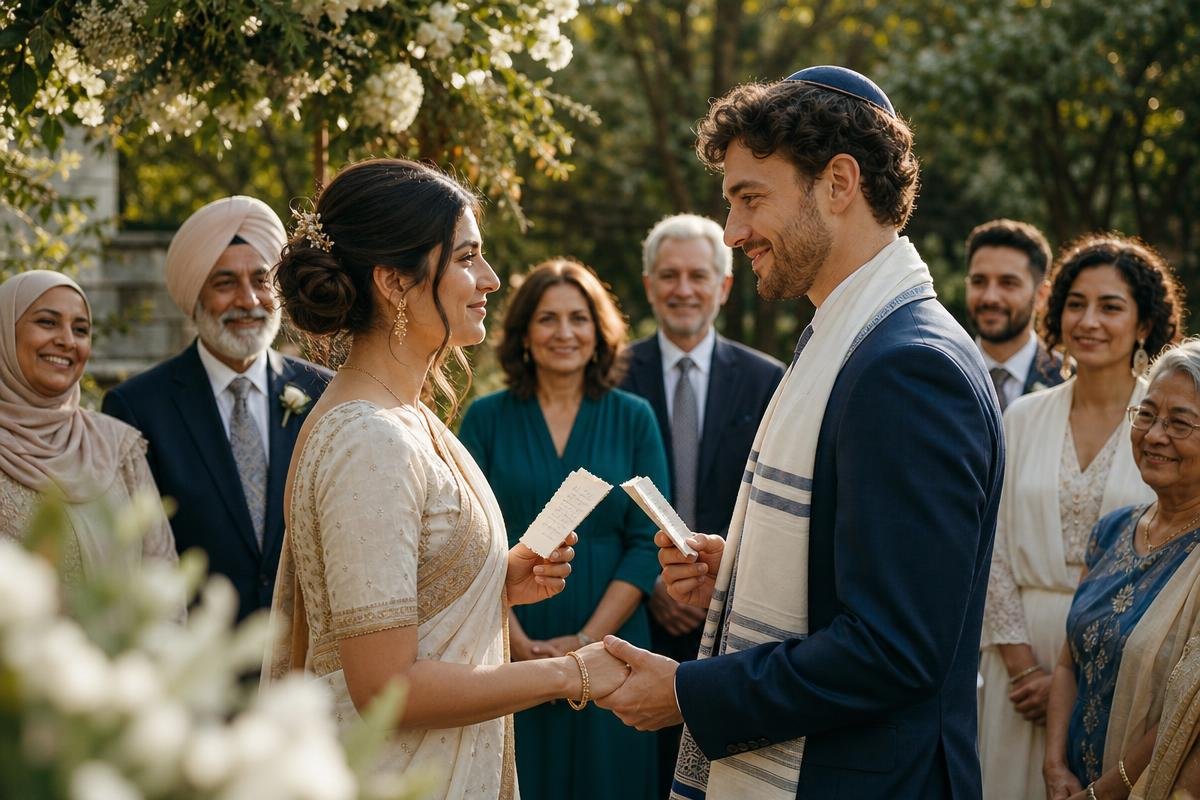
Wedding Vows Built on Shared Values Instead of Shared Theology
Writing wedding vows can feel complicated when two people love each other deeply but do not share the same religious language. The good news is that your vows do not have to settle every theological question. They need to tell the truth about the marriage you are choosing to build.
For many couples, interfaith wedding vows work best when they focus on shared values: honesty, compassion, courage, family, friendship, service, fidelity, growth, and peace. Those commitments can be meaningful to people with different beliefs, including couples who are religious, spiritual, culturally connected to a tradition, or not affiliated with a faith community.

The Pluralism Project describes interfaith dialogue as an intentional effort toward mutual understanding, cooperation, and respect. That is a useful standard for vow writing, too. Your ceremony does not need to erase differences; it should make room for both people to be known and honored. Learn more about interfaith dialogue from Harvard University’s Pluralism Project.
Start with the marriage you want to practice
Before choosing beautiful words, decide what your vows need to promise in ordinary life. A vow becomes stronger when it points to actions rather than vague admiration. “I love you” matters, but “I will speak honestly when a hard conversation is necessary” gives the promise a shape.
Ask yourselves: What should our marriage feel like on a difficult Tuesday, not only on our wedding day?
Example: “We want our home to be a place where both of us can speak honestly, recover from mistakes, welcome family, and keep learning from one another.”
Short answer: Honest, welcoming, resilient partnership.

Make a shared-values list before drafting. Each partner can choose five words privately, then compare the lists. Look for overlap, but do not treat differences as a problem to solve. If one partner chooses “faith” and the other chooses “curiosity,” both may belong in the ceremony when expressed respectfully.
Use a vow structure that leaves room for difference
A dependable structure helps nervous writers avoid rambling or accidentally turning vows into a speech about religion. Try this five-part framework:
- Recognition: Name what you admire in your partner and what brought you to this commitment.
- Shared purpose: Describe the kind of home, family, or community you hope to build.
- Specific promises: Make three to five commitments that can be practiced.
- Support through difference: Promise curiosity, respect, and room for each person’s conscience or tradition.
- Closing commitment: End with a clear statement of fidelity, partnership, or enduring love.
This structure works whether the ceremony includes prayer, scripture, cultural rituals, secular readings, or none of those elements. Theology can be included by each partner in a way that feels authentic, but shared vows do not have to use theological language to be serious or sacred.
| Vow section | Value-centered approach | Example direction |
|---|---|---|
| Recognition | Honor character and shared history | “I love the patience and courage you bring to our life.” |
| Shared purpose | Describe the life you will build | “We will make a home shaped by welcome and peace.” |
| Promises | Choose observable actions | “I will listen before defending myself.” |
| Difference | Protect mutual dignity and conscience | “I will respect the traditions and questions that shape you.” |
| Closing | State the commitment plainly | “I choose you as my partner, today and in the days ahead.” |
Build original vow frameworks from shared values
The following frameworks are starting points, not scripts to copy word for word. Replace the bracketed ideas with language that sounds like the couple. The strongest vows usually include at least one promise that is practical, one that is relational, and one that reflects the couple’s wider responsibilities.
Honesty and compassion
“I promise to tell you the truth with care, to listen when the truth is difficult, and to remember that being right is less important than treating you with compassion. I will make room for your feelings, even when I do not immediately understand them.”
Courage and growth
“I promise to be brave with you: brave enough to begin again, ask for help, admit when I am wrong, and keep growing. I will not expect us to remain exactly as we are. I will choose to meet the person you are becoming.”
Family and friendship
“I promise to build a family shaped by welcome, patience, and respect. I will honor the people and traditions that have helped make you who you are, while helping us create practices that belong to our home.”
Service and peace
“I promise to serve our life together in the small ways that matter: sharing the work, noticing your burdens, and showing up when the day is hard. When conflict comes, I will seek peace without pretending that important differences do not exist.”
Fidelity and steadiness
“I promise to be faithful in my words, choices, and attention. I will protect the trust between us, speak well of you when you are not in the room, and keep choosing our partnership through changing seasons.”
These frameworks deliberately leave theological language to the couple. One partner may add a personal reference to God, prayer, ancestors, nature, sacred tradition, or spiritual practice in an individual vow. The other may use different language. The goal is not identical phrasing; it is mutual respect and a promise both people can honestly make.
Talk about the subjects that vows cannot solve by themselves
Vows are important, but they should not carry the entire weight of premarital planning. Couples from different faith or cultural backgrounds may eventually need to discuss holidays, family expectations, children, religious education, worship, food practices, names, charitable commitments, and how each person wants traditions represented at home.
Ask yourselves: Which future decision would be hardest if we waited until after the wedding to discuss it?
Example: “We may need to talk now about how we will celebrate holidays, what role extended family will have, and whether future children will be taught one tradition, both traditions, or a broader set of values.”
Short answer: Discuss identity, family, and future choices early.
The American Psychological Association emphasizes open communication, constructive disagreement, and regular conversations about meaningful subjects in healthy relationships. Its relationship resources also point to the importance of discussing hopes, dreams, fears, and shared purpose—not only household logistics. Read the APA guidance on healthy relationship communication.
A calm planning conversation might follow this order:
- Each person describes what they want to preserve from their upbringing.
- Each person names what they do not want to repeat.
- Together, identify traditions you may create from scratch.
- Write down questions that require more learning or a conversation with a trusted clergy member, counselor, elder, or family representative.
Make the ceremony welcoming without flattening either tradition
A values-centered ceremony can still acknowledge both religious backgrounds. Consider inviting family members to offer readings, blessings, music, or reflections that are meaningful to them. If a language other than English is used, provide a translation or a brief explanation so guests understand what is happening.
Interfaith wedding guidance from InterfaithFamily, republished by My Jewish Learning, recommends involving families, explaining rituals, acknowledging both faith backgrounds, choosing readings thoughtfully, and translating language used during the ceremony. Review inclusive interfaith ceremony ideas.
Inclusion does not mean placing every tradition into one ceremony. A crowded program can make meaningful rituals feel like decorations. Instead, choose elements that have a clear purpose:
- To honor heritage: Include a reading, song, object, or blessing connected to one partner’s background.
- To unite families: Give relatives a role that does not require them to perform a belief they do not hold.
- To express shared values: Use a community promise, ring exchange, handfasting-style language, unity ritual, or nonreligious reading only when it fits the couple.
- To protect clarity: Explain what a ritual means and avoid borrowing sacred practices casually or inaccurately.
If a clergy member or religious leader is involved, ask about boundaries before finalizing the script. Some leaders or communities may have requirements about wording, co-officiation, location, rituals, or family commitments. Those expectations vary, so do not assume that one leader’s practice represents an entire religious tradition. My Jewish Learning’s overview of interfaith officiation illustrates why couples should ask direct questions early. Read questions to ask about interfaith officiation.
Use this final vow-editing checklist
Before you finalize the vows:
- Do both partners recognize themselves in the wording?
- Are the promises specific enough to practice?
- Have you avoided language that asks one partner to pretend to believe something?
- Have you made room for both family or faith backgrounds without stereotyping either?
- Can the vows be spoken comfortably in the ceremony space?
- Have you checked unfamiliar religious words, translations, and pronunciations?
- Have you shared the final draft with the officiant or ceremony leader?
Read the vows aloud several times. You will notice where a sentence is too long, too formal, or unlike the way either person speaks. Keep the lines that feel steady in the mouth. A good vow should sound like a promise the couple can remember long after the flowers are gone.
Let the vows name a shared direction
Interfaith wedding vows do not need to prove that two people believe the same things. They can make a more honest promise: that the couple will treat differences with dignity, build a home around shared values, and keep learning how to love one another well.
Start with the values you already practice. Turn those values into clear actions. Then give each partner room to speak from their own conscience and tradition. That balance—shared commitment without forced sameness—is often the heart of a meaningful interfaith ceremony.
For state-specific marriage requirements or questions about who may officiate, begin with the OrdainedPro state marriage requirements map and verify details with the appropriate government authority before the ceremony.
Frequently Asked Questions
What are interfaith wedding vows?
Interfaith wedding vows are promises written for a couple whose religious, spiritual, cultural, or nonreligious backgrounds differ. They may include personal theological language, but many couples center them on shared commitments such as honesty, compassion, fidelity, family, service, growth, and peace.
Can interfaith wedding vows include religious language?
Yes. Each partner may include language that reflects their own faith or spiritual perspective, provided the wording is honest and respectful. If a clergy member or religious leader is participating, confirm any expectations or boundaries before finalizing the ceremony.
How long should wedding vows be?
There is no universal required length for personal vows. In practice, concise vows are often easier to speak clearly and easier for guests to follow. Focus on a few specific promises rather than trying to explain the couple’s entire history or every religious tradition represented.
What values work well in interfaith wedding vows?
Common starting points include honesty, compassion, courage, family, friendship, service, fidelity, growth, peace, curiosity, hospitality, and mutual respect. Choose values that describe how the couple actually wants to live.
Should couples discuss children and religious traditions before writing vows?
Yes. Vows cannot resolve every future question, so couples should discuss holidays, family expectations, religious education, worship, cultural traditions, and the role of extended family before the wedding. A trusted counselor, clergy member, or community leader may help with difficult conversations.
Who should review interfaith wedding vows?
The couple should review the vows first, followed by the officiant or ceremony leader. If the ceremony includes a religious blessing, prayer, sacred text, or ritual, ask an appropriate authority from that tradition to review the wording when needed.