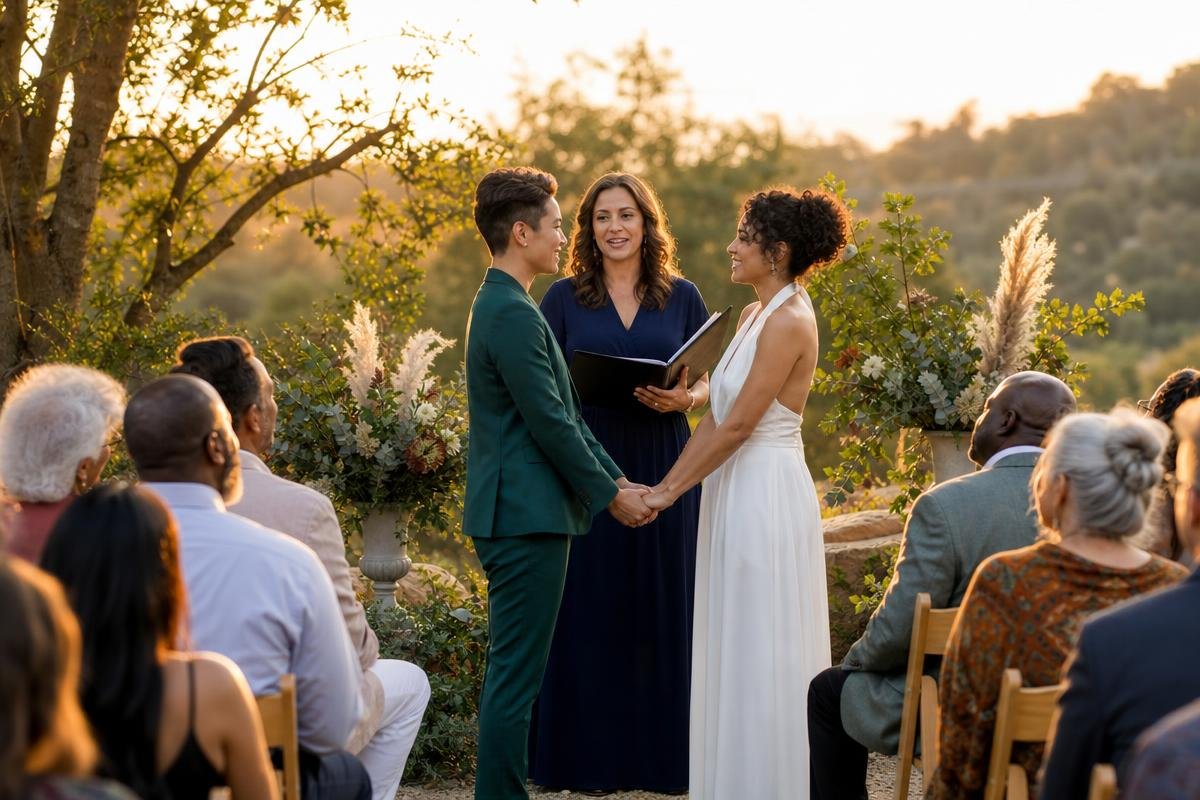
A spiritual but not religious wedding ceremony can be deeply meaningful without following a traditional faith structure. For an officiant, the challenge is not filling the ceremony with impressive language. It is listening carefully enough to discover what “spiritual” means to this particular couple.
One couple may think of nature, ancestors, or a sense of wonder. Another may mean love, shared values, personal growth, or quiet reflection. Some may want no spiritual language at all once they see how broad the word can be. Your job is to help them build a ceremony that feels honest, welcoming, and unmistakably theirs.

The Pluralism Project at Harvard University describes “spiritual but not religious” as a varied identity rather than one fixed belief system. Current Pew Research Center findings likewise show that people use spiritual and religious labels in different combinations. That is a useful reminder: never treat the phrase as a script template.
Start by asking what “spiritual” means to them
The first planning conversation should clarify the couple’s meaning, not just their preferred vocabulary. “Spiritual” can be a comfortable starting word, but it is not yet a ceremony plan.
Ask open questions such as:
- When you say spiritual, what experiences or ideas are you hoping to include?
- Are you drawn to nature, ancestors, energy, love, silence, gratitude, or something else?
- Are there words that feel especially true to your relationship?
- Are there words you do not want spoken during the ceremony?
- Would you like guests to participate, or should the ceremony remain observational?
- Do you want the ceremony to name a higher power, or should it stay fully secular?
Keep your tone curious rather than diagnostic. You are not asking the couple to defend their worldview. You are gathering the ingredients for a ceremony that will sound natural when spoken aloud.
Planning question: What do you want guests to feel or understand when the ceremony ends?

Example: “We want everyone to feel that our marriage is connected to the people, places, and choices that shaped us, but we do not want prayers or references to a specific religion.”
Short answer: Connection without formal religion.
Translate broad ideas into authentic ceremony language
Once you know what the couple means, help them move from abstract ideas to language that belongs to them. “The universe brought you together” may sound beautiful to one couple and vague or uncomfortable to another.
Build a shared word bank
Invite each partner to identify three to five words they would gladly hear in the ceremony. Look for overlap, then test those words in complete sentences.
For example, a couple may choose:
- Nature: seasons, rivers, rootedness, light, growth
- Ancestors: memory, inheritance, guidance, family stories
- Energy: presence, intention, movement, balance
- Love: devotion, friendship, patience, delight, courage
- Secular meaning: commitment, responsibility, partnership, trust
Do not assume that a word is welcome simply because it appears on a list of common spiritual vocabulary. Ask the couple to approve the meaning and the tone.
Read the language aloud
A phrase can look harmless on paper and feel too grand, mystical, or religious once spoken. Read a short sample aloud and ask whether it sounds like the couple, not whether it sounds poetic.
Useful test: If either partner would never say the sentence to a close friend, revise it. A ceremony can be elevated without becoming unnatural.
Choose elements that express meaning without borrowing carelessly
A spiritual ceremony does not need a ritual to feel significant. Sometimes a well-written welcome, a moment of silence, personal vows, or a clear statement of shared values is enough.
Possible elements include:
- A brief reflection on a meaningful landscape or place
- A moment of silence for absent or remembered loved ones
- Personal vows focused on daily choices and mutual care
- A reading from a poet, novelist, philosopher, or writer approved by the couple
- A shared statement of values such as curiosity, kindness, service, or resilience
- A symbolic exchange involving rings, handwritten promises, flowers, stones, or another personally meaningful object
- A guest blessing or collective affirmation written in the couple’s own language
Be especially careful with rituals associated with living religious, Indigenous, ethnic, or cultural communities. A practice may look attractive in a wedding magazine and still carry history, authority, or obligations that are not yours to casually reproduce. If the couple has a genuine relationship to a tradition, encourage them to consult an appropriate practitioner or community representative rather than treating a quick internet explanation as permission.
Use a decision guide for ceremony choices
When a couple is unsure whether an element belongs, walk through the purpose, language, and guest experience. This keeps the conversation practical instead of turning it into a debate about labels.
| Ceremony choice | Often works well when | Reconsider when |
|---|---|---|
| Nature imagery | The couple has a real relationship with a place, season, landscape, or outdoor setting. | The imagery is generic or makes claims about nature that the couple does not hold. |
| Moment of silence | The couple wants room for reflection, remembrance, or guest participation without prescribed beliefs. | The schedule is extremely compressed or the officiant gives no clear context. |
| Ancestor acknowledgment | The couple wants to honor family history or loved ones who cannot attend. | The language assumes all families are safe, supportive, or biologically connected. |
| Energy or universe language | Both partners use those ideas naturally and can explain what they mean. | One partner is agreeing only because the words sound fashionable or poetic. |
| Fully secular vows | The couple wants meaning grounded in promises, conduct, and shared life. | The officiant keeps adding spiritual language after the couple has declined it. |
The goal is not to make every ceremony fit one category. It is to make each choice explainable, respectful, and connected to the couple’s actual relationship.
Know what to avoid in the script
Avoid assumptions about belief
Do not assume that “spiritual” means belief in God, an afterlife, astrology, universal energy, reincarnation, or any particular understanding of nature. The Pew Research Center’s recent research on spiritual and religious self-descriptions shows that Americans combine these identities in varied ways. Your couple may be spiritual and religious, spiritual but not religious, neither, or still searching for language.
Avoid negative descriptions of religion
A ceremony can be nonreligious without criticizing religion. Phrases such as “we are free from outdated beliefs” may alienate guests and turn the ceremony into an argument. Keep the focus on what the couple affirms: love, responsibility, wonder, honesty, friendship, or a shared future.
Avoid overpromising what a ritual will do
Do not claim that a particular object, gesture, or spoken phrase guarantees protection, prosperity, healing, fertility, or lifelong harmony. A symbol can express intention; it cannot replace communication, accountability, or care.
Avoid writing one partner out
Some couples use “spiritual” language because one partner is comfortable with it and the other is not. Check every major phrase with both people. If their preferences differ, build a layered ceremony: use broadly accessible language in the main script and reserve more specific ideas for a reading, vow, or optional private ritual.
Officiant script checklist
- Both partners approved the central vocabulary.
- The opening explains the tone without labeling guests.
- Any reading or ritual has a clear purpose.
- No borrowed tradition is treated as decoration.
- Vows sound like the couple’s real voices.
- The ceremony leaves room for silence and emotion.
- Legal or filing requirements have been checked with the proper local authority.
Shape a ceremony that feels grounded
A dependable structure helps a spiritual ceremony feel intentional rather than improvised. You can adapt the order, but a simple framework usually works well:
- Welcome: Set an inclusive tone and name the gathering as a celebration of the couple’s commitment.
- Meaning: Offer a short reflection on the values, places, people, or experiences that matter to them.
- Recognition: Acknowledge family, friends, absent loved ones, or the wider community if the couple requests it.
- Promises: Invite personal vows or guide the couple through concise promises.
- Symbolic action: Exchange rings or include another approved gesture that reinforces the promises.
- Declaration: Close with language that reflects the couple’s wishes and the officiant’s role.
Keep the reflective portion focused. A spiritual ceremony does not become more meaningful because the officiant speaks at length. A few accurate sentences will usually serve the couple better than a long meditation built from generalities.
Handle legal and logistical questions separately
The ceremony’s spiritual style and the marriage’s legal requirements are related only in limited ways. Do not let a meaningful script conversation substitute for checking the marriage license, officiant authorization, filing process, witnesses, deadlines, or venue rules that may apply where the ceremony takes place.
For a starting point, direct couples and officiants to the OrdainedPro marriage-law map, then confirm details with the relevant government authority. Requirements can vary by jurisdiction and may change, so avoid making a universal statement about who may officiate or what makes a ceremony legally valid.
Keep your service agreement and ceremony design conversation clear as well. Spell out what is included, how many revisions are provided, when the final script is due, and who is responsible for supplying required paperwork. These practical details protect the couple’s experience and help you do the work calmly.
Finish with a script review, not a surprise
Send the couple a complete draft early enough for thoughtful review. Mark any lines that are intentionally flexible, such as the length of a moment of silence or the wording of a communal response.
Ask them to review three things:
- Truth: Does the ceremony accurately describe what they believe and value?
- Voice: Does it sound like language they would use or gladly hear?
- Welcome: Can guests participate without being pressured to adopt a belief?
A good final edit often removes more than it adds. Cut repeated uses of “journey,” “universe,” or “sacred” if they are not doing useful work. Replace broad promises with specific commitments. Let the couple’s real words carry the emotional weight.
Conclusion: let the couple define the meaning
The strongest spiritual but not religious wedding ceremony is not the one with the most unusual ritual or elevated language. It is the one where the couple recognizes themselves in every important choice.
Ask what spirituality means to them, confirm the words that feel authentic, treat cultural and religious practices with respect, and keep legal questions in their proper lane. Then write a ceremony that is warm, clear, and steady enough to hold the room when emotions rise. That is the real craft of officiating: helping two people make a public promise in language they can continue to believe.
Frequently Asked Questions
What is a spiritual but not religious wedding ceremony?
It is a wedding ceremony that draws on meaning, connection, reflection, nature, love, values, or personal beliefs without following the formal doctrine or required structure of a particular religion. The exact content should be defined by the couple.
What should an officiant ask a spiritual but not religious couple?
Ask what “spiritual” means to each partner, which words feel authentic, which words or references are unwelcome, whether they want nature, ancestors, energy, love, silence, or secular language, and how guests should participate.
Can a spiritual wedding ceremony include religious language?
It can, if both partners genuinely want that language and understand what it communicates. Do not assume that spiritual automatically means religious, or add references to God, prayer, scripture, or a faith tradition without explicit approval.
What rituals work well for a nonreligious spiritual wedding?
Possible choices include a moment of silence, personal vows, a meaningful reading, a nature reflection, an ancestor acknowledgment, a shared values statement, or a symbolic exchange. The couple should understand and approve the origin and meaning of any ritual.
How can an officiant avoid cultural appropriation in a spiritual ceremony?
Do not treat sacred or community-specific practices as interchangeable wedding decorations. Research the practice, ask whether the couple has a meaningful connection to it, and consult an appropriate practitioner or community representative when needed.
Does a spiritual but not religious ceremony meet marriage-law requirements?
Ceremony style and legal requirements are separate questions. Requirements for licenses, officiants, witnesses, filing, and other details can vary by jurisdiction, so check the relevant local government authority and use the OrdainedPro marriage-law map as a starting point.