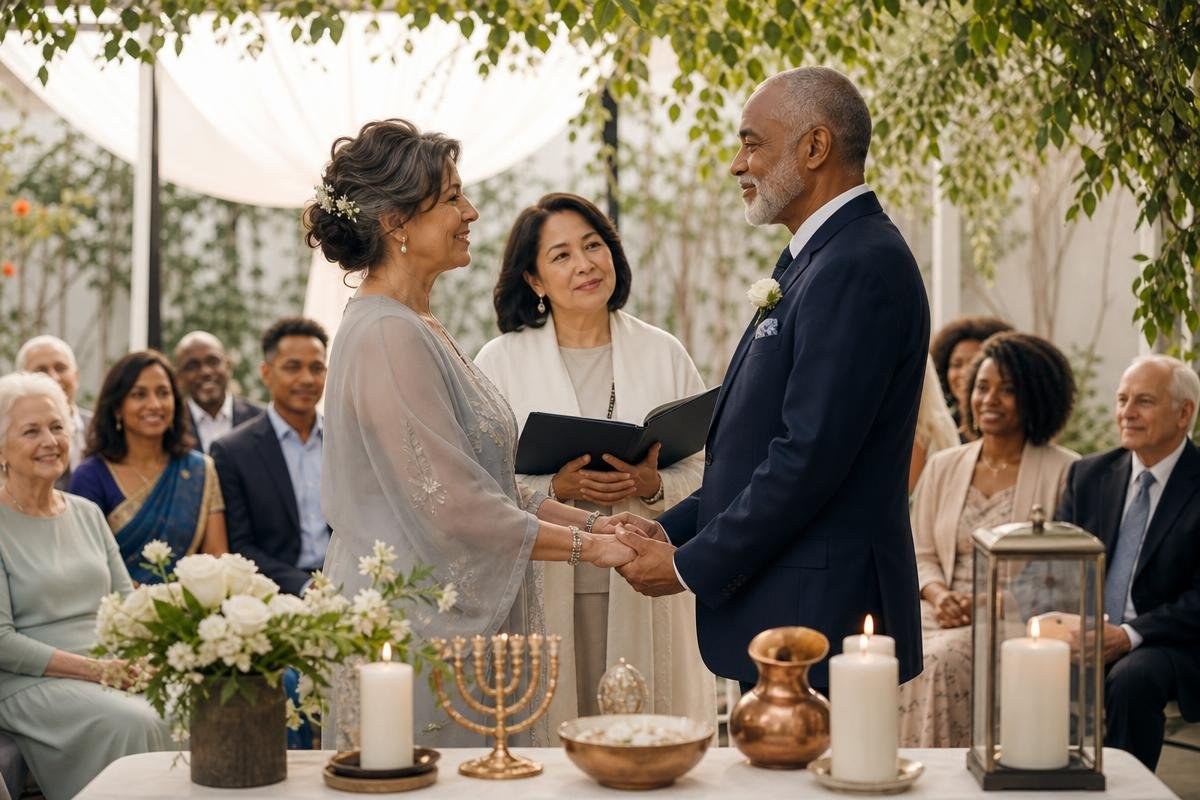
An interfaith vow renewal ceremony gives a couple room to honor where they began, recognize how life has changed them, and make fresh promises for the years ahead. It does not need to recreate the original wedding. In many cases, the most meaningful renewal ceremony is the one that honestly reflects the home, family, values, and beliefs the couple has built together.
For an experienced officiant, the assignment is simple to describe but important to handle well: create a ceremony where both people feel seen, neither tradition is treated as decoration, and the couple’s present-day marriage remains at the center.

Interfaith planning works best when it respects the distinctiveness of each tradition rather than blending everything into a vague spiritual mixture. That principle is consistent with guidance from Harvard’s Pluralism Project, which describes interfaith work as dialogue, understanding, and cooperation among different religious traditions while respecting each tradition’s particularity. Read the Pluralism Project’s overview of interfaith engagement.
Begin with the marriage they have now
A vow renewal is about more than repeating words from the wedding day. Start by learning what has changed: beliefs, family roles, spiritual practices, cultural traditions, and the couple’s understanding of commitment.
Use a simple discovery conversation
Ask each partner to answer these questions privately before the ceremony draft is written:
- What did we promise at the beginning that still feels true?
- What have we learned about love, partnership, or family since then?
- Which traditions still feel like home?
- Which traditions have we respectfully set aside?
- What do we want to promise for the next chapter?
Planning question: Which parts of your shared life deserve to be named in the ceremony besides your religious or cultural backgrounds?
Example: “We want to recognize the home we created, the way we supported one another through career changes, and the traditions we now celebrate with our children.”

Short answer: Home, resilience, family, and growth.
This conversation gives the officiant useful material for the welcome, reflection, vows, and closing blessing. It also prevents the ceremony from becoming a checklist of symbols with no connection to the couple’s actual life.
Choose a ceremony structure that feels balanced
A clear structure helps an interfaith vow renewal feel steady rather than crowded. You do not need to give every tradition equal minutes or use the same number of elements from each background. Balance means that both partners recognize themselves in the ceremony and understand why each element is present.
A practical ceremony order
- Welcome and gathering: Acknowledge the couple, their guests, and the meaning of renewing promises.
- Reflection on the years together: Name the experiences, qualities, and commitments that have shaped the marriage.
- Recognition of traditions: Include readings, blessings, music, symbols, or language that genuinely belong to the couple.
- Renewal promises: Invite the couple to speak updated vows rather than simply repeat the original ones.
- Symbolic ritual: Use one meaningful action to represent continuity, gratitude, unity, or future intention.
- Closing blessing or affirmation: End with words that welcome the couple into the next season of their life.
18Doors recommends explaining traditions and rituals so guests can understand what they are witnessing, acknowledging both faith backgrounds throughout the ceremony, and translating words spoken in another language. Those are especially helpful practices for a vow renewal, where some guests may be attending because of the couple’s long family history rather than because they already know the traditions involved. See 18Doors’ guidance on inclusive interfaith ceremonies.
| Couple’s priority | Helpful ceremony approach | Officiant’s planning note |
|---|---|---|
| Honor both religious backgrounds | Use one carefully chosen reading, blessing, or ritual from each tradition. | Confirm pronunciation, meaning, permission, and appropriate context with a qualified representative when needed. |
| Focus on shared values | Build the ceremony around gratitude, compassion, family, service, and future promises. | Use inclusive language without implying that all faiths teach the same thing. |
| Include children or family | Invite them to offer readings, carry symbolic objects, or make a family promise. | Give each participant a clear role and a short explanation. |
| Keep the ceremony intimate | Choose one central ritual and let the couple’s story carry the emotional weight. | Avoid adding traditions simply to fill time or appear balanced. |
Ideas for meaningful interfaith rituals
The strongest ritual is one that the couple understands and would continue to value after the ceremony. A renewal is a good place to revisit a familiar symbol, adapt a family practice, or create something new together.
Renewed vows with a shared promise
Invite each partner to write two short sections: one promise grounded in the years already lived and one promise for the years ahead. This creates a natural bridge between gratitude and commitment.
For example, a partner might promise to keep making room for honest conversation, to protect the family’s peace, or to remain curious about how the other person is changing. Encourage specific language. “I will love you forever” is sincere, but “I will keep choosing patience when life gets loud” gives the promise a shape guests can feel.
Two candles and one shared light
Each partner can light a candle representing an individual identity, family, or tradition. Together, they can light a third candle representing the life they have built. The officiant should explain that the shared light does not erase either person’s identity.
A blessing over wine, tea, water, or another meaningful drink
If a blessing over a drink belongs to one partner’s tradition, the couple may choose to include it with a clear explanation and appropriate guidance. If a religious blessing would not be suitable, the couple can instead offer a secular toast expressing gratitude for their years together.
A family or community blessing
Invite loved ones to speak one sentence each: a hope, a word of encouragement, or a blessing for the couple’s future. This works particularly well when the couple’s faith practices have evolved and their community includes people from several backgrounds.
A written renewal document
Some couples create a personal covenant, family statement, or artistic document to sign and display at home. It can include promises about hospitality, caregiving, parenting, holidays, service, or how the couple will handle difficult seasons. Do not describe a personal document as a legal contract unless a qualified professional has reviewed that claim.
Honor traditions without turning them into props
Interfaith ceremonies can go wrong when a symbol is chosen because it looks beautiful or sounds familiar, but the couple does not understand its meaning or has no relationship to the community that practices it.
Use a respect-first review
- Confirm the meaning: Learn what the ritual signifies within its tradition.
- Ask who may lead it: Some prayers, blessings, objects, or ceremonies may have community-specific requirements.
- Check the language: Use accurate pronunciation and provide a translation when appropriate.
- Discuss family concerns early: A parent or elder may know a custom has a meaning the couple has not considered.
- Do not force symmetry: One partner may want a religious element while the other prefers a cultural or secular expression.
Use caution: Do not present a ritual as universally acceptable across a religion, denomination, culture, or family. Religious authority and community expectations vary, so the couple should consult an appropriate clergy member, teacher, elder, or cultural advisor when a tradition has specific requirements.
The goal is not to make every guest agree with every belief. The goal is to help guests understand what the couple is choosing and why that choice matters to their marriage.
Write language for evolving beliefs
Many couples seek a vow renewal because their beliefs have changed. One person may now practice differently. Both partners may have become more spiritual, less religious, or more connected to family traditions than formal institutions. The ceremony can acknowledge that change without making either person defend it.
Use language that leaves room to grow
Helpful phrases include:
- “The traditions that have guided us…”
- “The values we continue to carry…”
- “The wisdom we have received from our families…”
- “The practices that bring us peace and purpose…”
- “The promises we choose freely today…”
If the couple wants explicitly religious language, use the names, prayers, and blessings they genuinely want. If they prefer a broader ceremony, speak about conscience, gratitude, hope, compassion, and the sacredness of commitment without pretending those words mean the same thing to every person in the room.
Research and professional guidance about relationships often treat marriage as an ongoing, committed relationship shaped by the partners’ influence on one another. That makes a renewal ceremony a natural opportunity to name not only the wedding promise, but also the continuing work of partnership. Review the American Psychological Association’s relationship resources.
Prepare the officiant, participants, and guests
A calm ceremony usually comes from practical preparation rather than last-minute inspiration. Give the couple a draft early enough to discuss language, pronunciation, readings, and family roles.
Use this preparation checklist
- Confirm how each partner describes their current beliefs and traditions.
- Identify which rituals are essential, optional, or off-limits.
- Verify names, pronunciations, translations, and titles.
- Ask whether children, parents, elders, or friends will participate.
- Decide whether guests need a printed explanation of the ceremony.
- Rehearse movement for candles, rings, documents, readings, or family blessings.
- Prepare a shorter version in case the couple becomes emotional or the schedule changes.
If guests will hear Hebrew, Arabic, Sanskrit, Latin, another heritage language, or a less familiar form of prayer, provide a translation or plain-language explanation. A program can include the name of the ritual, its basic meaning, and why the couple selected it.
Keep the couple’s private history private. A vow renewal may involve illness, grief, relocation, infertility, estrangement, financial hardship, or reconciliation. Ask permission before including any sensitive detail, and never assume a difficult chapter should be made public simply because it shaped the marriage.
Close with gratitude and a forward-looking promise
The ending should feel like a beginning, not a conclusion. After the vows and ritual, invite the couple to name one hope for the next season. It might be more time together, a welcoming home, continued service, deeper patience, or the courage to keep learning from one another.
A strong closing can be brief:
“May the life you have built continue to make room for difference, delight, honesty, and rest. May the traditions you carry remind you where you come from, and may the promises you renew today guide the home you continue to create.”
Then offer a clear final affirmation, such as: “With gratitude for the years behind you and hope for the years ahead, may you continue to choose one another with care.”
When you plan an interfaith vow renewal ceremony, keep returning to three questions: What has this couple lived through? What do they value now? What are they willing to promise next? Let the answers shape the ceremony, and the result will feel personal, respectful, and steady.
Frequently Asked Questions
What should an interfaith vow renewal ceremony include?
A meaningful ceremony usually includes a welcome, reflection on the couple’s shared years, recognition of their traditions, renewed vows, one or two intentional rituals, and a closing blessing or affirmation. The exact elements should reflect the couple’s current beliefs and relationship.
Can an interfaith vow renewal include religious readings from both traditions?
Yes, if both partners genuinely want them and the readings are used accurately and respectfully. Confirm pronunciation, translation, meaning, and any community-specific expectations with an appropriate religious or cultural advisor.
How can couples include children in a vow renewal?
Children can offer a reading, carry candles or family objects, participate in a family blessing, or help create a written family promise. Give each child a simple role that feels comfortable rather than making participation a performance.
Should an interfaith vow renewal repeat the original wedding ceremony?
It does not have to. Many couples use the renewal to acknowledge how their beliefs, family, and marriage have evolved. Updated vows and a reflection on the years together can make the ceremony feel more honest than repeating the original script.
How long should an interfaith vow renewal ceremony be?
The right length depends on the couple, guests, and number of participants. A focused ceremony with a few meaningful elements is often easier to follow than one that tries to represent every tradition or family custom.
Can a vow renewal be religious, spiritual, secular, or a blend?
Yes. The ceremony can use explicitly religious language, broad spiritual language, secular promises, or a carefully explained combination. The important point is that the language accurately reflects the couple rather than making assumptions about what they believe.