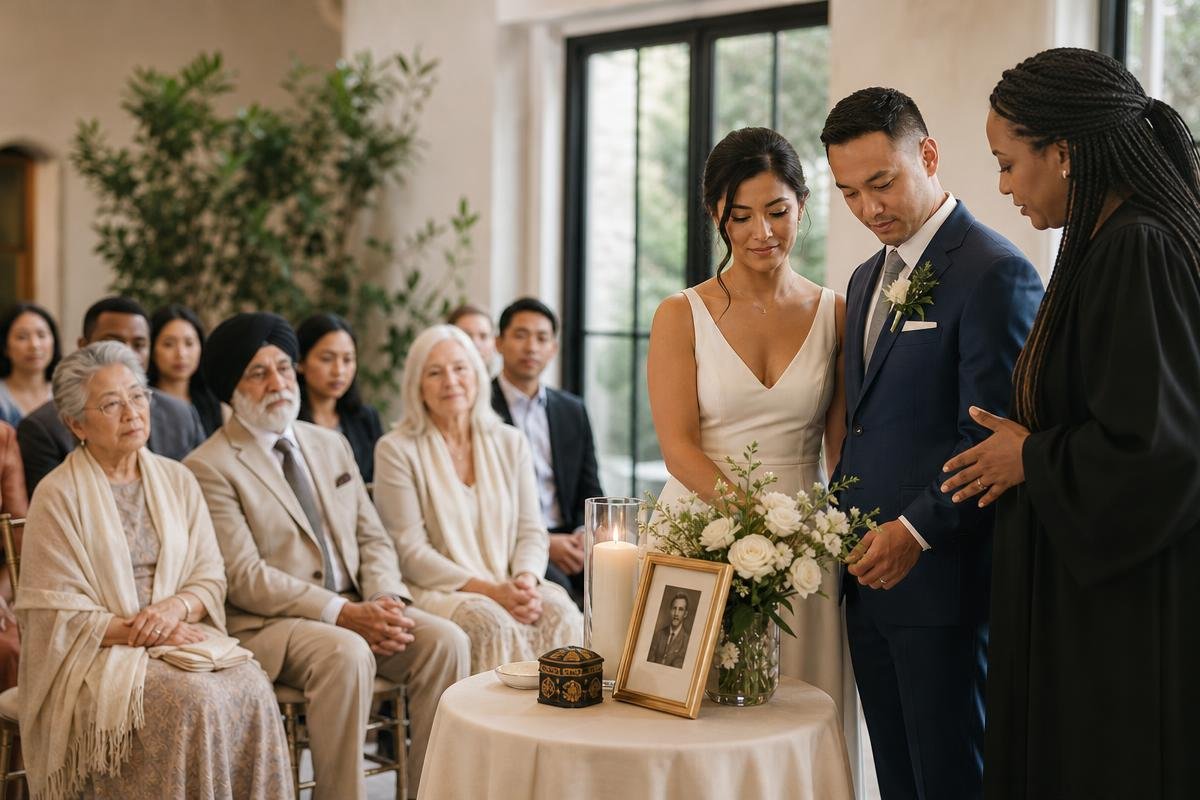
How to Honor Loved Ones from Different Faiths During a Wedding
When a wedding brings together people from different faiths, it can also bring together different ideas about memory, family, prayer, grief, and tradition. An interfaith wedding memorial does not need to choose one family’s customs over another’s. With thoughtful planning, it can create a shared moment that honors the people who helped shape the couple’s lives.
As the officiant, your job is not to speak for every religion in the room. Your job is to listen carefully, avoid assumptions, and help the couple choose a form of remembrance that feels honest and welcoming. A name, a candle, a flower, a piece of music, or a quiet pause can carry deep meaning when it is chosen with care.

The Harvard Pluralism Project offers background resources on many religious traditions, while Interfaith America encourages event planners to ask questions rather than assume they already understand every practice. Those are good habits for wedding officiants, too. Use the Pluralism Project as a research starting point, then confirm important details with the couple and, when appropriate, a trusted religious leader.
Begin with the couple’s meaning, not a list of rituals
Before suggesting candles or readings, find out what the couple wants the memorial moment to communicate. Some couples want to say, “We wish they could be here.” Others want to express gratitude for a person’s influence, acknowledge a family’s continuing bond, or make room for grief without changing the joyful tone of the ceremony.
Ask a useful planning question: What should guests understand about the loved ones being remembered when this moment is over?
Example: “We want our grandparents to be remembered as part of the family story, but we do not want the ceremony to feel like a funeral.”
Short answer: Gratitude without turning mournful.

That answer gives you direction. You might recommend a brief acknowledgment, a favorite piece of music, or flowers placed near the ceremony space instead of a long spoken tribute. If the loss is recent, ask whether the couple wants the names spoken aloud and whether particular family members should be warned about the moment in advance.
Check religious and cultural preferences before choosing the form
There is no universal interfaith memorial ritual. A candle may feel comforting to one family and religiously inappropriate or emotionally difficult to another. A prayer may be welcome, while a reading from a sacred text may need approval from a clergy member. Even a seemingly neutral action, such as placing food or incense near a photo, can carry meanings that vary widely across communities.
When the couple identifies with a specific tradition, encourage them to ask an appropriate religious authority about boundaries and preferred language. For example, the Catholic wedding guidance published by Ave Maria Press explains that a memorial candle or flower may be appropriate in some Catholic wedding settings, but it also advises couples to discuss the choice with the priest or deacon presiding. That is a useful reminder: a familiar wedding custom is not automatically permitted in every religious ceremony.
For Jewish couples, Reform Judaism recommends involving cherished elders, explaining unfamiliar rituals, translating Hebrew blessings, and using meaningful family objects when appropriate. These suggestions are especially helpful when the officiant is guiding guests from more than one background. Review Reform Judaism’s guidance on inclusive interfaith weddings before making assumptions about Jewish participation.
Choose a remembrance that fits the ceremony’s tone
Once you understand the couple’s intention and any religious boundaries, help them choose a format. The best choice is usually simple enough for guests to understand without a long explanation.
| Memorial option | Works well when | Planning consideration |
|---|---|---|
| Names and a brief acknowledgment | The couple wants a clear, low-profile tribute | Confirm pronunciation and the exact wording |
| Moment of silence | Families prefer a broadly accessible gesture | Tell guests when the silence begins and ends |
| Candle or flower | A visual symbol feels meaningful and permitted | Check venue safety and religious preferences |
| Photo, heirloom, or object | A person’s presence is best represented physically | Assign someone to transport and protect it |
| Reading, poem, or music | The loved one is strongly connected to words or sound | Check copyright, translation, tone, and length |
| Family participation | The couple wants remembrance to be shared | Offer a clear role and a backup plan |
Names and a short acknowledgment
This is often the most flexible option. You might say, “Before we continue, we pause to remember the loved ones whose care, wisdom, and love helped bring these two people to this day.” The couple may then name one person, several people, or a group such as “our grandparents and friends who are no longer with us.”
Silence, music, or a reading
A quiet pause can include guests who do not share the couple’s religious beliefs. Music can be especially effective when a loved one had a favorite song, played an instrument, or valued a particular tradition. A reading may come from a sacred text, a poem, a family letter, or a secular work. If the words come from a faith tradition, explain them briefly and make sure the couple is comfortable with the interpretation.
Candles, flowers, and meaningful objects
A memorial candle, a single flower, a photograph, a recipe card, a book, or a small heirloom can give the moment a physical center. The object does not need to be displayed as though it represents an entire religion. It can simply represent a person’s place in the couple’s story.
Invite family participation without putting anyone on the spot
Family involvement can make remembrance feel warm and shared, but it should never become an obligation. Some relatives may be honored to read a passage or place a flower. Others may be too emotional, uncomfortable with public speaking, or uncertain about participating in a ceremony shaped by another faith.
Offer choices. A family member might carry an object during the processional, place flowers before guests arrive, provide a song, sign the ceremony program, or help prepare a remembrance table at the reception. Participation can happen privately as well as publicly.
Interfaith wedding resources from 18Doors recommend involving family and friends in planning, explaining unfamiliar traditions in the program, translating non-English portions, and choosing rituals that are meaningful without excluding guests. Read the 18Doors guide to interfaith wedding ceremonies for additional ideas about shared participation and clear explanations.
Officiant’s memorial planning checklist
- Confirm every name and pronunciation.
- Ask which religious words or gestures are welcome.
- Decide who will speak, carry, light, place, or play something.
- Keep a backup reader or backup plan.
- Check venue rules for candles, flowers, music, and objects.
- Tell the couple exactly where the memorial appears in the ceremony.
- Give participants a printed script and rehearsal time.
Use inclusive language that does not make assumptions
Memorial language should be specific enough to feel sincere and open enough to include guests with different beliefs. Be careful with phrases such as “watching over us,” “present in spirit,” or “in heaven.” Some families may find those words beautiful; others may not share that theology.
When you do not know the preferred language, use the couple’s own words. For example:
“Today, Alex and Jordan remember the loved ones whose guidance, humor, courage, and affection remain part of their lives. Though those people cannot be with us in person, their influence is woven into the family and marriage being celebrated today.”
This kind of wording honors memory without declaring what happens after death. If the couple wants a more explicitly religious statement, let them provide the language or ask their religious advisor to approve it.
Also consider accessibility. If a reading is delivered in another language, provide a translation in the program or have the officiant explain its meaning. If guests are invited into a ritual, make participation optional unless the tradition and couple clearly intend otherwise.
Place the memorial moment where it will serve the ceremony
Location matters. A remembrance at the opening can acknowledge absent loved ones before the couple moves into the celebration. A moment before the vows can connect family history to the promises being made. A quiet gesture after the pronouncement can let the ceremony end with gratitude rather than sadness.
There is no single correct placement. Think about emotional pacing. If the couple expects tears, avoid placing the memorial immediately before a reading or vow that requires a nervous participant to speak. If the tribute includes a candle or object, build in enough time for people to move safely and without confusion.
A program note or welcome sign can also carry part of the remembrance. This may be the right solution when the couple wants to honor someone without speaking about loss during the ceremony. A reception display, photo table, special dessert, favorite song, or family toast can continue the tribute in a less formal setting.
Interfaith America’s guidance for faith-friendly events emphasizes thoughtful planning, asking questions, and making space for different worldviews. Its article on creating meaning in marriage also shows how couples may combine personal, family, cultural, and religious memories without treating one ritual as the only valid path. Review Interfaith America’s faith-friendly event guidance and its reflection on creating meaning in marriage.
Rehearse the details and protect the couple’s emotional space
A memorial can be brief and still require careful rehearsal. Practice the pronunciation of names, the movement of participants, the placement of objects, and the timing of music. If a person may become overwhelmed, agree on a signal that lets the officiant move forward gently.
Do not pressure anyone to improvise a eulogy. A short prepared sentence is often kinder than an open invitation to “say a few words.” Keep tissues and water nearby, but do not make grief the visual focus of the ceremony. The goal is to honor the loved ones while continuing to celebrate the couple’s commitment.
If the loss is very recent or the family is struggling intensely, encourage the couple to seek support from trusted people in their community. The officiant can listen and provide steady ceremony guidance, but should not present the wedding ceremony as a substitute for professional or pastoral support.
Conclusion: Make the remembrance simple, true, and shared
A meaningful interfaith wedding memorial does not need to combine every tradition in equal measure. It needs to reflect the couple’s values, respect the families involved, and give guests a clear way to understand the love being remembered.
Start with the couple’s intention. Check religious and cultural preferences. Choose one or two fitting gestures. Explain unfamiliar elements. Rehearse the details. When you do those things well, the memorial will feel less like a performance and more like what it is: a gracious place in the ceremony for the people whose lives helped make this day possible.
Frequently Asked Questions
What is an interfaith wedding memorial?
An interfaith wedding memorial is a planned moment that honors loved ones who cannot attend, often because they have died, while respecting the couple’s different religious, cultural, or nonreligious backgrounds. It may include names, silence, music, flowers, candles, readings, objects, or family participation.
Can an interfaith wedding memorial include a religious prayer?
Yes, if both partners are comfortable with it and the prayer is appropriate for the ceremony setting. Confirm the wording and any restrictions with the relevant religious leader when the ceremony includes formal religious elements.
What are respectful nonreligious memorial options for a wedding?
Couples can name loved ones, observe a moment of silence, play meaningful music, display a photograph or heirloom, place flowers, include a family reading, or add a remembrance note to the ceremony program or reception.
Should the officiant mention deceased loved ones by name?
Only if the couple wants that. Confirm the exact names, pronunciations, and wording in advance. Some couples prefer a general acknowledgment, while others find naming specific people especially meaningful.
How can family members participate in an interfaith wedding memorial?
They may read a short passage, carry or place a flower, provide music, share a prepared sentence, bring a meaningful object, help create a remembrance display, or participate privately before the ceremony. Participation should be invited rather than pressured.
Where should a wedding memorial moment appear in the ceremony?
It may fit near the welcome, before the vows, during a reading, or near the conclusion. Choose the placement based on emotional pacing, participant comfort, and any religious requirements of the ceremony.