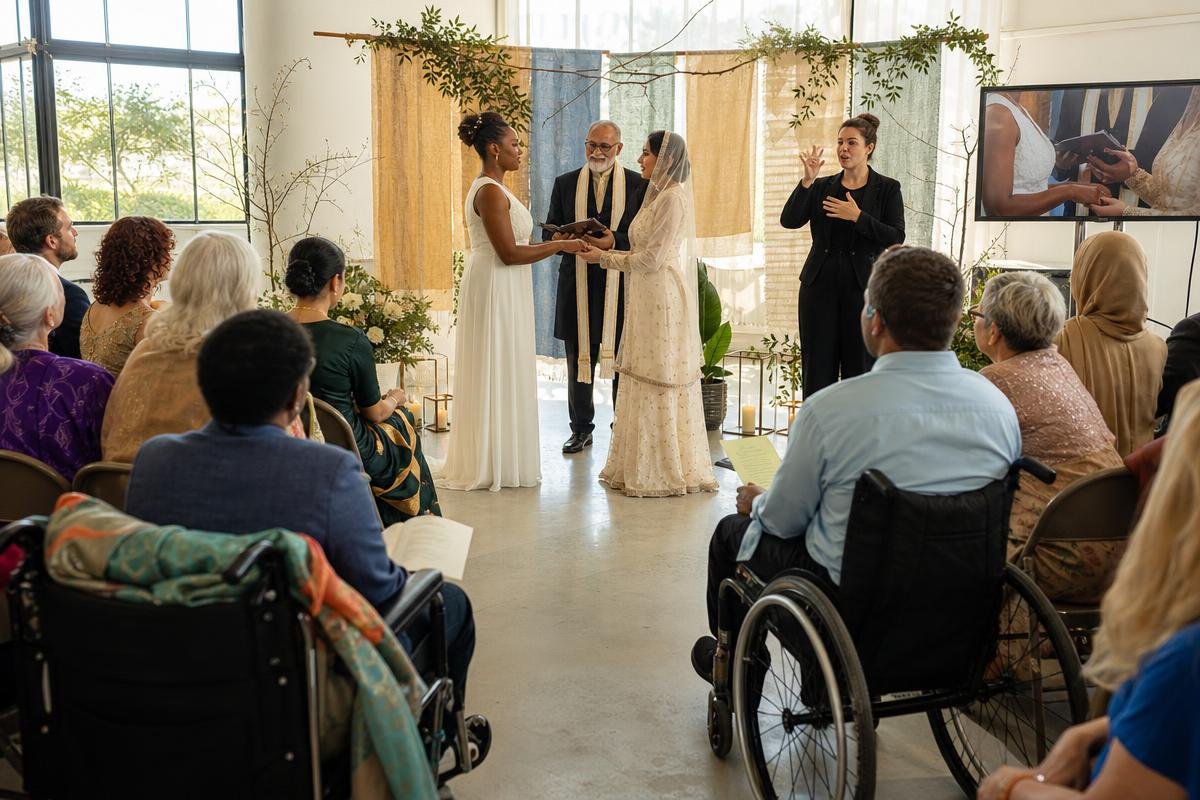
An accessible interfaith wedding is more than a ceremony that avoids religious language. It is a gathering where people with different beliefs, bodies, communication styles, and comfort levels can participate with dignity.
As the officiant, you do not have to solve every access need alone. Your job is to ask thoughtful questions early, coordinate with the couple and venue, and make sure the ceremony does not quietly exclude anyone. A few practical changes—clear communication, flexible seating, readable materials, and respectful ritual choices—can make a lasting difference.

1. Start with the couple’s definition of welcome
Interfaith couples may be balancing family traditions, religious expectations, secular values, and different ideas about what makes a ceremony meaningful. Accessibility belongs in that same conversation. It affects who can hear the promises, reach the ceremony space, follow the ritual, eat comfortably, and receive the final text.
Ask the couple which guests should be considered when planning access. They may mention someone who uses a wheelchair, a family member who is hard of hearing, a guest with a service animal, or relatives who need a quiet place to regroup. They may also identify needs that are not immediately visible, such as fatigue, chronic pain, sensory sensitivities, or difficulty processing fast spoken instructions.
Useful planning question: Which guests should be able to participate fully, and what might make that difficult at this venue?
Example: “We want my grandfather to sit near the front, my sister to follow the ceremony through captions, and both families to understand when a ritual is optional rather than required.”
Short answer: Plan for participation, not appearance.

Use person-first or identity-first language according to each person’s preference. Do not guess what someone needs based on a diagnosis or visible mobility aid. Ask, “What would make this easier for you?” and let the person answer directly.
2. Walk the venue as if you were a guest
A venue may describe itself as accessible while still creating difficult moments for a real ceremony. Before approving the layout, walk the complete guest route: parking or drop-off, entrance, restrooms, ceremony seating, ritual area, reception space, and exit.
Look for more than a ramp. Check whether doors are easy to open, pathways are wide enough for mobility devices, thresholds are manageable, and the ceremony platform can be reached without stairs. If the couple or a participant is expected to come forward, that route should be accessible too. Avoid asking someone to be carried onto a stage or moved through a back entrance unless they specifically choose that option.
Seating deserves careful attention. Preserve open spaces for wheelchairs and scooters without separating guests from their families. Offer chairs with arms for people who need support when standing, and keep a few seats near the front available for guests who need to see an interpreter, captions, the officiant’s face, or visual ritual details.
Keep aisles clear of décor, cords, floral arrangements, candles, and camera equipment. If the ceremony includes a processional, decide in advance whether everyone can use the same route and whether the pace allows people to move safely.
| Planning area | Ask the venue | Practical ceremony response |
|---|---|---|
| Mobility | Can guests reach every required area without stairs? | Use an accessible route for seating, rituals, photographs, and restrooms. |
| Seating | Can wheelchair spaces be placed with family and friends? | Remove chairs as needed and protect clear floor space. |
| Hearing and vision | Where can guests see faces, captions, interpreters, and ritual objects? | Adjust lighting, seating, microphone placement, and sightlines. |
| Sensory needs | Is there a quieter area away from music and crowd movement? | Identify a calm room or low-stimulation seating option. |
| Service animals | Can an animal enter and move safely through the venue? | Keep routes clear and brief staff without making the guest explain repeatedly. |
3. Make the spoken ceremony easier to hear, see, and follow
Good sound is essential at an interfaith wedding because the ceremony may include unfamiliar names, blessings, readings, translations, and ritual instructions. Use a microphone even for a small room, and test it from the seating areas rather than only from the officiant’s position.
Speak at a steady pace. Pause between sections. Announce who is speaking, explain what is happening before a ritual begins, and avoid turning away from the audience while reading. If music is used, reduce its volume during spoken portions and make sure it does not cover vows or instructions.
Guests may need captions, an interpreter, assistive listening equipment, large-print text, Braille, an electronic document, or a printed script. The appropriate option depends on the person and the complexity of the ceremony. The ADA National Network notes that effective communication may include qualified interpreters, real-time transcription, captioning, written materials, assistive listening systems, large print, Braille, and accessible electronic formats. The U.S. Department of Justice explains effective communication requirements, and the ADA National Network’s event-planning guide offers practical considerations for seating, interpreters, captions, printed materials, and event routes.
Do not assume that a family member can serve as an interpreter. If a guest requests a qualified interpreter or real-time captioning, coordinate early with the couple, venue, and service provider. Place the interpreter where guests can see both the interpreter and the speaker, with good lighting and a visually calm background.
Accessible ceremony copies are helpful even when no formal accommodation has been requested. Consider providing:
- A plain-text or accessible digital version.
- A large-print version with strong contrast.
- A concise ceremony outline with speaker names and ritual cues.
- Translations of readings, blessings, or non-English phrases.
- A pronunciation guide for names and sacred terms.
Share the final version with the couple and any interpreter or captioner before the wedding. Last-minute wording changes can make communication access harder.
4. Design interfaith rituals with genuine choice
Inclusion is not achieved by placing several religious symbols on a table and asking everyone to participate. A respectful interfaith ceremony explains the meaning of each ritual and makes room for guests who relate to it differently.
Work with the couple to identify what is essential, what is optional, and what should be left out. A ritual may be adapted so the couple participates while guests observe. A blessing may be offered as an invitation rather than a requirement. A reading may be introduced with enough context that people understand its importance without being pressured to affirm beliefs they do not share.
Consider physical participation as well. If a ritual traditionally involves standing, kneeling, walking, touching an object, lighting a candle, sharing food, or holding hands, provide equivalent ways to take part. A guest should not have to disclose a disability in front of the room to remain included.
Lead-in language can help: “The couple will now light two candles as a symbol of their families joining. Guests are welcome to watch, reflect, or participate in whatever way feels appropriate.”
Ask faith representatives or cultural advisers to review traditions that are not your own. Do not improvise sacred language, combine symbols without understanding their meaning, or use a ritual simply because it looks beautiful in photographs. The couple’s communities should help determine what is appropriate, authentic, and respectful.
5. Plan for sensory comfort, food, and service animals
A ceremony can be physically accessible and still overwhelming. Bright lighting, amplified music, incense, crowded receiving lines, strong fragrances, and sudden applause may create barriers for guests with sensory sensitivities or neurological conditions.
Tell guests in advance what to expect. If the ceremony includes loud music, flashing effects, incense, or a long period without a break, say so plainly. Ask the venue whether a quieter room or lower-stimulation area can be available. Keep the route to that space clear, and make sure leaving or returning does not attract unnecessary attention.
Food is part of inclusion, particularly when interfaith families follow different dietary practices. Ask the couple to identify religious, ethical, allergy-related, and medical dietary considerations with the caterer. Label dishes clearly, prevent cross-contact where the caterer has promised to do so, and make sure guests can reach food and water without navigating a crowded buffet.
Service animals should be treated as working animals, not as wedding entertainment. The ADA explains that service animals are generally dogs individually trained to perform work or tasks for a person with a disability, with limited provisions for miniature horses. Review the Department of Justice guidance on service animals and make sure venue staff understand that the animal should not be petted, fed, distracted, or separated from its handler without a legitimate safety reason.
6. Give the officiant’s team a simple access plan
Even a well-planned ceremony can fail if the wedding party, ushers, musicians, photographers, and venue staff do not know the plan. Create a one-page access brief. Include the accessible entrance, reserved seating, restroom location, quiet space, interpreter or captioning location, microphone instructions, service-animal expectations, and the person who handles questions.
Assign one calm point person rather than asking the couple to solve problems while preparing to marry. That person can confirm that aisles remain clear, captions are visible, the microphone works, and accessible seats are not taken by early-arriving guests.
Use neutral, respectful language. Staff should offer help without grabbing a mobility device, touching a person, moving a service animal, or speaking to a companion instead of the guest. A simple “Would you like assistance?” is better than an assumption.
Final access check
- Confirm the full route from arrival through departure.
- Test microphones, captions, lighting, and interpreter sightlines.
- Prepare large-print and accessible digital ceremony copies.
- Protect wheelchair spaces and companion seating.
- Review rituals, dietary needs, sensory considerations, and service-animal expectations.
- Name one person to handle access questions on the wedding day.
7. Keep the ceremony welcoming without making access feel like a spectacle
The best accessibility planning is often quiet. It gives people options without making them explain themselves publicly. Instead of announcing that a guest has an accommodation, say that accessible seating, ceremony copies, captioning, or a quiet space are available.
Build pauses into the ceremony. Allow extra time for people to move, respond, sign, read, or process instructions. Do not rush through a ritual because the schedule is tight. A ceremony that is a few minutes slower can be far more meaningful than one that leaves guests behind.
After the rehearsal, check the plan with the couple and any participants who requested access support. Ask what still feels difficult. Then make the final adjustment while there is time to do it well.
Conclusion: Make belonging part of the ceremony
An accessible interfaith wedding does not require every tradition to be included or every need to be anticipated perfectly. It requires humility, preparation, and a willingness to listen. Walk the venue, clarify the ritual choices, provide communication access, protect physical routes, and give guests more than one way to participate.
Your steady attention can help the couple honor their beliefs without asking anyone else to leave part of themselves at the door.
Frequently Asked Questions
What makes an interfaith wedding ceremony accessible?
An accessible interfaith ceremony considers mobility, seating, sound, captions, interpreters, sensory needs, service animals, dietary practices, ritual participation, and accessible ceremony materials. It also gives guests respectful choices instead of assuming everyone can participate in the same way.
Should an officiant provide a written copy of the ceremony?
Providing an accessible copy is often helpful. Consider a plain-text digital file, large-print version, ceremony outline, translated readings, and pronunciation guide. Share the final text with the couple and any interpreter or captioner before the wedding.
How can an officiant make interfaith rituals more inclusive?
Explain the meaning of each ritual, identify whether participation is optional, and offer equivalent ways to take part. Guests may observe, reflect, remain seated, use an alternative object, or participate privately rather than following a single physical or religious format.
What should an officiant ask an accessible wedding venue?
Ask about the complete guest route, accessible parking or drop-off, entrances, restrooms, ceremony seating, stage or ritual access, interpreter sightlines, captioning, sound, quiet areas, food service, and service-animal access. Confirm specific features instead of relying only on the word accessible.
Can family members interpret a wedding ceremony?
A family member may be preferred in some personal situations, but do not assume a relative can provide effective interpretation for a formal ceremony. Ask the guest what communication method works best and coordinate qualified interpreting or captioning services when needed.