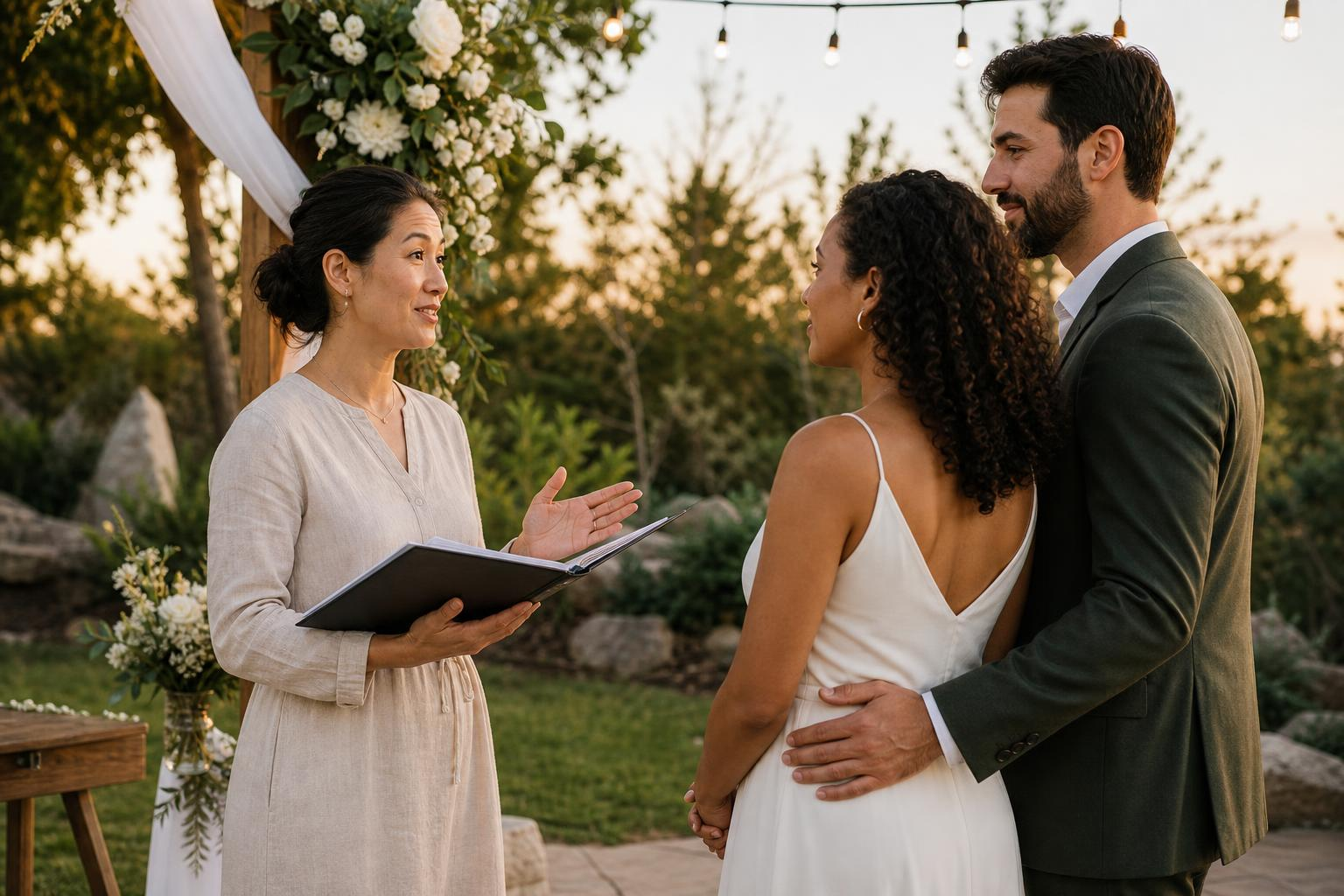
Being asked to officiate a wedding for a friend or family member is a meaningful honor—and a real responsibility. You are not only standing in front of the room. You are helping the couple mark an important commitment, guide their guests through the moment, and possibly complete legal paperwork afterward.
The good news is that you do not need to become a professional performer overnight. With steady preparation, a clear ceremony plan, and a careful approach to local requirements, you can do the job warmly and confidently.

1. Confirm what the couple wants from you
Before you write a word, have a planning conversation with both partners. Your job is to understand the kind of ceremony they want—not to create the ceremony you would personally choose.
Ask the questions that shape the ceremony
- Do they want a religious, spiritual, secular, or blended ceremony?
- How long should the ceremony feel?
- Will they write personal vows, repeat traditional vows, or use both?
- Are there family, cultural, or religious traditions they want included?
- Are there topics, jokes, names, or stories they want you to avoid?
- Who should participate through readings, blessings, music, or symbolic rituals?
- Should the tone be formal, relaxed, humorous, sentimental, or a mixture?
Planning question: What should guests feel when the ceremony ends?
Example: “We want everyone to feel welcomed, especially relatives who may not know one another well. We would like the ceremony to be warm and lightly humorous, but not overly casual.”
Short answer: Welcoming, warm, lightly humorous.
Write down the couple’s answers and send them back in a short summary. That simple step prevents misunderstandings later and gives you a reliable creative brief.

2. Handle the legal preparation early
A beautiful ceremony does not automatically make a marriage legally recognized. The couple must follow the rules of the jurisdiction where the ceremony takes place, and those rules can differ by state, county, city, license type, and personal circumstances.
For a general starting point, USAGov explains the difference between a marriage license and a marriage certificate. A license generally authorizes the marriage process, while a certificate serves as evidence that the marriage occurred. USAGov also notes that license expiration periods vary by issuing state.
The couple—not you—should confirm the current requirements with the office that issues the license. That may be a county clerk, city clerk, probate court, registrar, or another local authority. OrdainedPro’s marriage-law and officiant-requirement starting point can help them begin that research.
Confirm these details before the wedding week
- Where the couple is obtaining the license.
- Whether you are authorized to solemnize the marriage there.
- Whether an ordination, registration, application, appointment, or credential filing is required.
- Whether witnesses are required and, if so, how many.
- Whether the license has a waiting period or expiration date.
- Who must return the completed license and how it must be submitted.
- Whether the ceremony must occur in a particular location or with specific people physically present.
Do not rely on a general internet statement that “online ordination is valid everywhere” or that “officiants never need to register.” Those rules are jurisdiction-specific. For example, official requirements differ among places such as Utah County, Hennepin County, Minnesota, and the District of Columbia.
This article is educational and is not legal advice. If the couple has unusual circumstances—such as a destination ceremony, prior marriages, special license type, immigration concerns, or questions about authority—they should contact the appropriate government office or a qualified attorney.
3. Build a ceremony structure that feels natural
Most ceremonies become easier to write when you use a simple sequence. You can adjust the language and traditions, but the structure gives everyone a dependable path through the moment.
| Ceremony element | Purpose | Preparation note |
|---|---|---|
| Welcome and opening | Gather attention and set the tone | Keep it clear, personal, and brief |
| Reflection or story | Connect the couple’s relationship to the moment | Use only stories approved by both partners |
| Readings, blessings, or rituals | Include family, culture, faith, or symbolism | Confirm names, pronunciation, order, and cues |
| Declaration of intent | Give the couple a clear opportunity to state their intent | Use the wording required or requested for the ceremony |
| Vows and rings | Express promises and complete the central ceremonial exchange | Print or clearly mark each person’s lines |
| Pronouncement and closing | Mark the transition from ceremony to celebration | Confirm the couple’s preferred wording and first kiss cue |
Write for the ear, not the page
People hear a ceremony only once. Use shorter sentences, familiar words, and clear transitions. Mark pauses with extra spacing or symbols. If a paragraph feels difficult to read aloud, rewrite it until your mouth can handle it comfortably.
A dependable ceremony script might include:
- Welcome guests and acknowledge the purpose of the gathering.
- Share a short reflection about the couple’s relationship.
- Invite any readings, blessings, or family rituals.
- Ask the couple for their declarations of intent.
- Guide the vows and ring exchange.
- Deliver the pronouncement, if appropriate and legally permitted.
- Close with instructions for the first kiss, recessional, or celebration.
Do not fill every quiet moment with words. A pause after a vow or ring exchange can give the couple and guests time to take in what just happened.
4. Gather stories without taking over the spotlight
As a friend or relative, you may know stories that would make the ceremony personal. Choose carefully. The best story is not necessarily the funniest or most surprising one; it is the one that reveals something true about the couple and leaves them feeling respected.
Use the “kind, relevant, approved” test
- Kind: Does the story honor the couple?
- Relevant: Does it help guests understand their relationship or values?
- Approved: Have both partners heard and accepted the version you plan to tell?
Avoid private arguments, former relationships, embarrassing drinking stories, workplace gossip, jokes about divorce, or anything that could make one partner feel exposed. If you are unsure, leave it out. A wedding is not the place to test material.
Keep the personal reflection focused. One or two well-chosen moments are usually stronger than a long biography. Mention how the couple supports one another, what they have learned together, or what they hope to build—not only how they met.
5. Practice delivery and prepare for nerves
You do not need the voice of a professional actor. You do need to be audible, organized, and present. Practice out loud several times, preferably standing up and holding the same folder, tablet, or printed script you will use on the day.
A simple practice routine
- Read the full script once without editing.
- Mark names, vows, ring cues, and pronouncement language.
- Time the ceremony so you know its general length.
- Read it again while looking up regularly.
- Practice the transitions and the moments when you invite someone else to speak.
- Ask one trusted person to listen and identify anything unclear.
Pronounce every name correctly. Ask the couple, readers, and wedding party to say unfamiliar names aloud. Put phonetic notes directly into your script.
On the day, slow down more than feels necessary. Nervous speakers often speed up, drop their volume, or turn pages too quickly. Take one breath before each major section. Look at the couple when speaking to them and at the guests when welcoming or closing.
First-time officiant checklist
- Final script approved by both partners
- Names and pronunciations confirmed
- License instructions reviewed
- Vows and ring exchange clearly marked
- Readers and participants briefed
- Backup printed script packed
- Arrival time and ceremony location confirmed
- Microphone and sound check assigned
- License, pen, and required documents secured
6. Make the rehearsal useful, not exhausting
A rehearsal should answer practical questions. It does not need to become a full emotional performance.
Walk through the physical movements
Confirm where everyone stands, how the processional begins, where the couple will face, who holds the rings, when readers approach, and how the recessional works. Practice the handoffs. A reader should know when to come forward, and the couple should know where to place their hands during the ring exchange.
Review the ceremony’s verbal cues. Decide whether you will say “Please be seated,” “Who presents this person?” or “You may now share your vows.” If the couple wants a first kiss, clarify whether you will announce it or simply pause after the pronouncement.
Ask the coordinator, planner, venue manager, or designated helper who will manage music, microphones, late arrivals, weather changes, and unexpected interruptions. You should be focused on the ceremony, not searching for a missing ring or trying to fix the sound system while guests are seated.
7. Complete the license duties carefully after the ceremony
After the ceremony, do not assume the paperwork is finished just because everyone has signed something. Review the license for missing fields, unclear handwriting, incorrect dates, or signatures in the wrong places. Follow the instructions supplied by the issuing authority.
Different jurisdictions assign different responsibilities and deadlines. For instance, California’s Department of Public Health explains that officiants must complete and return the license within the period specified by California law. New York’s Department of Health describes the officiant’s responsibility to check and complete the officiant and witness portions. These examples are not a substitute for checking the rules where the wedding occurs.
Use the issuing office’s instructions as your final authority. Keep the completed document secure until it is delivered through the required method. If the couple is responsible for returning it, confirm who has it and when it will be submitted. If you mail it, use the method recommended by the issuing office and keep proof of delivery when appropriate.
The CDC’s vital-records directory can help people locate state and territory information for marriage records. It explains that marriage records are handled through the state or area where the event occurred rather than distributed by the federal government.
Conclusion: Prepare carefully, then be fully present
To officiate a wedding well, start by listening to the couple. Confirm the legal requirements early, build a ceremony with a clear structure, practice out loud, rehearse the movements, and handle the license with care.
Once the preparation is done, your main task is simple: help the couple feel supported in the room. Speak clearly, keep your promises to them, and let the ceremony belong to the two people who are getting married.
Frequently Asked Questions
Can a friend or family member officiate a wedding?
Often, a friend or family member can officiate if they meet the legal requirements of the jurisdiction where the ceremony takes place. Requirements may involve ordination, registration, appointment, filing credentials, witnesses, or other conditions. The couple should confirm the rules with the office issuing the marriage license.
What should an officiant ask the couple before writing the ceremony?
Ask about the desired tone, ceremony length, religious or cultural elements, vows, readings, family participation, preferred pronouncement, stories to include, and topics to avoid. Confirm the couple’s answers in writing before finalizing the script.
How long should a wedding ceremony be?
There is no single correct length. The couple’s preferences, traditions, readings, vows, and venue schedule should guide the decision. A concise ceremony with a clear structure is usually easier for guests to follow and easier for a first-time officiant to deliver.
What does a wedding officiant do with the marriage license?
The officiant may need to review, complete, sign, witness, and return the marriage license or certificate according to local instructions. Duties and deadlines vary, so follow the issuing authority’s directions rather than relying on a general rule.
Should an officiant memorize the ceremony?
Usually, no. A well-formatted script is safer and more professional than trying to memorize every line. Practice enough to look up regularly, but keep a printed backup and clearly mark names, vows, rings, readings, and transitions.
What should a first-time officiant wear?
Wear something that fits the couple’s requested level of formality, photographs well, and allows comfortable movement. Ask about the wedding-party color palette and avoid outfits that create distracting noise or blend into the background.