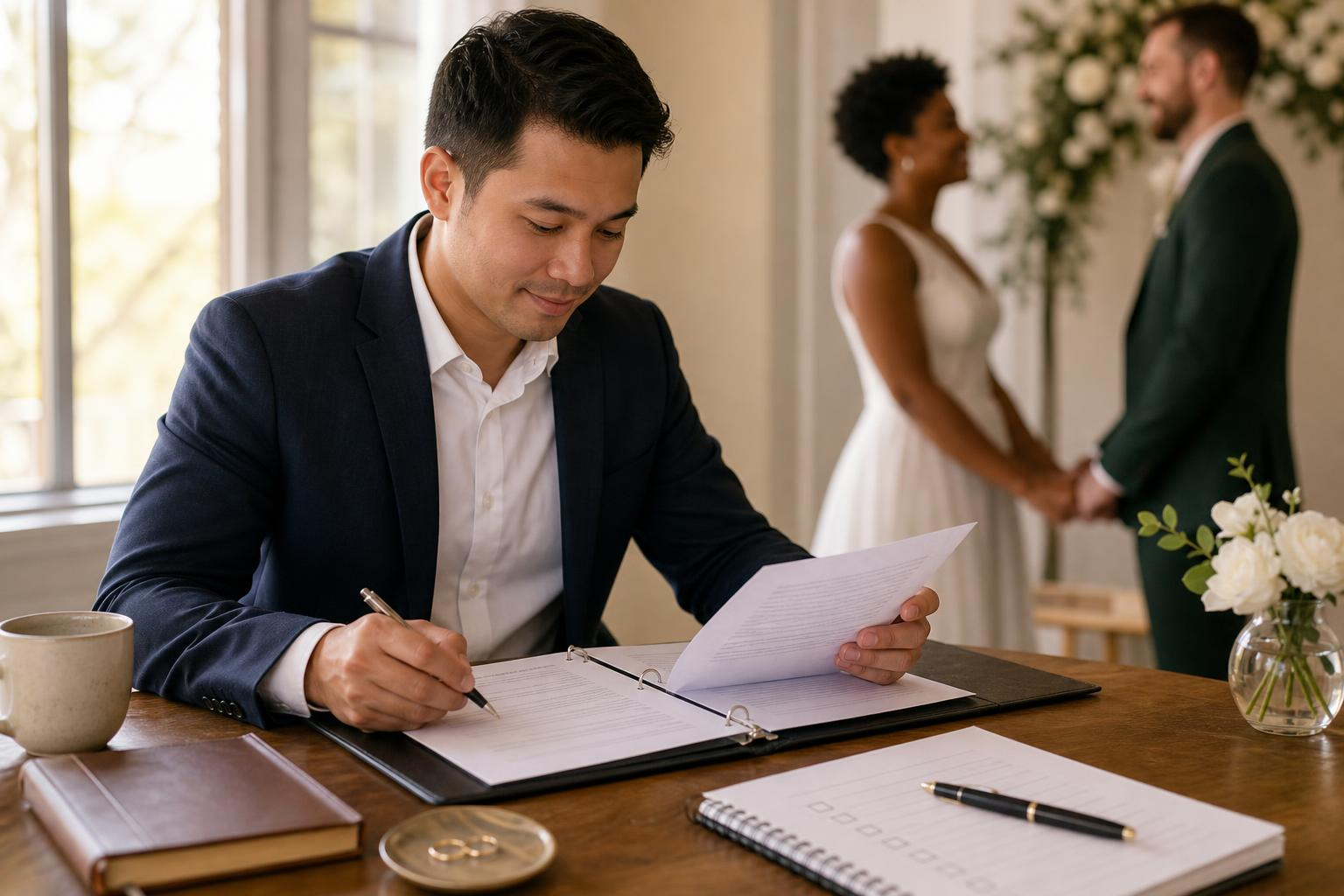
Being asked to officiate a wedding is a real honor—and, if you have never done it before, a job worth preparing for carefully. You do not need to be a professional performer. You do need to be organized, clear, calm, and willing to confirm the details that matter.
This first time wedding officiant checklist walks you through the work in order: preparing with the couple, confirming local requirements, rehearsing the ceremony, showing up ready, and handling the paperwork afterward. Keep it as a working document, print it if helpful, and check off each item as you go.

1. Start with the couple’s vision
Your first responsibility is not writing a clever speech. It is finding out what the couple wants the ceremony to feel like. Set aside a dedicated conversation rather than trying to collect details through scattered text messages.
Ask the questions that shape the ceremony
- How long would you like the ceremony to be?
- What tone fits you best: formal, warm, funny, spiritual, secular, traditional, or a blend?
- Are there readings, rituals, cultural elements, or religious references you want included?
- Are there topics, jokes, names, or family details that should be avoided?
- Will either partner write personal vows, or will you lead repeat-after-me vows?
- Who will bring the rings, and who will handle any ceremony items?
- Who is your day-of coordinator or venue contact?
What kind of ceremony are you helping create? Example: “We are envisioning a relaxed, inclusive ceremony with a short welcome, personal vows, and a simple reading that honors both families.” Short answer: Relaxed, inclusive, family-centered.
Write the answers down. A simple shared document can hold the couple’s preferences, pronunciation notes, ceremony order, readings, music cues, and final script approvals. The goal is to remove guesswork before the wedding day.
2. Confirm the legal and administrative details early
Do not wait until the rehearsal to ask about the marriage license. The couple should contact the appropriate issuing office for current instructions, and you should understand what part you are expected to complete.
In the United States, marriage licenses and certificates are handled through state or local vital-records systems rather than one federal marriage-record office. USA.gov explains that a license permits a marriage to take place, while a certificate proves that the marriage occurred. The CDC likewise directs people to the state or local office where the event occurred for marriage-record information.

Start with the official marriage-law information at USA.gov’s marriage laws page and the CDC’s Where to Write for Vital Records directory. For state or county requirements, use OrdainedPro’s marriage-law and officiant requirements map as a starting point, then verify details with the primary government office.
Make a legal-details confirmation list
- Identify the state, county, parish, borough, or municipality where the ceremony will happen.
- Ask the issuing office whether the officiant must be ordained, registered, authorized, or documented in a particular way.
- Confirm who must sign the license and whether witnesses are required.
- Confirm which fields the officiant completes and how names, titles, dates, and locations should be entered.
- Confirm who returns the completed document and the applicable deadline or delivery method.
- Keep copies of your ordination or authorization documents available if the local office requests them.
Do not assume that a rule from your home state applies to the wedding location. The couple’s residence, the venue, and the office issuing the license may all be in different places.
3. Build a ceremony script that is easy to use
A good script is not just beautiful writing. It is a working map. It should tell you what to say, when to pause, what to ask the couple to do, and where another person needs to step in.
Use a dependable structure
- Processional and welcome: Give guests a clear opening and allow the couple to settle.
- Opening remarks: Explain why everyone has gathered and set the emotional tone.
- Reading or reflection: Include only what the couple has approved.
- Commitment or declaration of intent: Follow the wording appropriate for the ceremony and local requirements.
- Vows: Mark whether the couple will repeat your words or read personal vows.
- Ring exchange: Identify who has the rings and include simple instructions.
- Pronouncement and kiss: Know the exact wording the couple wants and step out of the photographer’s frame.
- Recessional: Tell the couple and guests what happens next.
Keep stage directions in brackets or italics so they are easy to spot: “[Pause for reading],” “[Ask guests to stand],” or “[Step to the side for kiss].” Use phonetic pronunciation notes for unfamiliar names. Read the script aloud several times—not silently—because spoken sentences often need shorter wording than written paragraphs.
Prepare the script in more than one format
Bring a clean printed copy in a binder or folder, plus a backup copy stored digitally. A printed script is easier to read in bright sunlight, wind, or low light, and it keeps you from looking down at a phone throughout the ceremony. Place page numbers on every page and mark the spots where the couple’s names, vows, readings, and pronouncement appear.
4. Rehearse the movement, not just the words
A rehearsal is where small uncertainties become simple instructions. If the officiant, couple, wedding party, musicians, photographer, or coordinator can attend, walk through the ceremony in order.
| Rehearsal focus | What to confirm | Why it helps |
|---|---|---|
| Processional | Walking order, music cues, spacing, and where each person stands | Prevents people from wondering when to move |
| Speaking cues | When guests stand or sit, where readings happen, and who receives the microphone | Keeps the ceremony flowing without shouted instructions |
| Vows and rings | Who speaks first, who holds the rings, and whether vows are repeated or read | Reduces awkward pauses during the most important moments |
| Photography and sound | Microphone position, camera sightlines, and where you stand for the kiss | Improves both audio and photographs |
| Exit | Recessional order and where the couple goes afterward | Gives the ceremony a clear ending |
Walk the actual space if possible. Notice stairs, uneven ground, wind, glare, nearby traffic, and where the microphone or ceremony table will be placed. Ask the coordinator who is responsible for music, sound, rings, ritual items, and moving guests.
Rehearsal checklist
- ☐ Read the full ceremony from beginning to end
- ☐ Practice the processional and recessional
- ☐ Confirm who has the rings
- ☐ Practice vow and ring-exchange cues
- ☐ Test the microphone or confirm the sound plan
- ☐ Confirm where the license will be kept
- ☐ Mark your standing position and photo-safe step-aside point
5. Pack your officiant kit and plan your arrival
Arriving early gives you room to solve ordinary problems without making them visible to the guests. Check the route, parking, weather, venue access, and contact numbers the day before. On the wedding day, aim to be at the venue with enough time to settle in, check the ceremony space, and speak with the coordinator.
Bring the essentials
- Printed ceremony script and backup copy
- Marriage license or other documents, if the couple has asked you to carry them
- Several reliable pens, using the ink color required by the issuing office
- Printed vows, readings, and pronunciation notes
- Any approved ritual items
- Phone on silent, with emergency contacts available
- Water, tissues, mints, and a small stain-removal item
- Weather-appropriate layers or an approved backup accessory
Dress for the couple’s style without becoming the visual center of the ceremony. Confirm colors, formality, religious or cultural expectations, and whether your outfit needs to work outdoors. Keep jewelry, watches, phones, and accessories quiet and unobtrusive.
6. Lead the ceremony with calm, simple directions
Most first-time officiants worry about forgetting a line. In practice, guests remember whether you made the couple feel supported. Slow down, breathe before important moments, and speak clearly enough for the back row.
Use a steady day-of sequence
- Check in: Find the coordinator, confirm the couple is ready, and locate the rings and license.
- Check the space: Test the microphone, review your standing position, and look for tripping hazards.
- Settle the room: Give the coordinator any final announcement or phone-silencing language.
- Follow the run of show: Use your script’s stage directions instead of improvising every transition.
- Pause when needed: If a plane, vehicle, cough, dropped item, or emotional moment interrupts, wait. A quiet pause usually feels more professional than trying to talk over it.
- Keep the couple central: Look at them, not only at the page. Give them time to breathe, laugh, and take in the moment.
If you lose your place, do not announce the mistake. Take a breath, find the next bold heading, and continue. If a name or vow line needs correction, correct it plainly and move on. A calm recovery is part of doing the job well.
7. Finish the paperwork and follow up
The ceremony is not the end of your responsibility if you have agreed to help with the marriage license. After the pronouncement, follow the instructions provided by the issuing office. Check every required field before anyone leaves, and make sure signatures are legible and complete.
Do not guess about filing deadlines, mailing instructions, witness signatures, correction procedures, or whether the couple or officiant must return the document. Confirm those details with the responsible government office. The CDC notes that marriage records are maintained through state, county, city, or other local vital-record offices, so the correct process depends on where the marriage occurred.
After the license has been handled, send the couple a brief follow-up message. Thank them for trusting you, confirm what was submitted or handed back, and note any remaining action they should take to request certified copies. USA.gov explains that certified marriage-certificate copies are obtained through the vital-records office for the place where the marriage occurred.
Conclusion: Make preparation your confidence
You do not need to perform like a stage professional. You need to know the couple’s wishes, confirm the local administrative requirements, rehearse the transitions, bring a readable script, and arrive early enough to think clearly.
Save this checklist, review it with the couple, and turn each uncertain detail into a confirmed detail. That is how a first ceremony becomes a steady, meaningful service for the two people who trusted you with it.
Helpful references: Review USA.gov marriage-law information and the CDC vital-records directory before finalizing the administrative portion of your checklist.
Frequently Asked Questions
What should a first-time wedding officiant do first?
Start by meeting with the couple to understand their ceremony vision, preferred tone, vows, readings, rituals, pronunciation notes, and timing. Then identify the location where the ceremony will occur and confirm which government office provides the marriage-license instructions.
What should an officiant bring to a wedding?
Bring a printed ceremony script, backup copy, approved vows and readings, several pens, pronunciation notes, any agreed-upon ritual items, water or mints, and the marriage-license documents if the couple has asked you to carry them. Confirm document and ink requirements with the issuing office.
Does a first-time officiant need to attend the rehearsal?
Attending is strongly recommended when practical. The rehearsal lets everyone practice the processional, standing positions, music and microphone cues, vows, ring exchange, pronouncement, kiss, and recessional.
How early should a wedding officiant arrive?
Arrive with enough time to park, check in with the coordinator, inspect the ceremony space, test or review the sound setup, locate the rings and license, and read through your opening lines. The exact amount of time depends on the venue and ceremony complexity.
Who files the marriage license after the ceremony?
The responsible person and filing method vary by state and local office. Before the wedding, confirm whether the officiant, couple, clerk, or another authorized person must return the completed document, along with the deadline and delivery instructions.
Can an online ordination automatically qualify someone to officiate a wedding?
Not automatically everywhere. Ordination and officiant-authorization rules can vary by state and locality, and some places may have additional registration or documentation requirements. Verify the specific rules with the marriage-license office and flag the question for human review when uncertain.