Wedding officiant guide
Short Wedding Ceremony Script: Simple, Meaningful, and Easy to Deliver
A short wedding ceremony can still carry real weight. In fact, when every sentence has a job, a simple ceremony often feels more personal than a long one filled with borrowed language.

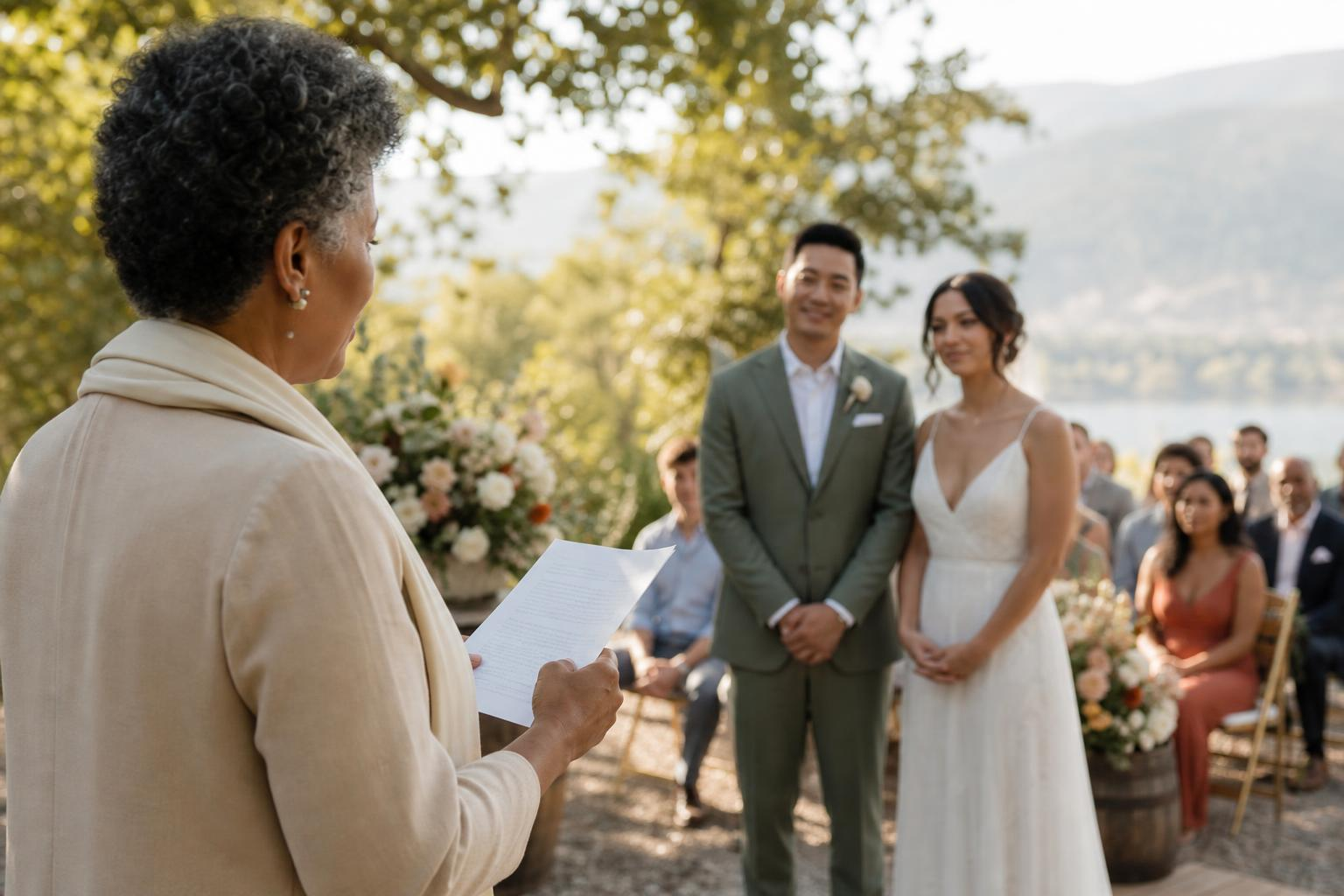
For an officiant, the goal is not to sound grand. Your job is to help the couple feel seen, guide the guests through the moment, and deliver the required words clearly and respectfully. The following short wedding ceremony script gives you a steady framework you can adapt without turning the ceremony into a speech about yourself.
Important note: Ceremony wording and legal requirements can vary by location and ceremony type. Confirm the couple’s marriage-license instructions with the appropriate local authority before the wedding. OrdainedPro’s marriage-law starting point can help you begin that check, but it does not replace an official government source or legal advice.
When a short ceremony works best
A shorter ceremony is a good fit when the couple wants the focus on their vows, rings, and commitment rather than on a long address. It can also work well for courthouse-style celebrations, backyard weddings, destination ceremonies, second weddings, vow renewals, or gatherings where guests are standing outdoors.
The right question is not simply, “How short can we make this?” A better question is, “What does this couple want their guests to remember when the ceremony ends?”
Example:
“We are envisioning a relaxed ceremony where our closest people feel included, the vows are the center of attention, and no one has to sit through a long formal address.”

Short answer:
Relaxed, personal, and vow-centered.
A short format may be less suitable when the couple wants several readings, cultural traditions, musical selections, family blessings, or a detailed religious liturgy. Those elements can be beautiful, but each one needs time and careful placement. The Knot similarly notes that ceremony length and structure depend on the couple’s vows, readings, religious or cultural elements, and other participants. Review sample ceremony structures when you need to compare a simple format with a more elaborate one.
| Couple’s priority | Best approach | Officiant’s focus |
|---|---|---|
| Keep the vows central | Short welcome, brief reflection, vows, rings, pronouncement | Use clear transitions and avoid extra commentary |
| Include family and friends | Add one reading, blessing, or participation moment | Explain each person’s role before the ceremony |
| Honor religious or cultural traditions | Use the tradition’s established order and wording | Confirm expectations with the couple and authorized leader |
| Keep the event highly informal | Use conversational language with a simple structure | Stay warm without becoming casual about the commitment |
What a short ceremony still needs to accomplish
Short does not mean incomplete. A well-built ceremony usually gives the guests enough context to understand why they have gathered, gives the couple space to make promises, and brings the moment to a clear conclusion.
Five useful building blocks
- Welcome: Acknowledge the couple and the people gathered with them.
- Meaning: Offer one brief paragraph about marriage, partnership, or the couple’s shared life.
- Intent: Invite each person to affirm that they are entering the marriage willingly, if that wording is appropriate for the ceremony.
- Promises and rings: Make room for personal vows or repeat-after-me vows, followed by the ring exchange.
- Pronouncement and closing: State the next moment confidently and help guests know what happens afterward.
Think of these pieces as a strong frame. You can add a reading, family blessing, unity ritual, or moment of remembrance without losing the shape of the ceremony. You can also remove a section when the couple has already handled it elsewhere, provided the ceremony remains appropriate and any required elements are confirmed.
An original short wedding ceremony script
Use this as a starting point, not a script you must read word for word. Replace the bracketed details, and keep the couple’s natural voice in mind.
Welcome
“Good [morning/afternoon/evening], everyone. Thank you for being here to celebrate [Partner One] and [Partner Two]. Your presence is a meaningful part of this day, and the couple is grateful to share this moment with you.”
Reflection
“Marriage is built in the ordinary days as much as in the extraordinary ones: in the promises kept, the challenges faced together, the laughter shared, and the decision to keep showing up for one another. Today, [Partner One] and [Partner Two] are making that commitment in the presence of the people who know and support them best.”
Declaration of intent
“[Partner One], do you take [Partner Two] to be your married partner, to share your life with love, honesty, patience, and respect?”
Partner One: “I do.”
“[Partner Two], do you take [Partner One] to be your married partner, to share your life with love, honesty, patience, and respect?”
Partner Two: “I do.”
Vows
“[Partner One], please repeat after me: I choose you as my partner. I promise to listen, to be honest, to support you, and to keep building our life together. I will meet the years ahead with you, one day at a time.”
“[Partner Two], please repeat after me: I choose you as my partner. I promise to listen, to be honest, to support you, and to keep building our life together. I will meet the years ahead with you, one day at a time.”
Ring exchange
“These rings are a visible reminder of the promises you are making today. [Partner One], please place the ring on [Partner Two]’s finger and repeat after me: With this ring, I give you my love and my promise.”
“[Partner Two], please place the ring on [Partner One]’s finger and repeat after me: With this ring, I give you my love and my promise.”
Pronouncement
“[Partner One] and [Partner Two], you have made your promises and exchanged rings in the presence of your loved ones. By the authority entrusted to me, I now pronounce you married.”
“You may share your first kiss as a married couple.”
Closing
“Everyone, please join me in celebrating [Partner One] and [Partner Two]. May your life together be filled with trust, good humor, steady companionship, and many reasons to be grateful. Thank you all for being part of this day.”
This script is intentionally plainspoken. It gives the couple room to sound like themselves, and it gives you enough structure to keep the ceremony moving without rushing.
How to make a simple script feel personal
The easiest way to personalize a short ceremony is to add one or two specific details, not five minutes of biography. Ask the couple for a shared value, a favorite quality in one another, or a small truth about the life they are building.
Use details that reveal character
“They love to travel” is pleasant but general. “They make a point of finding the best local breakfast wherever they go” gives guests a picture of the couple’s curiosity and companionship. Choose details that support the meaning of marriage rather than turning the ceremony into a timeline of the relationship.
Keep the focus on both people
Use balanced language. If one partner is described as adventurous, name the quality that the other brings to the partnership, such as steadiness, humor, generosity, or courage. The ceremony should sound like a partnership, not a tribute to one person.
Let the couple choose the tone
Some couples want solemn and traditional language. Others prefer warmth, humor, or a modern nonreligious tone. Ask before you draft. A joke that works at dinner may not work in the ceremony, especially if it embarrasses one partner or depends on guests knowing private history.
Where to place a reading, blessing, or tribute
A reading can add texture without making the ceremony feel long. Place it after the welcome or reflection, before the vows, when guests are ready to listen. Introduce it in one sentence and identify the reader clearly.
For inspiration, the Poetry Foundation maintains collections of love and wedding poems, including selections by Shakespeare, Elizabeth Barrett Browning, Emily Dickinson, Walt Whitman, and other poets. Its love-poem collection and wedding-poem guide can help a couple find a reading that matches the mood they want.
Before including any religious reading, blessing, or ritual, confirm that it fits the couple’s beliefs and the rules or expectations of the officiant, congregation, venue, or tradition involved. A secular ceremony may welcome a poem, while a particular religious service may have its own approved texts and order.
If a family member is reading, send them the exact passage and coach them to read slowly. Have a printed backup copy with your ceremony materials. These small preparations prevent the kind of awkward pause that makes a nervous reader feel stranded.
Practice the delivery, not just the words
A script can look excellent on paper and still feel clumsy aloud. Read it out loud at least twice, preferably standing up with the same folder, microphone, or tablet you plan to use.
A simple rehearsal process
- Mark the pauses: Add a slash where you want to breathe and a blank line before each response.
- Circle names: Confirm pronunciation with the couple and practice each name until it feels natural.
- Rehearse movement: Know when to invite the couple to face one another, exchange rings, or share a kiss.
- Check the responses: Make sure the couple knows whether they should repeat after you or answer independently.
- Plan for silence: If a ring is dropped or someone becomes emotional, pause. A calm moment is not a failure.
Speak more slowly than you think you need to. Guests may be seated far away, outdoors, or listening through a sound system. Short sentences and clean transitions will help everyone follow along.
Officiant checklist
- Couple’s preferred names and pronunciations confirmed
- Final script approved by both partners
- Vow and ring wording clearly labeled
- Reading, blessing, or tribute confirmed
- Microphone and ceremony location checked
- Marriage-license instructions verified with the proper authority
- Printed backup copy packed
Handle the legal details separately from the ceremony script
The words that make a ceremony meaningful are not always the same as the steps that make a marriage recordable. Keep those tasks separate in your planning notes.
Ask the couple which government office issued the marriage license, what must be completed after the ceremony, who is responsible for returning it, and whether witnesses or other signatures are required. Do not guess based on a ceremony you performed in another state or county.
For example, official county instructions may address who completes the license, what information is required from witnesses, and where the completed document must be returned. San Luis Obispo County’s instructions for the person performing a marriage ceremony are one example of the kind of official document to consult; the couple should use the instructions for the jurisdiction that issued their license. Review official marriage-license completion instructions when applicable.
This article is not legal advice, and a script template cannot determine whether a particular officiant, ordination, ceremony, license, or signature will satisfy local law. State-specific and county-specific questions should be checked against a primary government source or qualified professional.
Final advice for a confident first ceremony
Keep the ceremony centered on the couple, make every sentence earn its place, and give yourself enough structure to stay calm. A short wedding ceremony script works best when it is not merely brief; it is deliberate.
Confirm the details, practice the transitions, speak clearly, and leave room for the real emotion of the day. You do not have to perform perfection. You only need to guide the couple and their guests through this important moment with care.
Frequently Asked Questions
How long should a short wedding ceremony script be?
Write for the experience rather than a word count. A short ceremony usually includes a welcome, brief reflection, vows, rings, pronouncement, and closing. Read the complete script aloud so you can judge its pace and remove anything that does not serve the couple.
What should an officiant say in a short wedding ceremony?
A simple ceremony normally includes a welcome, a few meaningful remarks, a declaration of intent if appropriate, vows, ring exchange, pronouncement, and closing. Add readings or rituals only when they genuinely matter to the couple.
Can I use this short wedding ceremony script for any state?
Use it as a ceremony-writing template, not as a guarantee of legal compliance. Marriage requirements vary by state and sometimes by county. Confirm the couple's license and officiant instructions with the issuing government authority before the ceremony.
How do I personalize a short wedding ceremony?
Add one or two specific details that show the couple's character, shared values, or hopes for marriage. Keep the focus balanced between both partners and ask the couple to approve the final wording before the wedding.
Should a short ceremony include a poem or reading?
It can, if the reading fits the couple and the ceremony's tone. Choose a brief passage, introduce it clearly, and confirm that any religious or cultural reading is appropriate for the ceremony being performed.
How can I avoid sounding nervous while officiating?
Practice aloud, mark pauses, confirm name pronunciation, label each response, and bring a large-print backup copy. Speak slowly and pause when needed; calm pacing sounds more confident than rushing.