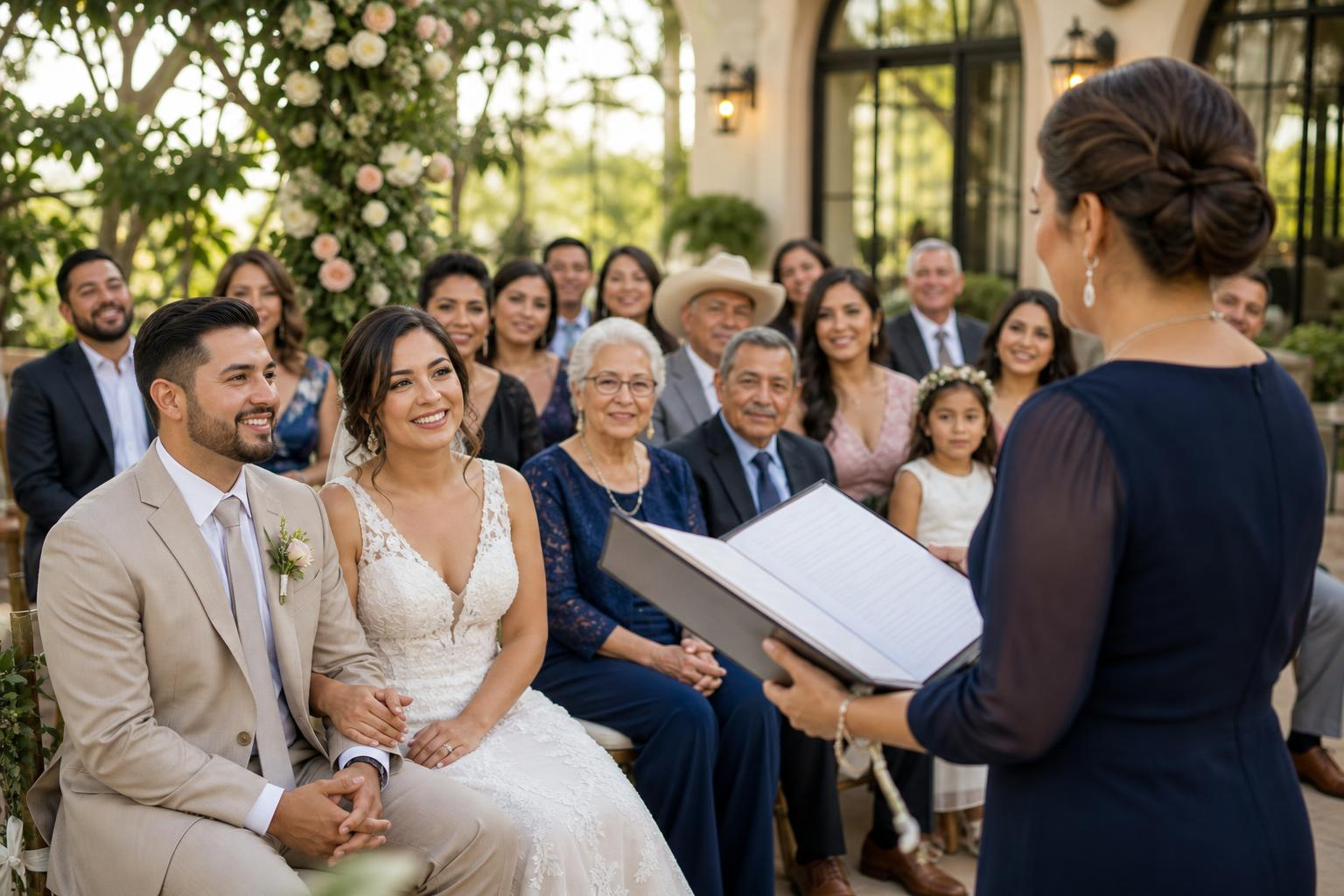
Bilingual Wedding Ceremony Tips for English and Spanish Weddings
A bilingual wedding ceremony can make both sides of the family feel seen, respected, and genuinely included. It can also become difficult to follow if every sentence is repeated without a plan. The good news is that a little structure solves most of the trouble.
For an English and Spanish wedding, the goal is not to translate every word mechanically. The goal is to create one ceremony with a clear emotional rhythm, thoughtful language choices, and enough breathing room for guests to stay connected to the couple.

1. Choose the right bilingual ceremony format
Start with the guest experience. Before writing the script, decide how much of the ceremony each language community needs to understand in real time. Some guests may be comfortable hearing another language for a short reading or greeting. Others may need the vows, ring exchange, and declaration of marriage presented in their primary language.
There is no single correct format. A bilingual wedding ceremony may be mostly English with selected Spanish sections, mostly Spanish with selected English sections, or a carefully balanced blend. You can also use a professional interpreter for spoken portions and provide a bilingual program for written support.
The American Translators Association distinguishes translation, which handles written text, from interpreting, which handles spoken communication. That distinction matters when deciding whether you need a bilingual officiant, a written translator, an interpreter, or a combination of services. Learn more about the difference between translation and interpreting.
Plan around meaning, not mathematical equality. A ceremony does not need to be exactly half English and half Spanish to feel fair. A short welcome in both languages, bilingual vows, one reading in English, one reading in Spanish, and a bilingual ring exchange may provide a better experience than repeating every paragraph twice.
| Format | How it works | Best fit | Main consideration |
|---|---|---|---|
| Alternating sections | One section is delivered in English, the next in Spanish. | Couples who want both languages represented without repeating everything. | Each family may miss some portions unless the program provides summaries. |
| Repeated key sections | The welcome, vows, ring exchange, and declaration are delivered in both languages. | Guests who need the central promises understood aloud. | The ceremony will take longer, so keep each version concise. |
| Mostly one language with highlights | The ceremony uses one primary language and adds readings, vows, greetings, or blessings in the other. | Couples with one dominant language and a desire for meaningful inclusion. | Choose the highlighted sections carefully so they feel intentional. |
| Bilingual officiant plus printed support | The officiant blends languages while the program includes a written outline or translation. | Couples seeking smooth delivery with extra help for guests. | Use a polished script and consistent terminology. |
2. Create a translation flow that feels natural
Avoid sentence-by-sentence ping-pong. Repeating every line immediately in the other language can make the ceremony feel longer and less intimate. It may also cause guests to focus on waiting for the translation instead of watching the couple.

Instead, group language choices into complete thoughts. For example, the officiant might welcome everyone in English and Spanish, share the couple’s story in English, invite a Spanish-language reading, and then present the vows in both languages. This gives each section a beginning and an ending.
Use transitions to guide the room
Simple transitions help guests understand what is happening:
- Opening: “Bienvenidos a todos. Welcome, everyone.”
- Language cue: “Ahora escucharemos una lectura en español.”
- Return cue: “And now, we return to English.”
- Shared moment: “We will now hear these vows in both languages.”
These cues do not need to sound formal or repetitive. They are small signposts that keep the ceremony easy to follow.
Keep translated sections equivalent in meaning. Spanish and English do not always use the same sentence structure or number of words. A good translation preserves the promise, tone, and intent rather than forcing identical wording. If a translation feels stiff when spoken aloud, revise it for natural speech before the wedding day.
For important written portions, finish the original script before translation begins and keep the translator involved in the purpose and tone of the ceremony. The American Translators Association offers guidance on preparing written material and working with language professionals. Review ATA guidance on buying translation services.
3. Pace repeated sections so guests can stay present
Shorter is kinder. When a section will be spoken twice, write both versions with a clean, simple structure. Long paragraphs become especially tiring when repeated, and they can make the ceremony feel more procedural than personal.
A practical pacing method
- Write the emotional point. Decide what the couple and guests should feel or understand.
- Draft the first language. Use natural spoken language rather than formal writing.
- Translate for meaning. Preserve the emotional point, not every grammatical pattern.
- Read both versions aloud. Remove duplicate phrases and awkward transitions.
- Mark pauses. Add breathing space before vows, rings, readings, and the declaration.
If the same promise appears in both languages, the officiant can use a brief introduction instead of explaining the repetition each time. For example: “You will hear these promises in English and Spanish so everyone can share this moment.” Then move confidently into the text.
Coordinate with the photographer and musicians. A pause after each language may affect cue timing, processional music, microphone changes, and photo opportunities. Share the final ceremony order with the wedding planner, venue coordinator, sound team, and anyone performing a reading.
4. Include both families without turning culture into decoration
Ask what inclusion means to the couple. English and Spanish may connect to family history, immigration, faith, regional identity, childhood memories, or the everyday language of the relationship. The right ceremony reflects the couple’s actual life rather than adding cultural elements simply because they sound traditional.
Invite both partners to review the wording, names, readings, rituals, and pronunciation. If a family member is giving a reading, let that person choose the language in which they are most comfortable and confident.
A bilingual program can help guests follow the order of service without requiring every spoken paragraph to be repeated. It may include:
- The ceremony outline in both languages.
- Translations of readings or selected vows.
- Names with correct accent marks.
- A short note explaining special rituals.
- Pronunciation guidance for names, places, or family titles.
Respect regional differences. Spanish vocabulary and expressions vary across countries and families. Ask the couple whether they prefer a particular word, form of address, or pronunciation. A phrase that feels warm to one family may sound overly formal or unfamiliar to another.
Consider giving both families a meaningful role: a Spanish-language welcome, an English-language reading, bilingual vows, a family blessing, music in both languages, or a moment of gratitude that names loved ones from each side. Inclusion works best when it is connected to a person or relationship, not added as a checklist.
5. Practice pronunciation with care
Names come first. A perfectly written bilingual script will not help if names are mispronounced. Ask the couple to provide phonetic spellings, audio recordings, or a short pronunciation call. Confirm surnames, family titles, place names, religious terms, and any Spanish words that the officiant will say aloud.
Build a pronunciation practice list
- Couple’s names and surnames.
- Parents’ and grandparents’ names.
- Readers, witnesses, and participants.
- Names of cultural or religious traditions.
- Vow phrases and ring-exchange wording.
- Words with accents or unfamiliar letter combinations.
Practice slowly first, then at ceremony pace. Record yourself and listen for stress, vowel sounds, and rushed endings. Ask a trusted fluent speaker to review the list, but do not wait until the rehearsal to begin.
Use respectful correction. If someone offers a pronunciation change, write it directly into the working script. Avoid relying on memory. A simple phonetic note under each name is often more dependable than a last-minute reminder.
If the couple is writing vows in a language one partner is still learning, let them choose a manageable amount. Speaking a short phrase sincerely is often more moving than attempting a long passage that creates anxiety.
6. Organize the bilingual script for ceremony-day use
Make the script easy to operate. The officiant should never have to search through pages to find the next language, cue, or participant. Use clear headings, generous spacing, page numbers, and visual labels such as ENGLISH and ESPAÑOL.
A useful script structure
- Processional and opening cues.
- Bilingual welcome.
- Statement of purpose.
- Couple’s story or reflection.
- Readings and reader introductions.
- Declaration of intent.
- Vows.
- Ring exchange.
- Pronouncement or closing declaration.
- Recessional and photography instructions.
Use one master script for the officiant and separate, simplified copies for readers and the couple. Put stage directions in brackets or a different style so they are not confused with spoken words. Mark who speaks, which language comes next, and where the officiant should pause.
Bilingual script checklist
- Both language versions have been reviewed by the couple.
- Names and pronunciation notes are confirmed.
- Repeated sections are shortened where possible.
- Reader entrances and microphone cues are marked.
- Vows and ring wording are printed in the correct order.
- A final copy is saved offline and printed.
Rehearse the handoffs. The most common awkward moments happen between speakers, not inside the paragraphs. Practice when the officiant turns toward a reader, when a partner changes languages, when the rings are presented, and when the couple needs a pause before repeating a vow.
7. Confirm ceremony paperwork separately from ceremony language
A beautiful bilingual ceremony and the couple’s marriage paperwork are related to the wedding day, but they are not the same planning question. Marriage license, officiant, witness, filing, and ceremony requirements depend on the location and the issuing authority. USAGov explains that a marriage license legally allows a couple to marry and directs couples to check the relevant state or local authority for requirements. Review general US marriage-certificate and license information.
Do not assume language alone determines validity. Before publication or performance, confirm the current requirements with the appropriate government marriage authority for the ceremony location. OrdainedPro’s marriage-law and officiant information map can be a useful starting point, but it should not replace the issuing authority’s instructions.
Keep the legal portion concise and accurate. If the couple wants a warmer, more personal bilingual experience, place most storytelling, readings, blessings, and cultural elements around the required declarations rather than altering official wording without verification.
For a ceremony involving a religious organization, ask that organization about its own language, ritual, and officiant expectations. Religious authority requirements can be separate from civil marriage requirements.
Put the plan into practice
What should guests from both language communities understand without waiting for a printed translation?
Example: “We want everyone to understand the welcome, our vows, the ring exchange, and the final declaration, while readings and storytelling can alternate between English and Spanish.”
Short answer: Repeat the central promises.
Once the couple chooses that priority, the rest becomes much easier. Draft the ceremony around complete sections, translate for natural speech, practice names and transitions, and give every participant a clean final script. A well-planned bilingual wedding ceremony does not feel like two ceremonies placed side by side. It feels like one shared promise, spoken with room for every important voice.
Before the wedding, complete one full read-through with the actual script, microphone, readers, and music cues. Then make the final changes while there is still time to breathe. On ceremony day, speak clearly, pause generously, and remember that your job is not to perform linguistic perfection. Your job is to help two people make a meaningful promise in a way their families can truly receive.
Frequently Asked Questions
How do you structure a bilingual wedding ceremony in English and Spanish?
Choose a clear format before writing: alternate complete sections, repeat only key moments, or use one primary language with meaningful highlights in the other. Many couples repeat the welcome, vows, ring exchange, and declaration while using readings or storytelling to represent both languages.
Should the entire wedding ceremony be translated twice?
Not necessarily. Repeating every paragraph can make the ceremony feel long and less intimate. A better approach is to repeat the moments guests most need to understand and support the rest with a bilingual program or selected readings.
Do I need a translator or an interpreter for a bilingual wedding?
A translator works with written text, while an interpreter works with spoken language. You may need a bilingual officiant, a written translator for the script and program, a spoken interpreter, or a combination depending on the ceremony plan.
How can a wedding officiant practice Spanish pronunciation?
Ask the couple for phonetic spellings or audio recordings, create a pronunciation list, practice aloud, and confirm names with a fluent speaker. Focus especially on names, surnames, family titles, readings, vows, and culturally specific terms.
How can both families feel included in a bilingual wedding ceremony?
Give both families visible and meaningful roles. Consider a bilingual welcome, readings in different languages, vows or ring exchanges in both languages, a family blessing, music choices, or a short explanation of an important cultural ritual.
Can a bilingual ceremony still meet marriage requirements?
Civil marriage requirements vary by location. Confirm the marriage license, officiant, witness, filing, and ceremony requirements with the appropriate state or local marriage authority before the wedding. This article is general planning information, not legal advice.