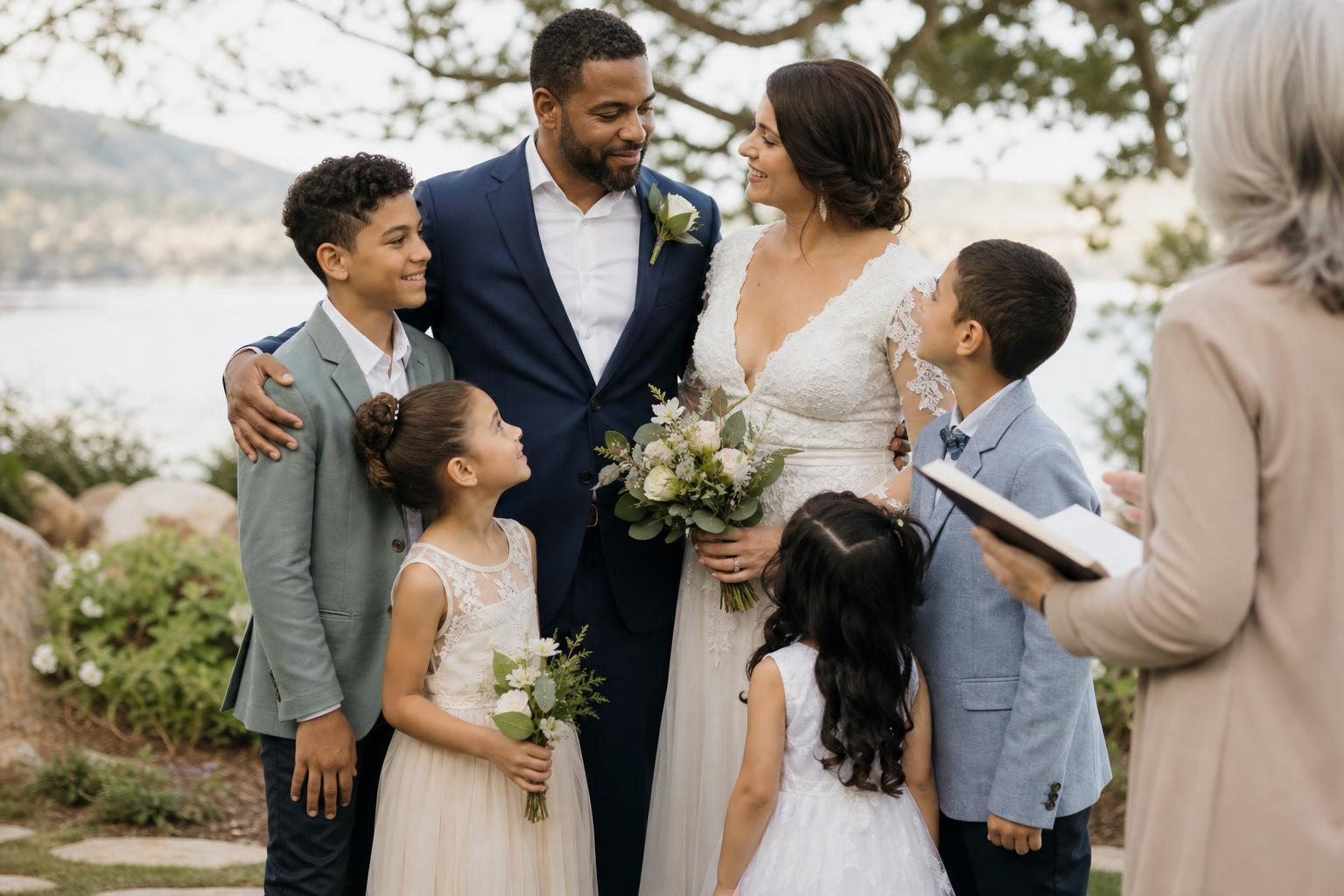
A blended family wedding ceremony has room for joy, tenderness, and a little honest complexity. The goal is not to make every family member perform happiness on cue. The goal is to create a ceremony where children understand what is happening, know they matter, and can participate in a way that feels safe and genuine.
As the officiant, your steady presence can help the couple avoid common pressure points. Offer choices, use clear language, and remember that no child should have to publicly approve every part of a family transition. A meaningful ceremony can include children without asking them to carry the emotional weight of the adults.

This guide offers practical blended family wedding ceremony ideas, original sample wording, and a simple way to match each role to a child’s age, personality, and comfort level.
1. Begin with a private family conversation
Before writing the ceremony, encourage the couple to speak with each child privately and together. The conversation should happen well before the rehearsal, not while everyone is already dressed and waiting to walk down the aisle.
Ask what each child would enjoy, what they would rather avoid, and whether they want a public role at all. Some children love a reading or unity ritual. Others would rather sit in the front row, help choose music, or participate in a private family moment before the guests arrive.
Planning question: What would help each child feel included without making them feel responsible for the adults’ happiness?
Example: One child may want to stand beside the couple during the vows, while another may prefer to help select the ceremony music and receive a private promise after the service.

Short answer: Inclusion should offer choice.
The American Academy of Pediatrics notes that children should be asked whether they want a special role in a remarriage ceremony. That simple principle is worth keeping at the center of your planning: invitation is healthier than pressure. HealthyChildren.org guidance on remarriage and blending families offers additional family-focused context.
2. Match ceremony roles to age and comfort
A role is successful when the child can understand it, practice it, and leave it without embarrassment if the moment becomes overwhelming. Age matters, but temperament matters just as much.
| Child’s stage | Possible ceremony roles | Helpful planning note |
|---|---|---|
| Young children | Carry a small sign, place flowers, hold a family object, or stand briefly with a trusted adult | Keep the task short and provide a backup adult. |
| School-age children | Read a short passage, help with a unity ritual, carry rings, or make a family promise | Let the child rehearse the wording and choose whether to use a microphone. |
| Teenagers | Give a reading, serve as an attendant, help design the ceremony, or offer a personal reflection | Respect privacy and avoid asking for emotional disclosure in front of guests. |
| Adult children | Stand in the wedding party, offer a toast, read a blessing, or participate in a family ritual | Treat them as adults with their own relationships, boundaries, and schedules. |
| Any age | Attend without a formal role, help choose music, or take part in a private family moment | Being present is meaningful participation; no public assignment is required. |
For a toddler, a five-minute job may be more than enough. For a teenager, the best role may be one with creative control and no forced sentiment. For an adult child, a private conversation may matter more than a ceremonial title.
Research-based family guidance from Utah State University Extension describes family rituals as potentially useful in stepfamily life, while also emphasizing consistency and attention to existing parent-child bonds. That supports a practical officiating approach: build a new ritual without suggesting that previous family relationships have disappeared. Utah State University Extension guidance on rituals in stepfamilies is a useful reference for that distinction.
3. Use wording that welcomes without replacing anyone
Blended family wording should honor the new marriage while avoiding language that implies a biological parent has been erased or replaced. Be careful with phrases such as “becoming a real family today” or “one family, leaving the past behind.” Those lines may sound polished, but they can land painfully for children who are still connected to another parent, grieving a loss, or adjusting to a new household.
Instead, use language about adding relationships, making room, and choosing care. Here is original sample wording an officiant can adapt:
“Today, [Name] and [Name] are promising to build their marriage with patience, honesty, and care. They also recognize the children and family members who are part of their lives. This marriage does not erase the love, history, or relationships that brought each person here. It creates another place for trust to grow.”
For a step-parent promise, keep the commitment realistic. A step-parent should not promise to replace a parent or control every part of a child’s life. A better promise focuses on respect, support, listening, and gradual trust.
“[Child’s name], I promise to treat you with respect, to listen when you speak, and to support the relationship you have with the people who love you. I will not ask you to become someone else for me. I will make room for trust to grow at its own pace, and I will keep showing up with patience and care.”
For a family welcome, the officiant might say:
“To the children and loved ones gathered here: you are not being asked to perform a perfect picture of family. You are being welcomed as yourselves. May this household make room for honesty, laughter, quiet days, new traditions, and the time it takes for trust to become strong.”
4. Choose a family ritual that fits the message
A unity ritual can give children something concrete to do, but the object should support the family’s actual message. Sand, stones, candles, letters, flowers, and family artwork can all work. None is automatically meaningful just because it is traditional.
Family sand ceremony
Each person pours a different color of sand into a shared vessel. The wording should explain that the family is creating shared memories while each person remains an individual.
“Each color represents a person with a history, a voice, and a place in this family. As the colors come together, they create something shared without requiring anyone to lose their own identity.”
Family tree or planting ritual
Each child can add soil, a stone, or a small note to a plant. This works well for families who prefer a living symbol and want a ritual that can continue after the wedding.
Family vows or promises
Instead of asking children to make promises to the adults, invite the adults to promise specific forms of care. Children may respond with a simple “I’m willing,” “I do,” or no spoken response at all.
Shared artwork
Children can sign a canvas, place a fingerprint, add a written hope, or help create a piece of art before the ceremony. This is especially useful for children who dislike public speaking.
Whatever you choose, explain the symbol plainly. A short, sincere explanation is usually stronger than a dramatic speech that promises the family will never struggle.
5. Plan boundaries around names, parents, and emotions
Blended family ceremonies sometimes involve complicated relationships. A child may have a living biological parent who is not attending. Another parent may be present but uncomfortable with the ceremony. A child may be grieving, angry, or unsure about the marriage. The officiant does not need to solve those relationships from the microphone.
Your job is to help the couple decide what belongs in the public ceremony and what should remain private. Discuss names, pronouns, family titles, readings, photographs, and who will escort whom. Confirm every detail with the couple and avoid improvising sensitive language.
If a child becomes upset, the ceremony plan should allow a quiet exit. Assign a trusted adult who can step out with the child without turning the moment into a public crisis. Build in flexibility: a reading can be shortened, a ritual can be completed by the adults, and a child can return when ready.
It is also wise to avoid language that makes the ceremony sound like a final test of family unity. Families continue developing after the wedding. The most honest promise is not “we will always agree.” It is “we will keep treating one another with care while we learn how to live this life together.”
6. Rehearse the mechanics, not the feelings
A rehearsal should answer practical questions so the family does not have to improvise under pressure.
- Mark positions. Show each participant where to stand and where to go next.
- Practice the object. If children will carry rings, pour sand, light candles, or hold a certificate, let them handle the materials beforehand.
- Use the actual wording. Read the promises aloud so everyone knows whether the language feels natural.
- Choose a backup. Decide who completes the role if a child freezes, wanders, or chooses not to participate.
- Protect privacy. Tell photographers and guests which moments should not be turned into a public spectacle.
Blended family ceremony checklist
- Each child was asked about participation privately.
- Every role has a simple backup plan.
- Step-parent wording avoids replacement language.
- Names, titles, and pronouns are confirmed.
- The ceremony allows a child to opt out gracefully.
- The couple has decided what remains private.
- The officiant has the final script and pronunciation notes.
7. Keep the ceremony warm, clear, and brief
Children and guests generally benefit from a ceremony with a clear structure. You can welcome everyone, name the meaning of the marriage, recognize the children, lead the couple’s vows and ring exchange, include the chosen family ritual, and close with a hopeful blessing or declaration.
Do not let the family portion become a second wedding ceremony inside the wedding ceremony. One or two thoughtful moments are usually enough. The children do not need to read every poem, answer several questions, or stand in the spotlight for an extended period.
A strong closing might sound like this:
“May this marriage be a home for patience, humor, honesty, and steady care. May every person in this family have room to be known, heard, and respected. And may the promises made today continue through ordinary days, not only special ones.”
If the couple also needs information about state-specific officiant or marriage requirements, direct them to the OrdainedPro state marriage-law map as a starting point. Verify current requirements through the appropriate government authority before publication or relying on them for a ceremony.
Conclusion: Give the family room to grow
The best blended family wedding ceremony does not pretend that every relationship is finished becoming. It gives the couple a public moment to promise care and gives children permission to participate honestly, at their own pace.
As the officiant, keep the choices clear, the wording respectful, and the logistics calm. Ask before assigning. Avoid replacement language. Offer a graceful way to say no. Then help the family mark this new chapter without asking anyone to erase the chapters that came before.
Frequently Asked Questions
How can children be included in a blended family wedding ceremony?
Children can read a short passage, carry rings, participate in a unity ritual, help choose music, stand with the couple, create artwork, or simply attend without a formal role. The best choice depends on age, personality, and comfort.
Should children repeat vows during a blended family ceremony?
Only if they freely want to. Many families ask adults to make promises of respect, patience, and support rather than asking children to promise love, obedience, or acceptance.
What should a step-parent promise during the ceremony?
A step-parent can promise to listen, show respect, support the child’s existing relationships, make room for trust, and continue showing up with patience. Avoid promises to replace a parent.
What if a child does not want a public role?
Respect the decision. A child can participate privately, help with planning, sit in a meaningful place, or attend without speaking. Prepare a backup plan so opting out does not become a public problem.
What are meaningful blended family unity ceremony ideas?
Popular options include a family sand ceremony, planting a tree, adding stones to a keepsake vessel, creating shared artwork, or exchanging family promises. Choose a ritual that reflects the family’s real values.
How long should the family portion of the ceremony be?
Keep it focused. One or two meaningful family moments are usually more effective than a long sequence of readings, vows, and rituals. The exact timing should match the children and the overall ceremony.