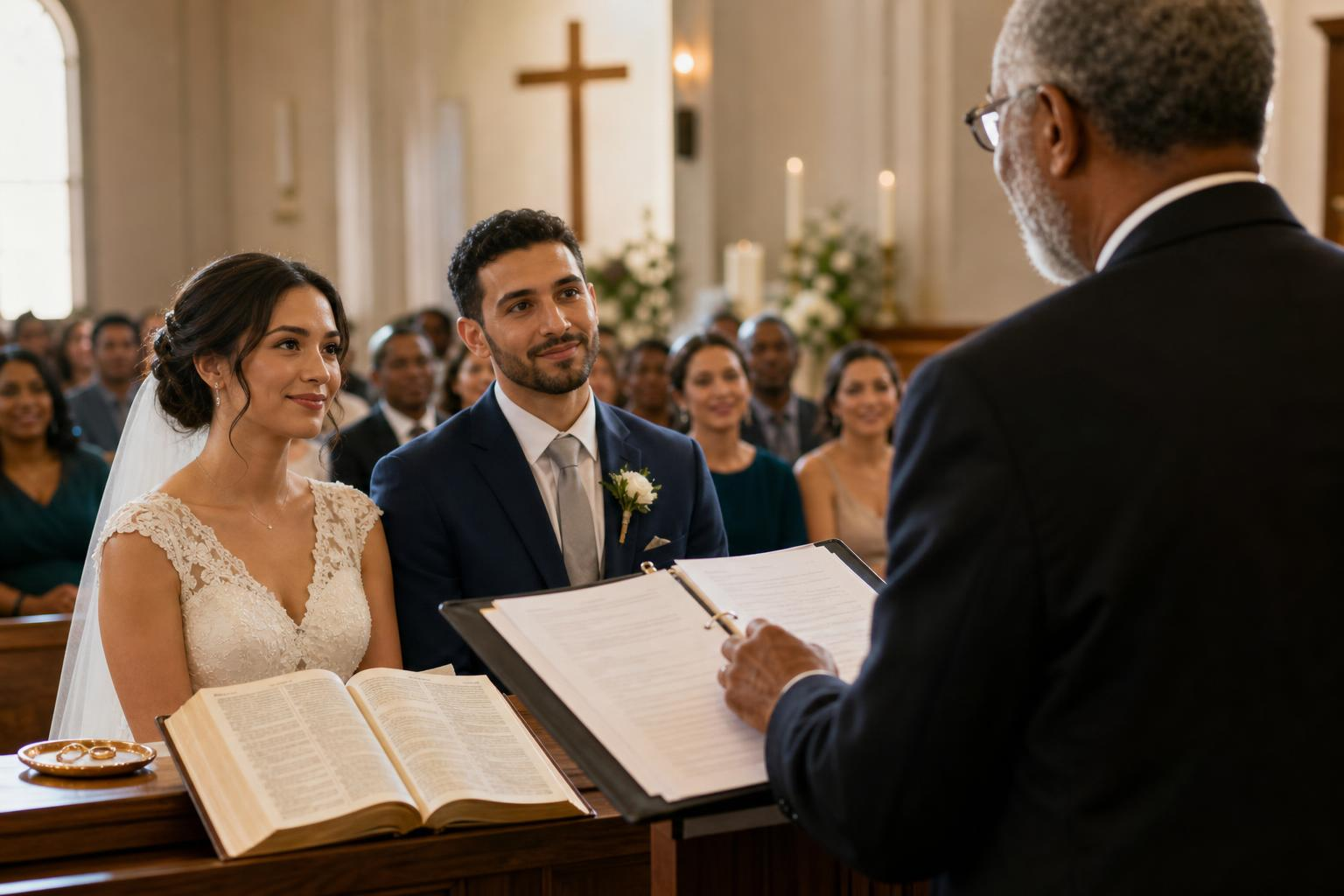
Christian Wedding Ceremony Script: Structure, Readings, and Traditions
A Christian wedding ceremony can be reverent, joyful, personal, and wonderfully simple. As the officiant, your job is not to perform every tradition you have ever heard of. Your job is to guide two people through a meaningful covenant in a way that feels faithful to their beliefs and welcoming to the people gathered around them.
This guide will help you shape a Christian wedding ceremony script with a practical order of service, Scripture options, original transitions, and adaptable traditions. Denominations do not all use the same wording or order, so treat this as a working framework rather than a universal church rite.

Start with the couple’s Christian tradition and ceremony goals
Before writing a single line, learn what kind of Christian ceremony the couple actually wants. “Christian” can describe a wide range of worship styles, denominational practices, family traditions, and personal convictions. A Catholic wedding, a United Methodist service, an evangelical ceremony, and a small nondenominational gathering may all center on Christ while using very different language.
Ask the couple what they want guests to experience. Do they want the ceremony to feel like a worship service, an intimate blessing, a Scripture-centered gathering, or a relaxed celebration with prayer? Also ask whether a pastor, priest, church leader, or family member needs to approve the wording.
Planning question: What should guests understand about your marriage by the time the ceremony ends?
Example: “We want everyone to see that our marriage is a promise before God, but we also want the service to feel warm, understandable, and welcoming to friends who are less familiar with church.”
Short answer: Faithful, welcoming, easy to follow.

A published denominational service can help you understand the shape of a Christian wedding without assuming that its wording belongs in every ceremony. For example, the United Methodist Church presents Christian marriage as a worship service that may include gathering, prayer, Scripture, a witness or sermon, vows, rings, blessing, and dismissal. The Roman Catholic understanding of matrimony also has its own sacramental preparation and parish expectations. Those differences are exactly why the couple’s tradition should guide your draft.
Use a dependable order of service
A strong ceremony script gives everyone a clear path. The order below works as a flexible starting point for many Christian weddings:
- Processional: The wedding party and couple enter.
- Welcome and gathering: You greet the guests and explain why everyone is assembled.
- Opening prayer: Invite God’s presence and give thanks for the couple.
- Declaration of intention: Ask each person whether they enter marriage freely and willingly.
- Family or community blessing: Invite the gathered people to support the marriage.
- Scripture reading: A reader shares a selected passage.
- Message or reflection: Offer a brief meditation on Christian love, covenant, service, and hope.
- Vows: The couple makes their promises to one another.
- Exchange of rings: The rings serve as visible signs of the promises.
- Prayer of blessing: Pray for the couple, their home, and the life ahead.
- Pronouncement and kiss: Declare the marriage according to the ceremony’s wording and the couple’s wishes.
- Recessional: Send the couple and guests into the celebration.
You do not have to include every possible part. A short ceremony may combine the welcome and opening prayer, use one Scripture reading, and move directly from the vows to the blessing. A more liturgical ceremony may include hymns, congregational responses, communion, or additional prayers.
| Element | Best fit | Officiant’s planning note |
|---|---|---|
| Opening prayer | Most Christian ceremonies | Keep it connected to the couple rather than making it a general sermon. |
| Congregational response | Church-centered or highly participatory services | Print or display the response so guests know when to speak. |
| Scripture reading | Any ceremony wanting an explicit biblical foundation | Confirm the translation and reader’s comfort before the rehearsal. |
| Family blessing | Couples who want visible support from parents, children, or friends | Use inclusive wording when family structures are blended or complex. |
| Communion | Traditions and congregations that permit it | Confirm church policy, who may receive, and who presides before promising it. |
| Unity candle or other symbol | Couples seeking a visual tradition | Explain the meaning briefly so the action does not feel disconnected. |
Choose Bible readings that serve the couple
Popular Christian wedding readings include 1 Corinthians 13, Genesis 2:18–24, Song of Solomon 2:10–14 or 8:6–7, Ephesians 4:1–6, Colossians 3:12–17, 1 John 4:7–16, and John 2:1–11. These passages emphasize different dimensions of marriage and Christian life.
- 1 Corinthians 13: A familiar reflection on patient, kind, enduring love.
- Colossians 3:12–17: A practical picture of compassion, forgiveness, peace, gratitude, and love.
- 1 John 4:7–16: A reading that connects love with the character and presence of God.
- Genesis 2:18–24: A creation-focused passage often used when the couple wants to emphasize companionship and becoming one household.
- John 2:1–11: A Gospel reading that places a wedding within the story of Jesus’ ministry.
The United Methodist service provides a broad list of suggested lessons, including passages from Genesis, the Psalms, the Gospels, Paul’s letters, and Revelation. That list is useful because it reminds you that a wedding reading does not have to be limited to the three or four verses most people already know.
Read the entire passage before recommending it. A verse may sound beautiful in isolation but carry a wider context that does not fit the couple’s message. Also ask whether the couple wants the reading to focus on romantic love, mutual service, spiritual growth, family, hospitality, or perseverance.
Reader introduction: “A reading from Paul’s first letter to the Corinthians, describing the patient and enduring character of love.”
Transition after reading: “These words give us more than a description of affection. They give us a pattern for the daily work of marriage: patience when life is difficult, kindness when emotions are strong, and hope when the future is still unfolding.”
Write original transitions between the sacred moments
The transitions are where many ceremony scripts become awkward. A reading ends, everyone looks at you, and the next part needs to begin. You do not need a long sermon. You need one or two sentences that explain why the next action belongs here.
From welcome to prayer
“We have gathered with joy, but also with gratitude. Before we hear the couple’s promises, let us turn our attention to the God who has accompanied them and who will continue to guide their life together.”
From Scripture to the message
“The reading gives us a picture of love as something active and faithful. Let us consider how that kind of love can become visible in the ordinary decisions of married life.”
From message to vows
“A Christian marriage is not built by good intentions alone. It is strengthened by promises spoken clearly and practiced faithfully. Today, [Name] and [Name] will make those promises to one another.”
From vows to rings
“The vows have been spoken with the heart and heard by this community. These rings now give those promises a visible sign that the couple can carry into every season of life.”
From rings to blessing
“The rings are exchanged, but the work of loving well continues day by day. Let us pray for grace, wisdom, patience, and joy as this couple begins married life.”
Keep transitions specific. Mention the passage, the promise, or the symbol you just used. That small connection makes the ceremony feel thoughtfully designed rather than assembled from separate pieces.
Shape vows, rings, and prayers with care
Vows should be understandable when spoken aloud. Avoid sentences so long that the couple loses their place. If the couple writes personal vows, ask them to include concrete promises rather than only compliments. “I promise to listen before responding” gives the marriage something to practice. “You are my favorite person” is lovely, but it does not carry the same practical weight by itself.
A simple Christian vow pattern is:
“I, [Name], take you, [Name], to be my spouse. I promise to love you, honor you, encourage you, and stand with you in joy and difficulty. I will seek God’s wisdom for our life together and remain faithful to you as long as we both shall live.”
Adapt the wording to the couple’s theology, relationship, and denomination. Some couples prefer “husband” and “wife,” while others prefer “spouse” or simply each other’s names. Do not quietly change those choices during the ceremony.
For ring vows, offer a short line that is easy to repeat:
“I give you this ring as a sign of my love and commitment. With all that I am and all that I have, I honor you.”
A Christian blessing can ask for steadfast love, wise decisions, peace in the home, courage in hardship, generosity toward others, and a growing awareness of God’s presence. Keep the prayer focused on the couple instead of turning it into a second sermon.
Script-readiness checklist
- Names and pronunciation are confirmed.
- Vows fit the couple’s chosen language.
- Scripture translation is approved.
- Readers know where to stand and when to begin.
- Ring wording is printed in the officiant’s copy.
- Prayer, music, and family roles are confirmed.
- Pronouncement wording is approved before rehearsal.
Adapt Christian traditions without making them feel automatic
Traditions work best when guests understand their purpose. A unity candle can represent two lives joined in a shared household while each person remains a distinct individual. A family blessing can recognize parents, children, siblings, or chosen family members. A congregational response can remind guests that marriage is supported by a community, not carried by the couple alone.
Other traditions may include a hymn, a responsive prayer, a kneeling blessing, communion, the Lord’s Prayer, a presentation of the couple, or a symbolic gift such as a Bible. None should be added merely because a wedding checklist says they belong there. Ask what the action means to this couple and whether their church tradition welcomes it.
The United Methodist model, for example, allows family and friends to read Scripture, sing, play music, or offer a witness in their own words. It also treats the congregation as active participants rather than passive spectators. That is a helpful principle for any officiant: give guests a clear way to pray, respond, sing, or support the couple.
If the couple is blending denominations or has different levels of religious practice, use language that is honest and generous. You can center the ceremony on Christian love and prayer without pretending that every family member shares the same vocabulary.
Handle church and legal details before the wedding day
Religious approval and civil requirements are separate questions. A church, denomination, or clergy member may have rules about premarital counseling, approved wording, music, communion, photography, or who may officiate. The government office that issues the marriage license may have different requirements about signatures, filing, deadlines, or officiant eligibility.
Do not make promises about legal validity based only on an online ordination, a past ceremony, or what worked in another state. For state marriage-law and officiant-requirement questions, use OrdainedPro’s marriage-law starting point, then confirm the current requirements with the appropriate government marriage authority. This article is not legal advice, and state rules can differ.
For denominational expectations, ask the couple to speak directly with their church or clergy contact. The USCCB explains matrimony within the Catholic sacramental framework, while the United Methodist service identifies the pastor’s responsibility and church approval process. Those are examples of denominational authority, not rules that apply to every Christian ceremony.
On the practical side, carry two copies of the script, mark every cue, bring a pen, and keep the legal paperwork separate from the ceremony pages. A calm officiant is often the person who prepared for the small details before anyone else noticed them.
Build the final script for speaking, not just reading
Read the complete script aloud at least once. You will catch phrases that look elegant on the page but feel stiff in the mouth. Mark pauses, congregation responses, moments when the couple should face each other, and places where you need to slow down.
Use large enough type and generous spacing. Put stage directions in brackets or italics so they do not get mistaken for spoken words. Keep a clean master copy and a ceremony-day copy with only the notes you truly need.
During the rehearsal, practice the handoffs: who gives you the rings, who takes the microphone, who cues the music, who reads the Scripture, and how the couple will move after the pronouncement. Good choreography protects the emotional tone of the service.
Finally, remember that a Christian wedding ceremony is not improved by length alone. Clear words, sincere prayer, thoughtful Scripture, and promises the couple can actually live are worth more than a crowded script.
Frequently Asked Questions
What is the usual order of a Christian wedding ceremony?
A common order includes the processional, welcome, opening prayer, declaration of intention, Scripture reading, message or reflection, vows, ring exchange, prayer of blessing, pronouncement, and recessional. Denominations and churches may add or remove elements.
What Bible readings are popular for Christian weddings?
Frequently chosen passages include 1 Corinthians 13, Genesis 2:18–24, Song of Solomon 2:10–14 or 8:6–7, Colossians 3:12–17, 1 John 4:7–16, and John 2:1–11. The best reading is one that fits the couple’s beliefs and the message of the ceremony.
Can a Christian wedding ceremony script be adapted for different denominations?
Yes. Couples may adapt the language, prayers, vows, music, Scripture translation, and traditions to their denomination or church community. They should confirm required elements and approval policies with their pastor, priest, or church leader.
Should a Christian wedding include communion?
Communion may be appropriate in some Christian traditions and congregations, but policies differ. Confirm who may receive, who must preside, how the rite is incorporated, and whether the couple’s church approves it before including communion in the script.
How long should a Christian wedding ceremony script be?
There is no single required length. A concise ceremony can be meaningful when it includes a clear welcome, prayer, Scripture, vows, rings, blessing, and pronouncement. Plan the spoken content around the couple’s goals and the church’s expectations.
Can an ordained wedding officiant use this Christian ceremony outline?
An officiant can use the outline as a planning framework, but should confirm both the couple’s church expectations and the civil officiant requirements where the marriage will take place. Religious authorization and legal eligibility are separate issues.