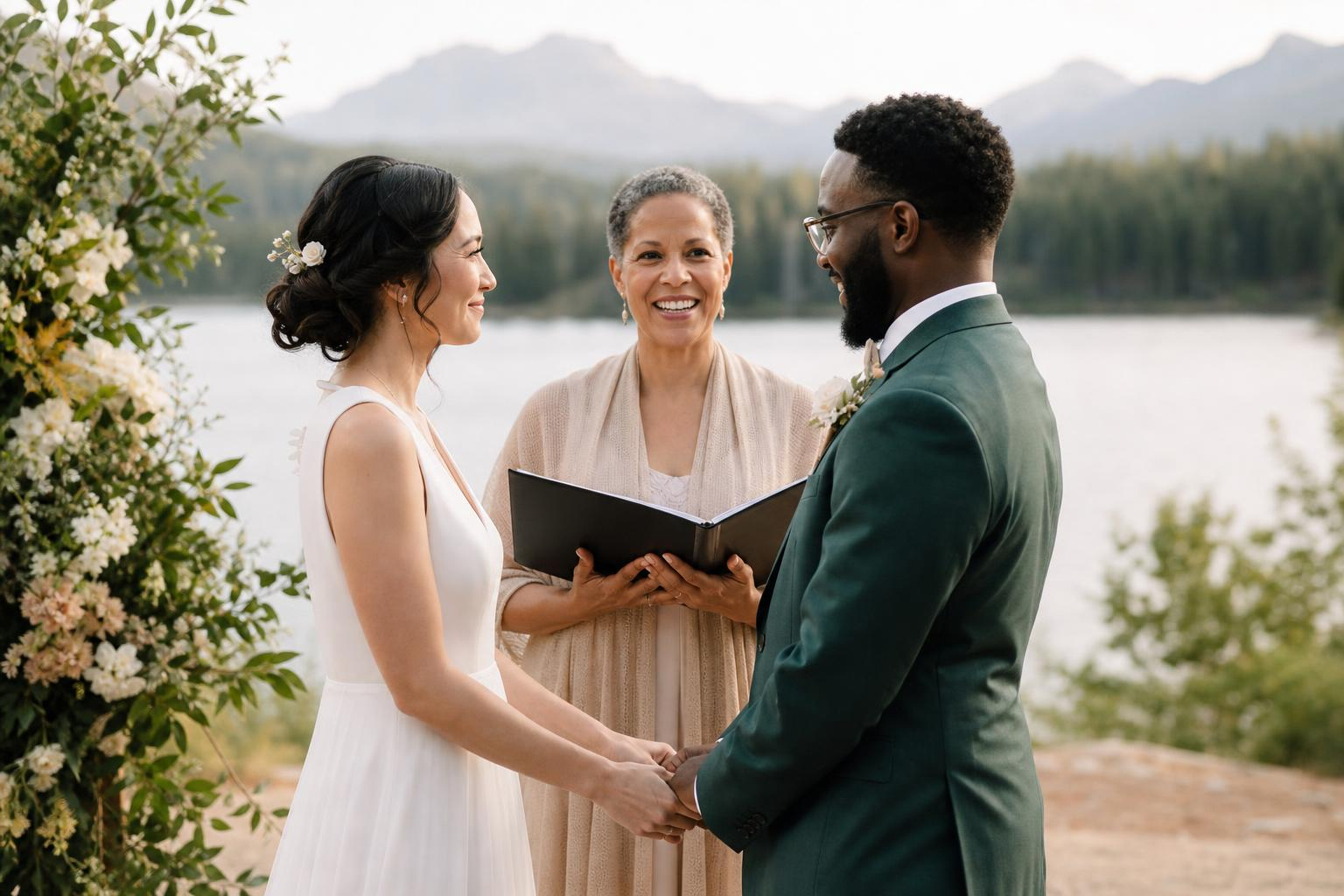
Quick answer: A declaration of intent is the couple’s clear statement that they choose to marry each other. Wedding vows are the personal promises they make about how they will live out that marriage.
Those two moments can sound alike, and some ceremonies blend them together. Still, keeping the distinction clear helps you write a ceremony that feels personal without overlooking the formal parts that may matter where the wedding takes place.

Because marriage rules differ by jurisdiction, treat this as a ceremony-planning guide rather than legal advice. Before finalizing your script, confirm the local requirements through the appropriate marriage authority. The USA.gov marriage-laws resource provides a useful starting point, and OrdainedPro’s state requirements map can help you identify the next place to check.
What a declaration of intent does
The declaration of intent is the part of the ceremony where the officiant asks each partner whether they freely choose to marry the other. Each person then gives a clear affirmative response, such as “I do,” “I will,” or another response that plainly communicates consent.
In practice, the declaration is usually brief and direct. The officiant may ask, “Do you, Alex, take Jordan to be your spouse?” The partner might answer, “I do.” The question can be warm and modern, traditional, religious, or simple, but the meaning should remain unmistakable.
Do not assume that one exact sentence is used everywhere. Wording, ceremony requirements, officiant qualifications, witnesses, license procedures, and filing duties can vary by state, county, or other local authority. The National Conference of State Legislatures overview of marriage officiants is helpful for understanding why local checking matters.
What wedding vows are meant to do
Wedding vows are promises between the partners. They describe the qualities, commitments, and choices the couple wants to bring into married life. Vows may include promises to listen, support one another, make room for laughter, care for family, or keep choosing the relationship during difficult seasons.

Unlike a declaration of intent, vows are usually written to sound like the couple themselves. One couple may choose classic language. Another may write three honest sentences. A third may use repeat-after-me vows because public speaking feels intimidating.
Personal vows and repeat-after-me vows
Personal vows: Each partner writes and delivers original promises. This format gives the couple the most room for personality, but it benefits from a time limit and a little rehearsal.
Repeat-after-me vows: The officiant speaks one short phrase at a time, and the partner repeats it. This is often easier for nervous speakers and helps the ceremony stay paced.
Traditional vows: The couple uses established language supplied by the officiant, a faith community, or another ceremony tradition. If the wording comes from a religious or cultural source, confirm that it fits the couple’s wishes and the setting.
Declaration of intent vs. vows: a practical comparison
| Ceremony element | Main purpose | Typical style | Officiant’s job |
|---|---|---|---|
| Declaration of intent | Confirm that each partner chooses to enter the marriage | Short, direct, and clear | Ask the question, listen for an affirmative response, and keep the exchange unambiguous |
| Wedding vows | Express promises about the couple’s life and commitment | Personal, traditional, religious, humorous, or repeat-after-me | Set expectations, provide prompts, and protect the couple’s pace and privacy |
| Ring exchange | Use rings as a visible symbol of commitment | Brief words or longer ring vows | Coordinate the handoff and make sure each partner knows when to speak |
| Pronouncement | Close the formal ceremony with the officiant’s declaration | Traditional or personalized | Use wording appropriate to the jurisdiction and the ceremony’s tone |
The table shows the central distinction: the declaration answers, “Are you choosing this marriage?” The vows answer, “What promises are you making within it?” A strong ceremony gives each question its own space, even when the language is elegant and compact.
Which comes first in a wedding ceremony?
A common structure places the declaration of intent before the personal vows. That order gives the ceremony a steady progression: welcome the guests, establish the meaning of the gathering, confirm the couple’s intent, exchange vows, exchange rings if desired, and conclude with the pronouncement.
A simple ceremony sequence
- Welcome and opening: Explain why everyone has gathered.
- Relationship or commitment reflection: Share a short message suited to the couple.
- Declaration of intent: Ask each partner whether they choose to marry.
- Personal vows: Invite the couple to make their promises.
- Ring exchange: Include it as a symbolic element if the couple wants it.
- Pronouncement and closing: Follow the locally appropriate process and end with a clear transition to celebration.
This is a useful default, not a universal script. Some couples prefer to exchange vows before the declaration. Others combine the two in a short repeat-after-me passage. The important thing is that the couple understands what each section means and that any required elements are handled according to local rules.
How to write a clear declaration of intent
When you draft this part, keep your creativity on a short leash. The declaration should sound like the couple, but it should also make the decision to marry plain to everyone in the room.
Four drafting checks
- Name both partners clearly. Use the names and forms of address the couple has approved.
- Ask a direct question or use an unmistakable statement. Avoid language that sounds like a general promise of love but never identifies the decision to marry.
- Confirm the response. Make sure each partner knows whether to answer “I do,” “I will,” “We do,” or another agreed response.
- Respect identity and tradition. Ask whether the couple prefers “spouse,” “partner,” “husband,” “wife,” or another term.
A clean example might be:
“Taylor, do you freely choose Morgan as your spouse and enter into marriage together?”
“I do.”
That example is for planning inspiration, not a statement that the wording is legally sufficient everywhere. Check the local authority before treating any sample as final.
How to help couples write meaningful vows
Many couples are not short on feelings; they are short on a starting point. Give them a simple framework rather than asking them to produce a perfect speech.
A practical vow framework
- Begin with recognition: Name what the partner means to you.
- Recall a shared quality: Mention patience, humor, courage, curiosity, faith, or another real strength.
- Make concrete promises: Promise actions, not only emotions.
- Look ahead: Describe the kind of life you hope to build.
- Close with a clear commitment: End with a sentence that feels natural to say aloud.
Ask the couple to keep the vows focused enough to deliver comfortably. You are not grading literature. You are helping two people speak honestly in front of the people who matter to them.
What would make the vows sound like this particular couple rather than a generic wedding script?
Example: “We want our vows to feel relaxed, specific, and lightly humorous, with promises about teamwork, travel, and showing up for one another when life gets difficult.”
Short answer: Specific promises, natural language, shared humor.
Officiant preparation checklist
- Confirm the couple’s preferred names and pronouns.
- Ask whether the vows are personal, traditional, or repeat-after-me.
- Confirm who speaks first and whether both partners use the same format.
- Print or load the declaration and vows in separate, clearly marked sections.
- Rehearse pauses, ring handoffs, and responses.
- Verify local ceremony and filing requirements before the wedding day.
What to confirm before the ceremony
Your final review should cover both the couple’s experience and the administrative details. Start with the local marriage authority, not with a favorite script template.
Confirm the applicable rules for the place where the ceremony will occur, including who may officiate, whether witnesses are required, what the officiant must sign, and how the completed license is returned. Requirements can change, and a general article cannot replace instructions from the relevant government office.
Then review the script with the couple. Explain which parts are formal, which parts are optional, and which parts can be personalized. If the couple wants an unusual format, such as a declaration spoken together, a private vow exchange, or a ceremony with no rings, make sure the spoken intent remains clear and the local requirements are still addressed.
For state-specific research, begin with the OrdainedPro requirements map and then confirm details with the appropriate government or county authority. Keep a copy of the source or instructions you relied on in your planning file.
A calm way to explain the difference to couples
When a couple asks, “Do we need both?”, answer in plain language: “The declaration of intent is the clear decision to enter the marriage. The vows are the promises you want to make within that marriage. We can keep both short, combine them carefully, or give each its own moment, as long as the required local elements are handled correctly.”
That explanation reassures the couple without pretending that every jurisdiction works identically. It also gives them room to choose a ceremony that feels like theirs.
Frequently Asked Questions
Is a declaration of intent the same as wedding vows?
No. A declaration of intent confirms that each partner chooses to enter the marriage. Wedding vows are the personal promises the partners make about their shared life. Some ceremonies combine the two, but they serve different functions.
Do couples have to exchange personal wedding vows?
Personal vows are often optional, but ceremony requirements vary by jurisdiction. A couple may use traditional vows, repeat-after-me wording, or a short ceremony format. Confirm the local requirements before deciding what can be omitted.
What does a declaration of intent usually sound like?
It is commonly phrased as a direct question, such as asking whether one partner freely chooses the other as a spouse, followed by a clear affirmative response. The exact wording should be reviewed for the location where the ceremony takes place.
Which comes first, the declaration of intent or the vows?
The declaration of intent commonly comes before the personal vows, but the order can be personalized when local requirements are respected. Keeping the declaration separate often makes the ceremony easier for guests and the couple to follow.
Can the couple say the declaration of intent together?
Some couples prefer a shared response such as “We do.” Whether that format is acceptable for the ceremony depends on local requirements, so verify it with the relevant marriage authority before finalizing the script.