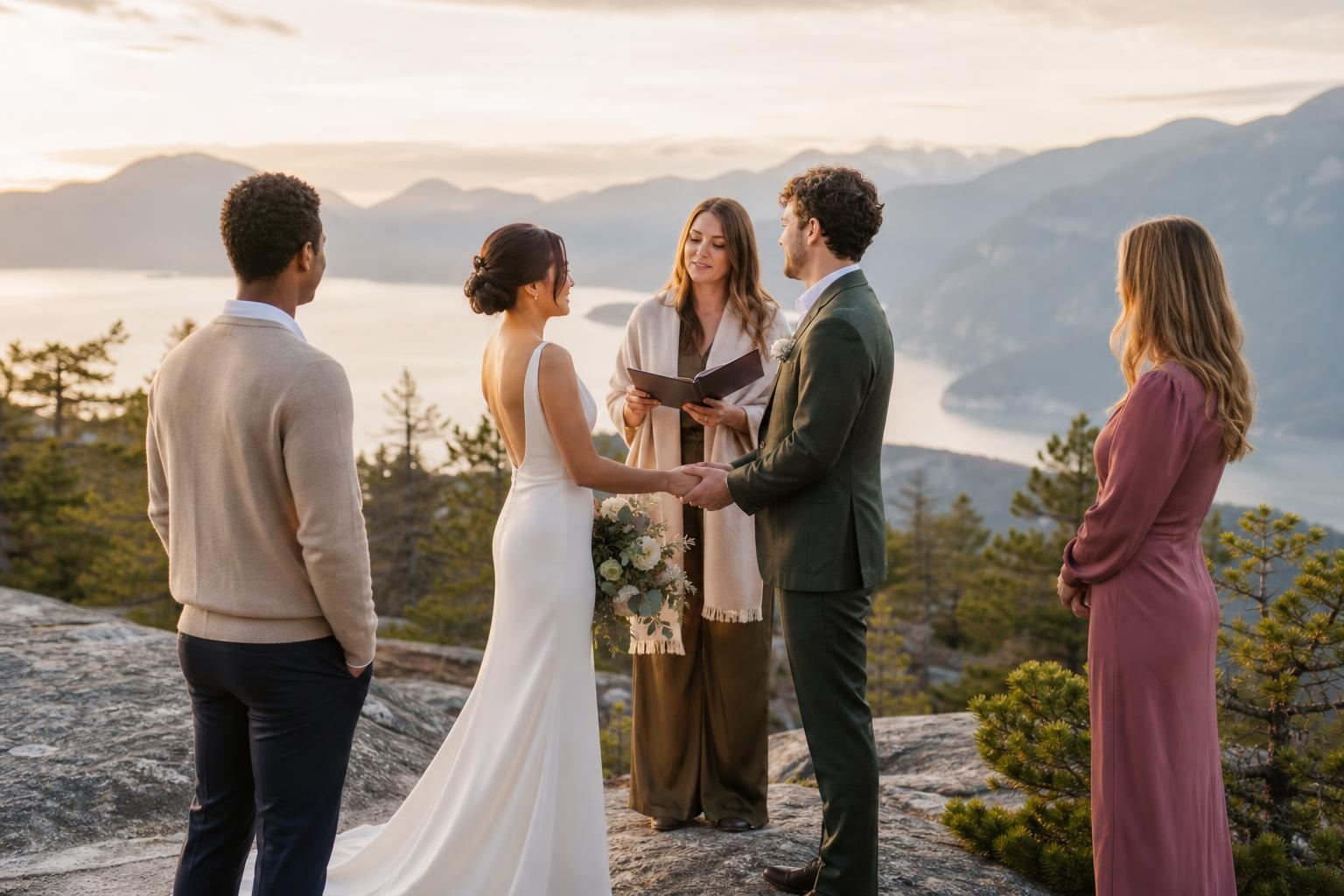
Elopement Ceremony Script for an Intimate Wedding
An elopement does not need a long program, a crowded venue, or a room full of formalities to feel deeply meaningful. What it does need is a clear beginning, a few honest words, intentional vows, and a confident officiant who knows what comes next.
This compact elopement ceremony script is designed for a couple, an officiant, and witnesses at an intimate wedding. You can use it as written, trim it for a shorter ceremony, or add personal details that reflect the couple’s story and setting.

Important planning note: Marriage-license, officiant, witness, filing, and location requirements vary by jurisdiction. Confirm current requirements with the appropriate state or local authority before the ceremony. OrdainedPro’s marriage-law and officiant lookup map can be a useful starting point, but it should not replace confirmation from the issuing government office.
1. Build the ceremony around five simple moments
A short ceremony is easiest to officiate when it has a dependable structure. Think of it as a steady path rather than a performance.
- Welcome: Bring everyone’s attention to the moment.
- Meaning: Explain why the couple chose to marry in this intimate way.
- Promises: Invite personal vows or guide the couple through repeat-after-me vows.
- Ring exchange: Give the couple a physical, memorable action.
- Pronouncement: Close with confidence and celebration.
That structure is enough for a sincere elopement. Read it aloud before the wedding so you can hear where the pacing feels natural. A script that looks brief on a page may take longer when the couple pauses, laughs, or gets emotional.
2. A compact elopement ceremony script
The following wording is intentionally warm, flexible, and easy to deliver outdoors or in a small indoor space.
Welcome and opening
Officiant: “Welcome, everyone. We are here to celebrate the marriage of [Name] and [Name]. Today is simple by design, but it is no less important. In choosing this intimate ceremony, you have made room for what matters most: your promises, your presence, and the life you are building together.”

“Marriage is a partnership shaped in ordinary moments as much as in extraordinary ones. It asks for honesty, patience, laughter, forgiveness, and the willingness to keep choosing one another. Today, you make that choice openly and with intention.”
Declaration of intent
Officiant: “[Name], do you take [Name] to be your spouse, promising to share your life with them, to support them, and to stand beside them through the years ahead?”
Partner: “I do.”
Officiant: “[Name], do you take [Name] to be your spouse, promising to share your life with them, to support them, and to stand beside them through the years ahead?”
Partner: “I do.”
Personal vows
Officiant: “[Name], please share your vows.”
Partner: “I, [Name], choose you, [Name], as my spouse and my partner. I promise to meet our life with honesty, kindness, and courage. I will celebrate your joys, respect your hopes, and stand with you when life is difficult. I promise to keep learning you, loving you, and choosing you, today and every day.”
Officiant: “[Name], please share your vows.”
Partner: “I, [Name], choose you, [Name], as my spouse and my partner. I promise to meet our life with honesty, kindness, and courage. I will celebrate your joys, respect your hopes, and stand with you when life is difficult. I promise to keep learning you, loving you, and choosing you, today and every day.”
If the couple has written their own vows, replace the sample wording with their vows and keep the transition simple: “[Name], please share the promises you have prepared.”
Ring exchange
Officiant: “These rings are a visible reminder of the promises you are making today. They have no beginning or end, just as your commitment is meant to be carried forward through every season.”
Officiant to first partner: “Please place the ring on [Name]‘s finger and repeat after me: ‘With this ring, I give you my love and my promise. I choose you today and always.’”
Officiant to second partner: “Please place the ring on [Name]‘s finger and repeat after me: ‘With this ring, I give you my love and my promise. I choose you today and always.’”
Pronouncement
Officiant: “[Name] and [Name], you have spoken your intentions, shared your vows, and exchanged rings. By the authority entrusted to me, and in accordance with the requirements that apply to your marriage, I now pronounce you married.”
“You may kiss.”
“Please join me in celebrating [Name] and [Name].”
3. Make the wording fit the couple and the landscape
The strongest elopement ceremonies sound like the couple, not like a generic form. Before the wedding, ask what they want the ceremony to feel like: quiet and reflective, playful and relaxed, spiritual, romantic, adventurous, or family-centered.
Use the setting sparingly. A mountain overlook, shoreline, desert trail, garden, or courthouse room already carries visual meaning. You do not need to describe every detail. One thoughtful sentence is usually enough.
Example: “Here beside the water, with the sound of the waves around you, you are beginning a marriage grounded in movement, steadiness, and shared adventure.”
Short answer: Let the setting support the promises.
For a religious or spiritual ceremony, use only language the couple has specifically requested and that you are authorized and comfortable to deliver. If a faith community, clergy member, or religious organization has its own requirements, confirm those directly rather than assuming a civil-style script will meet them.
4. Plan for witnesses, documents, and the officiant’s job
In an intimate wedding, witnesses may be close friends, relatives, hired witnesses, or people the couple has just met through travel arrangements. Give them a clear role so they do not feel like extra furniture in the scene.
Simple witness wording
Officiant: “You have been invited to witness these promises. Your presence helps mark this moment, and your support can remain part of this couple’s story long after today.”
If witnesses need to sign a marriage document, tell them in advance when and where that will happen. Keep pens, identification reminders, and document instructions separate from the ceremony script. The officiant should know who is responsible for returning or filing the paperwork, but should not guess at a jurisdiction’s process.
USAGov explains that a marriage license permits a couple to marry, while a marriage certificate serves as proof that the marriage took place. It also directs couples to the vital records office in the state where the marriage occurs for current instructions and copies. Review the official USAGov marriage certificate and license guidance and confirm details with the relevant local office. This legal and administrative guidance requires manual review before publication.
5. Scenic-location and travel considerations
A beautiful location can also create practical challenges. The officiant’s job is to help the couple enjoy the scenery without allowing the scenery to take over the ceremony.
| Planning area | What to confirm | Why it matters |
|---|---|---|
| Permission | Whether the location requires a permit, reservation, or special-use authorization | A public scenic area may still regulate ceremonies, group activity, equipment, or photography. |
| Access | Parking, trail distance, accessibility, restrooms, and cell service | Guests and vendors need to know what the location is actually like, not just how it looks in photos. |
| Weather | Wind, heat, rain, snow, smoke, tides, closures, and alternate locations | Outdoor conditions can affect safety, hearing, clothing, documents, and the couple’s comfort. |
| Visitor impact | Whether the ceremony may block paths, use decorations, play amplified music, or limit public access | Many scenic sites remain open to other visitors during the ceremony. |
| Travel timing | Arrival buffer, time-zone changes, traffic, shuttles, and seasonal road conditions | A late arrival can turn a peaceful ceremony into a rushed one. |
The National Park Service notes that wedding rules are location-specific. For example, National Mall wedding permits address equipment, candles, decorations, visitor access, and parking, while Glacier National Park advises couples to plan for changing weather, high visitation, and operational considerations. Some parks require a special-use permit for every wedding or elopement, and a permit may not give the couple exclusive use of the site. Review the location’s official rules, such as the National Mall wedding permit guidance or Glacier National Park wedding information, before promising anything to the couple.
Outdoor elopement checklist
- Confirm the exact ceremony location and backup plan.
- Check permit, parking, access, and visitor-use rules.
- Print directions and the ceremony script.
- Protect the marriage documents from wind, rain, and sand.
- Bring water, a charged phone, and a simple timepiece.
- Decide who cues music, rings, vows, and photographs.
6. Rehearse the transitions, not every emotion
Couples rarely need to rehearse how to feel. They do benefit from knowing where to stand, when to turn toward each other, how to hold the rings, and who speaks first.
- Walk through the entrance: Decide whether the couple enters together, separately, or simply begins where they are standing.
- Practice the vow cue: Make sure each partner knows whether to repeat after you or read from a card.
- Test the ring handoff: Decide who holds the rings and how they reach each partner.
- Set the photo pause: After the pronouncement and kiss, pause for a few seconds before moving.
- Agree on recovery words: If someone loses their place, calmly say, “Take your time,” then repeat the last cue.
For travel weddings, send the couple a one-page version of the ceremony several days ahead. Include the meeting point, expected walking conditions, weather plan, document reminder, and your phone number. Keep the full script with you, but give the couple a shorter ceremony outline so they know what to expect without feeling over-rehearsed.
7. Close the ceremony with calm confidence
The last minute often feels bigger than the first. Speak clearly, leave a beat after the pronouncement, and give the couple permission to enjoy what just happened.
After the kiss, you can say: “Take a moment to look around and take this in. This place, these people, and these promises will always be part of the beginning of your marriage.” Then announce the next step, whether that is photographs, signing documents, a toast, or a quiet walk together.
A good elopement ceremony script does not try to fill every silence. It gives the couple a trustworthy framework, leaves room for genuine emotion, and helps the day move smoothly from one meaningful moment to the next.
Ready to officiate the ceremony?
Personalize the names, pronouns, vows, spiritual language, and setting reference. Confirm the local paperwork and location rules, print a readable copy, and rehearse the transitions once. Then arrive early, stay observant, and let the couple’s promises remain at the center of the day.
Frequently Asked Questions
How long should an elopement ceremony be?
Many intimate ceremonies work well when they are brief enough to feel focused but spacious enough for vows, pauses, and photographs. Build around a welcome, intent, vows, rings, and pronouncement, then adjust the length to the couple's preferences and location.
Can couples write their own elopement vows?
Yes. Personal vows can replace the sample repeat-after-me vows in this script. The officiant should confirm who speaks first, give each partner a clear cue, and keep a backup copy available.
Do elopement ceremonies need witnesses?
Witness requirements vary by jurisdiction and may also depend on the marriage documents being used. Couples should confirm the current rule with the government office issuing the license before the ceremony.
Does an elopement at a scenic public location require a permit?
It may. National parks and other public lands can have location-specific permit, access, equipment, photography, and visitor-use rules. Check the official site for the exact location before planning the ceremony.
What should an officiant bring to an outdoor elopement?
Bring a printed script, backup vows, a reliable pen, a charged phone, directions, water, weather protection for documents, and any ceremony items the couple requested. Confirm who is responsible for the marriage paperwork.
Can this elopement ceremony script be used for a religious wedding?
It can be adapted if the couple and the relevant faith authority approve the wording. Religious organizations may have their own preparation, language, or officiant requirements, so confirm those directly.