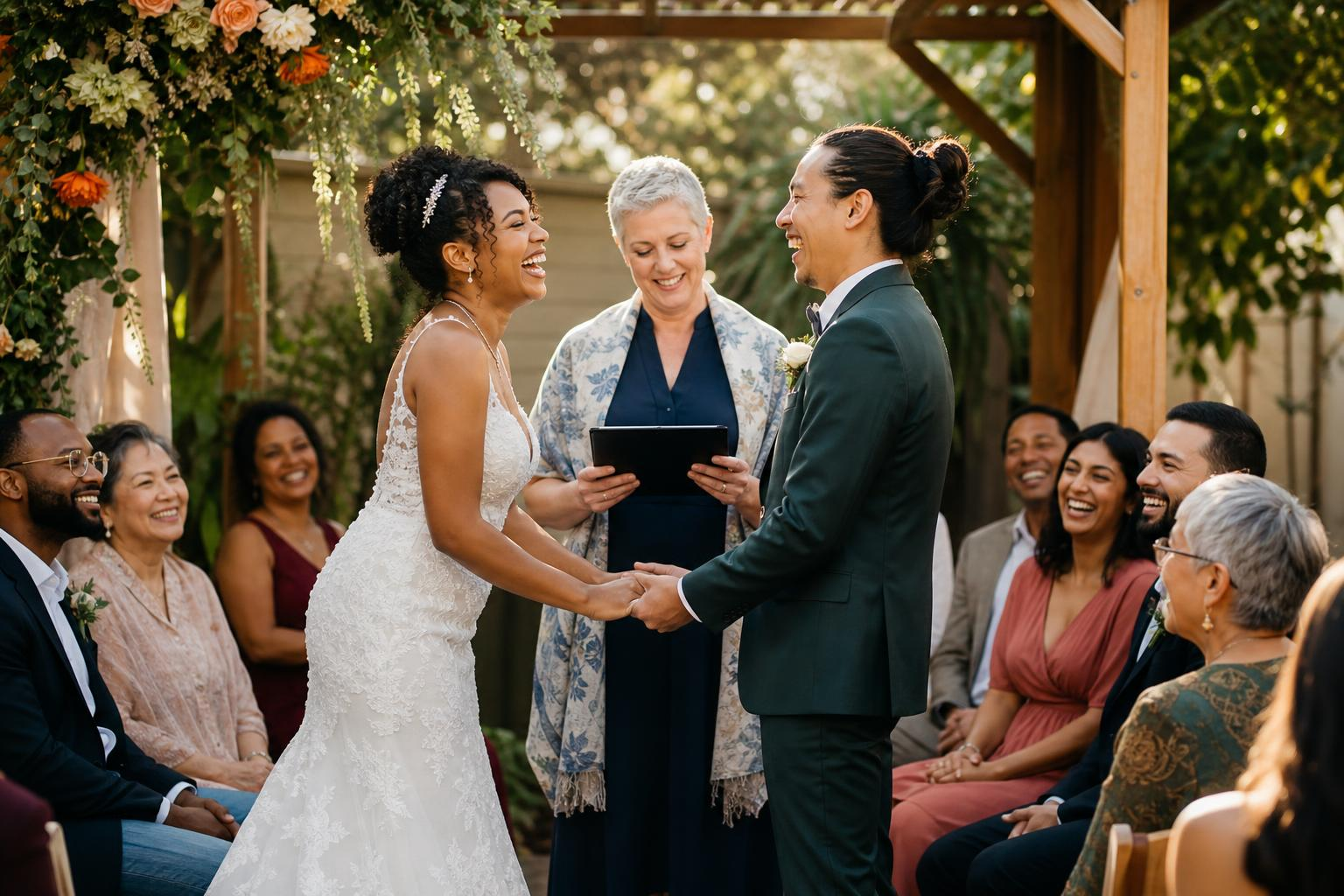
A funny wedding ceremony script should make people smile without making anyone wonder whether the ceremony has lost its heart. That balance is very doable. The best humor usually comes from the couple’s real personality: the habits they tease each other about, the ordinary moments that became treasured memories, and the promises they are genuinely excited to make.
As the officiant, your job is not to become the evening’s comedian. You are there to help the couple sound like themselves, welcome their guests into the story, and guide the room gently between laughter and sincerity.

Start with the couple’s actual sense of humor
Before writing a single joke, learn how the couple naturally laughs together. One pair may enjoy dry understatement. Another may love goofy wordplay, movie references, playful competition, or stories about daily life. Your script will feel meaningful when the humor grows from that shared language.
Ask the couple what they want guests to feel during the ceremony. Do they want a relaxed gathering that feels like a dinner with close friends? A polished ceremony with two or three light moments? A fully unconventional celebration? Their answer should shape the rhythm, vocabulary, and level of risk.
Planning question: What kind of laughter feels most like you as a couple?
Example: “We want guests to laugh because the ceremony sounds like our real conversations, but we still want the vows and commitment to feel grounded.”
Short answer: Personal, warm, and lightly playful.

The Knot’s guidance for officiants makes a similar practical point: the ceremony should stay focused on the couple rather than becoming a showcase for the officiant. Their advice also emphasizes asking follow-up questions about why a story mattered, not merely repeating what happened. Read more about writing an engaging officiant script.
Put humor in the right places
Not every line needs a laugh. In fact, humor usually works better when it has room to breathe. A simple structure is to place a light moment near the beginning, one or two personal observations in the middle, and a gentle smile near the closing. Then allow the vows, ring exchange, and declaration to carry their own emotional weight.
Good places for a laugh
- The welcome: Use a brief, friendly line to help guests settle in.
- The couple’s story: Mention a harmless habit, shared obsession, or funny first impression.
- The relationship lesson: Turn a practical truth into a loving observation.
- The promises: Add playful language only when the couple has approved it.
- The transition: Use a small smile before moving into a more heartfelt section.
Places to slow down
- The declaration of intent
- The couple’s personal vows
- Ring exchange wording
- Readings, blessings, or prayers
- The final pronouncement
A useful rule is simple: laughter should open the door to tenderness, not compete with it. After a joke, give the room a moment to respond before moving on. A calm pause often makes the next sincere sentence land better.
| Script moment | Humor usually works when it is… | Use caution when… |
|---|---|---|
| Opening welcome | Brief, inclusive, and easy for every guest to understand | It delays the ceremony or depends on inside knowledge |
| Couple’s story | Specific, affectionate, and connected to their growth | It exposes private details or embarrasses one partner |
| Promises | Clearly approved and balanced with sincere commitments | The joke could sound like the promise is not serious |
| Family or cultural elements | Respectful of the meaning and traditions involved | You are unsure whether humor is welcome in that setting |
| Closing | Hopeful, concise, and celebratory | It ends on a punchline instead of a blessing or strong wish |
Use original humor instead of borrowed punchlines
Original examples tend to feel more sincere because they point back to the couple’s life. You do not need a perfect joke. You need a recognizable truth expressed kindly.
Everyday partnership jokes
- “They have learned that love means sharing a life, a calendar, and occasionally the last quiet moment before the alarm goes off.”
- “They are promising to face the big decisions together, including the surprisingly serious question of where to order dinner.”
- “Their relationship is built on trust, affection, and a remarkable willingness to rewatch a favorite show because one of them fell asleep.”
Playful story transitions
- “That first conversation did not look like the beginning of a marriage. It looked like two people discovering they had very strong opinions about coffee.”
- “Over time, the small routines became the real love story: shared errands, familiar jokes, and the ability to communicate entire paragraphs with one raised eyebrow.”
- “They did not agree on everything. They simply became very good at deciding which disagreements deserved snacks and which deserved a walk.”
Lightly humorous promises
- “I promise to listen, even when I am already preparing my response.”
- “I promise to support your dreams, respect your quiet time, and ask before changing the thermostat.”
- “I promise to choose you in the big moments, the boring moments, and the moments when neither of us knows what we are doing.”
These lines are starting points, not finished copy. Change the details so the words sound natural when spoken aloud. A joke that reads well on a screen may feel stiff at a microphone.
Get clear consent before using personal material
Consent is more than asking, “Can I tell this story?” A responsible officiant confirms the details, the audience, and the limits. Couples may be comfortable laughing about a private habit in a planning meeting but not in front of grandparents, coworkers, children, or religious leaders.
Use a simple approval process:
- Share the exact wording. Do not ask for general permission and then improvise a sharper version at the ceremony.
- Ask both partners separately if appropriate. One person’s favorite story may be the other person’s sore spot.
- Clarify the audience. Mention whether the ceremony includes children, parents, professional contacts, or guests from different cultural backgrounds.
- Offer an easy veto. Tell the couple they can remove a line without explaining why.
- Mark approved and off-limits material. Keep those notes with your final script.
Example: “I have a line about the camping trip. I can use it as written, soften it, or leave it out entirely. Which version feels comfortable for both of you?”
Short answer: Exact wording, mutual approval, no pressure.
This approach also protects the couple from the common problem of a funny story becoming larger than the people it is supposed to celebrate. The American Psychological Association notes that communication patterns matter in relationships, which is a useful reminder for officiants: humor should support connection rather than create avoidable friction. Review the APA’s relationship communication guidance.
Know where tasteful humor does not belong
Some material is risky because it makes one person the target. Teasing can be affectionate when both people enjoy it, but a wedding ceremony is not the place to test whether a joke will finally land.
Be especially careful with:
- Embarrassing origin stories: First dates, drunken encounters, or rejected proposals may not feel funny to everyone involved.
- Family jokes: A comment about parents, in-laws, or family traditions can reopen old tension in a room where everyone is listening.
- Identity and belief: Religious practice, culture, disability, gender, sexuality, race, and family structure should never be treated as casual punchlines.
- Relationship fears: Jokes about leaving, cheating, being trapped, or “escaping” marriage can sound different when spoken during vows.
- Audience-dependent references: If half the room needs an explanation, the line may not belong in the ceremony.
If a joke creates a winner and a loser, set it aside. Choose humor that lets the couple laugh together, not humor that asks the guests to laugh at one partner.
Balance the funny lines with meaningful language
A ceremony feels substantial when it names what the couple is choosing. After a light observation, connect it to a value: patience, loyalty, curiosity, generosity, steadiness, or the willingness to keep learning one another.
For example:
“They have debated routes, restaurants, movie endings, and the correct way to load a dishwasher. Beneath all those decisions is something much more important: they keep making room for each other. They listen, adjust, and return to the same team.”
That kind of passage works because the joke is not the destination. It points toward partnership. You can use the same pattern throughout the script:
- Begin with a recognizable detail.
- Let the room smile.
- Explain what the detail reveals about the relationship.
- Move into a sincere statement or promise.
Readings can help with this balance, especially when the couple wants a lyrical or reflective moment. The Poetry Foundation maintains a collection of wedding poems and love poems that can help couples explore different tones, from classic and formal to contemporary and playful. Browse the Poetry Foundation’s love-poem collection.
Rehearse the script like a real ceremony
Good writing can still stumble if it has not been spoken aloud. Rehearse with the couple, and if possible, practice standing, pausing, looking up, and moving between sections.
Final rehearsal checklist
- Read every joke aloud at a natural pace.
- Confirm the couple approved the final wording.
- Check that names and pronouns are correct.
- Mark pauses after expected laughs.
- Keep meaningful sections free from unnecessary ad-libs.
- Prepare a clean printed or digital backup.
- Know which lines can be removed if the room feels different than expected.
During rehearsal, notice whether the couple laughs comfortably or looks toward one another for reassurance. Their reaction is valuable information. A line that seemed clever in a message may not sound like them when spoken in front of a room.
Also consider the setting. Outdoor ceremonies may have wind, distance, and microphone issues. A joke with subtle wording may disappear if guests cannot hear every word. Choose clear language, and do not rely on timing that requires perfect audio.
Keep the ceremony about the marriage, not the performance
The strongest funny wedding ceremony script feels generous. It welcomes guests, honors the couple, and gives everyone a glimpse of the life they are building. It does not require the officiant to dominate the room.
When in doubt, shorten the joke and strengthen the meaning that follows. One warm laugh connected to a true observation is usually more memorable than a string of punchlines. The Knot likewise advises officiants to keep the focus on the couple and avoid turning the ceremony into a one-person show. See additional funny ceremony script ideas from The Knot.
Before the ceremony begins, review any required wording, signatures, or procedural instructions with the appropriate marriage authority for the location. Requirements can vary, and this article is general planning guidance rather than legal advice.
Take the next step: Draft three personal details, three sincere values, and three possible jokes. Share the exact wording with the couple, remove anything that makes either partner uneasy, and build the final script around their promises—not your punchlines.
Frequently Asked Questions
How much humor should a funny wedding ceremony script include?
Usually, a few well-placed humorous moments are enough. Focus on a warm opening, one or two personal observations, and perhaps a light promise, while allowing the vows and declaration to remain sincere.
What makes wedding ceremony humor meaningful?
Meaningful humor reveals something true about the couple and connects naturally to a relationship value such as patience, loyalty, teamwork, or choosing one another every day.
Should an officiant ask permission before telling funny stories?
Yes. Share the exact wording with both partners, confirm what topics are off-limits, and give them an easy way to remove or revise any line.
What wedding ceremony jokes should officiants avoid?
Avoid jokes involving infidelity, divorce, ex-partners, money, fertility, pregnancy, appearance, family conflict, private sexual experiences, identity, or anything that makes one partner the target.
Can funny vows still feel serious?
Yes. A playful promise can work when it is balanced with clear commitments about love, support, respect, and partnership. The couple should approve the exact wording before the ceremony.
How can an officiant tell whether a joke works?
Read it aloud during rehearsal and watch the couple’s reaction. The joke should sound natural, be understandable to the audience, and leave room to transition into a sincere thought.