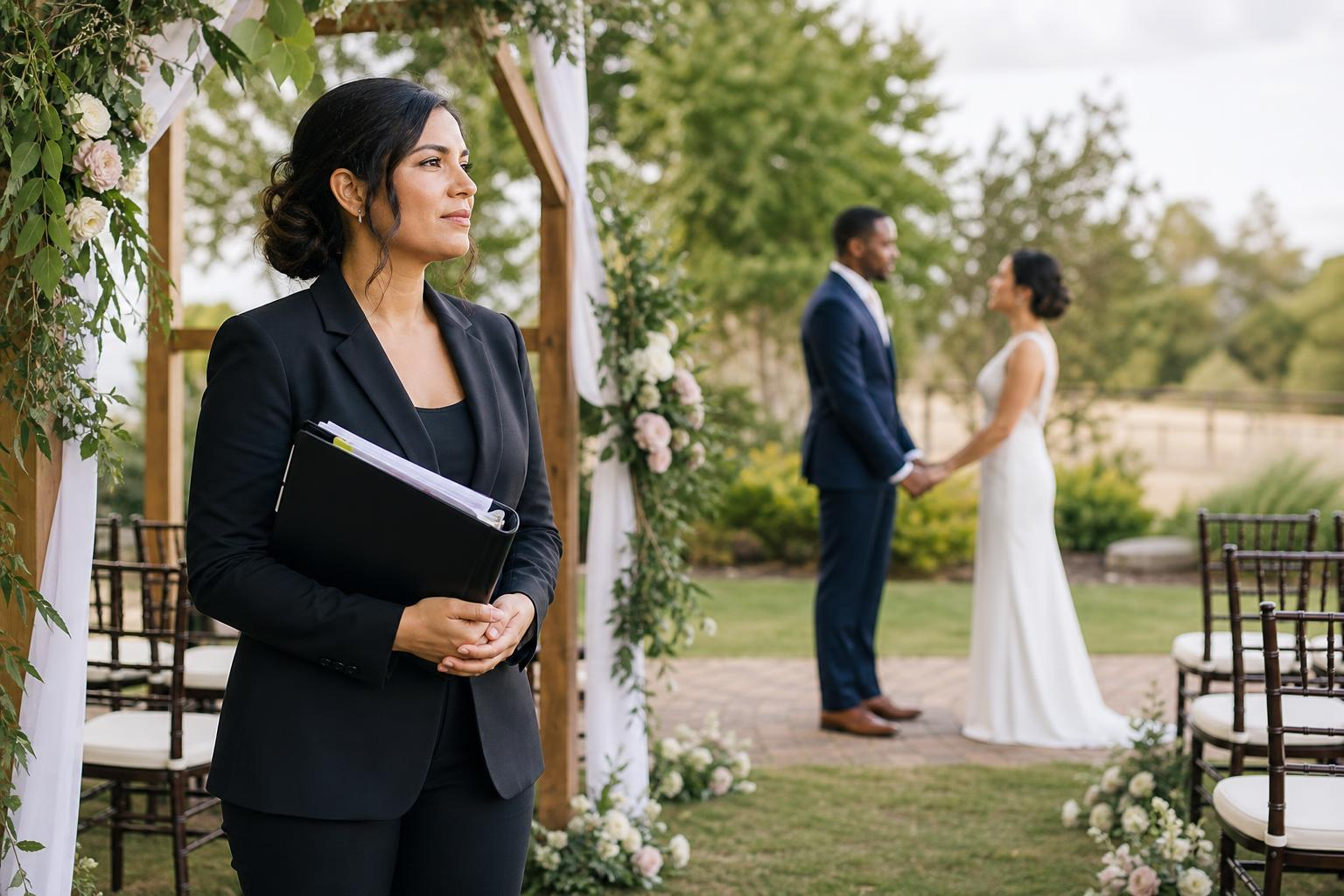
Officiant confidence guide
How to Calm Wedding Ceremony Nerves as an Officiant
Being a nervous wedding officiant does not mean you are unprepared or unsuited for the job. It usually means you understand that the ceremony matters. The goal is not to eliminate every flutter in your stomach. The goal is to give those nerves a dependable place to go: your breathing, your preparation, your notes, and your attention to the couple.

With a simple plan, you can steady your voice, recover from small mistakes, and lead the ceremony with warmth instead of rushing through it.
1. Know what your nerves are trying to tell you
Before you fight your nerves, name what is happening. A racing heart, dry mouth, tense shoulders, or a suddenly busy mind are common stress responses before an important performance. The National Institute of Mental Health explains that stress can be a short-term response to an external situation, while anxiety may continue even when there is no immediate threat.
For an officiant, the useful distinction is practical: ordinary pre-ceremony nerves often respond well to preparation and calming routines. If intense anxiety continues outside ceremonies, causes you to avoid important activities, or interferes with daily life, consider speaking with a qualified health professional. This article is not medical advice, and you do not need to handle persistent distress alone.
Reframe the job. You are not performing a one-person show. You are helping two people and their guests move through a meaningful sequence of moments. Your attention belongs partly on the couple, not entirely on how you look or sound.
2. Build a short calming routine before the ceremony
Do not wait until your hands are shaking to decide how you will calm down. Test a brief routine during rehearsal, then use the same sequence on the wedding day. Familiarity matters because your mind has fewer decisions to make when the pressure rises.

A simple five-minute reset
- Plant your feet. Stand with both feet about hip-width apart. Relax your knees and let your shoulders drop.
- Breathe gently. The NHS breathing exercise guide recommends comfortable breathing, inhaling gently and exhaling slowly. Try breathing in through your nose and out through your mouth without forcing a deep breath.
- Lengthen the exhale. If it feels comfortable, inhale for four counts and exhale for six. Repeat several times. Stop or return to normal breathing if you feel lightheaded.
- Release physical tension. Unclench your jaw, lower your shoulders, and loosen your grip on your notes.
- Say one steady sentence. Try, “I know the next step,” or “Slow is steady.”
Regular practice is more useful than a dramatic last-minute rescue. The NHS notes that breathing exercises tend to be most useful when practiced regularly, not only during a stressful moment.
Example: You arrive fifteen minutes early, step somewhere quiet, place both feet on the floor, complete several comfortable breaths, read your opening sentence aloud, and check that your ceremony packet is in order.
Short answer: Breathe, ground, review, begin.
3. Rehearse the ceremony as a sequence, not just a script
Reading the ceremony silently is not the same as leading it. A nervous wedding officiant benefits from rehearsing the physical and verbal sequence together.
Practice in layers
- Read aloud once. Listen for sentences that feel awkward, too formal, or difficult to say in one breath.
- Mark the transitions. Identify when you welcome guests, invite readings, ask the couple questions, guide vows, announce rings, and close the ceremony.
- Practice with movement. Stand where you expect to stand. Turn toward the couple when addressing them and toward the guests when making a public announcement.
- Time a full run-through. Use the real script, the real pauses, and any readings or rituals that will be included.
- Practice one recovery. Intentionally lose your place once, pause, find your marker, and continue.
Toastmasters International recommends practicing aloud, recording yourself, visualizing the event, walking through the speaking space, and practicing recovery from mistakes. Those techniques translate well to a wedding because the ceremony has a clear structure and several predictable handoffs.
Do not memorize every word unless the couple specifically wants a fully memorized ceremony and you can deliver it naturally. A well-organized script with clear prompts is often safer than relying on memory while emotions are high.
Use a three-part rehearsal check
| Rehearsal focus | What to check | Why it helps |
|---|---|---|
| Words | Opening, names, vows, ring wording, closing | Reduces uncertainty about what comes next |
| Movement | Where you stand, turn, pause, and hand off | Prevents awkward searching during the ceremony |
| Recovery | What you will do after a stumble or blank moment | Turns a surprise into a practiced step |
4. Print and organize notes for a calm glance
Your notes should support you without making you look down constantly. A nervous officiant often becomes more nervous after losing a place in the script, so make the page easy to navigate.
Make the script ceremony-friendly
- Use a readable font and generous line spacing.
- Start each major section on a new page when practical.
- Bold or highlight names, vows, ring prompts, and key transitions.
- Write stage directions in a different style, such as uppercase or brackets.
- Number every page and mark the front of the packet.
- Bring a complete backup copy in a separate folder or bag.
- Keep a one-page running order available for quick orientation.
Put your opening and closing where they are easy to find. Those moments carry extra emotional weight, and knowing exactly how you will begin and finish can make the middle feel much easier.
Officiant note-packet checklist
- Names and pronunciations confirmed
- Final ceremony wording printed
- Pages numbered and clipped
- Backup copy packed
- Important cues highlighted
- Pen and water available
- Phone silenced or assigned to another person
Keep notes discreet. A slim folder, portfolio, or tablet may work well, but choose the format you have already practiced with. Wedding-day nerves are not the time to learn a new device, app, or teleprompter.
5. Slow your pacing without sounding stiff
Nerves commonly speed up speech. The result is not only harder for guests to follow; it can also make you feel as though the ceremony is running away from you. Your best pacing tool is a deliberate pause.
Mark the places where silence helps
Add a small slash or the word “pause” after the welcome, before important questions, after a reading, before the vows, and immediately after the couple responds. These pauses give guests time to absorb the moment and give you a quiet chance to breathe.
Speak in complete thought groups rather than trying to push through every sentence without stopping. Look up at the couple at the end of a meaningful line. That eye contact naturally slows you and makes the ceremony feel more personal.
Toastmasters also advises speakers to arrive early, become familiar with the speaking area, and test equipment such as microphones. Use that practical advice at the venue: locate your standing position, check whether the microphone is handheld or mounted, and confirm who will signal you if the ceremony order changes.
Try this rehearsal drill: Read one paragraph at your intended ceremony pace, then read it again while deliberately slowing the final three words of each sentence. Keep the version that sounds warm and natural, not theatrical.
6. Know how to recover when something goes wrong
Confidence does not mean nothing goes wrong. It means you know what to do next. A guest may cough, a ring may be misplaced, a name may come out incorrectly, or you may simply lose your place.
Use the pause-and-recover method
- Stop. Do not fill every second with “um” or an apology.
- Breathe once. Let the pause work for you.
- Find your marker. Use the bold heading, page number, or running order.
- Continue plainly. Say, “Let me return to that,” or “The next part of the ceremony is…”
If you mispronounce a name, correct it simply and move on. If you skip a sentence, do not restart the entire ceremony unless the couple asks you to. Guests are usually more interested in the couple than in evaluating your delivery.
Example: You lose your place just before the ring exchange. You pause, glance at the highlighted heading, and say, “Now we come to the exchange of rings.” The ceremony continues without a long explanation.
Short answer: Pause, locate, continue calmly.
Toastmasters’ video “5 Public Speaking Tips to Speak with Confidence,” presented by 2018 World Champion of Public Speaking Ramona Smith, may be helpful if you want a short visual refresher before practicing. It focuses on preparation and confident delivery rather than wedding-specific procedure.
7. Build confidence by serving the couple
The most dependable confidence is not the feeling that you are flawless. It is the knowledge that you have done your part to make the ceremony easier for the couple and guests.
Before the wedding, confirm the pronunciation of names, the order of the ceremony, who is reading, how the couple wants to be addressed, and what signals you should expect from the coordinator. On the day, greet the couple briefly, ask whether they need anything from you, and then give yourself permission to focus on the next clear step.
Ask yourself: What would help these two people feel supported during the next five minutes?
Example: The couple looks overwhelmed just before the processional, so you quietly remind them that you will guide the ceremony one part at a time and that they only need to listen for your prompts.
Short answer: Calm leadership through clear guidance.
If your nerves remain strong after careful preparation, start with lower-pressure practice opportunities. Read a short passage aloud, lead a rehearsal section, or practice in front of one supportive person. Repeated, manageable exposure can make the role feel more familiar over time.
A steady officiant is more valuable than a perfect one
You do not need a booming voice, perfect memory, or polished stage presence to lead a meaningful wedding ceremony. Prepare the sequence, print usable notes, practice your opening and recovery lines, breathe comfortably, and slow down enough to let the moment land.
On the wedding day, remember the simple assignment: be clear, be kind, and take the next step. That is more than enough to help the couple feel safe in your hands.
Frequently Asked Questions
Is it normal to feel nervous as a wedding officiant?
Yes. A wedding ceremony is an important public moment, so feeling some stress before speaking is common. Preparation, a simple breathing routine, organized notes, and a slower pace can help you manage it.
What should a nervous wedding officiant do right before the ceremony?
Arrive early, confirm the ceremony order, check the microphone or speaking area, place both feet on the ground, take several comfortable breaths, review the opening, and identify the next cue in your notes.
How can I stop rushing when I officiate a wedding?
Mark intentional pauses in your script, breathe after important lines, look at the couple before continuing, and practice aloud at a slower pace than feels necessary. Pauses usually sound shorter to the audience than they feel to the speaker.
Should a wedding officiant memorize the ceremony?
Usually, a well-organized script is safer than memorizing every word. Consider memorizing or becoming especially familiar with the opening and closing, while using clearly marked notes for vows, readings, names, and transitions.
What should I say if I lose my place during the ceremony?
Pause, breathe, find your page marker, and use a simple recovery line such as “Let me return to that” or “The next part of the ceremony is…” Then continue without overexplaining.
When should an officiant seek help for anxiety?
If anxiety persists outside ceremonies, interferes with daily life, causes significant avoidance, or feels difficult to manage despite reasonable preparation, consider speaking with a qualified health professional.