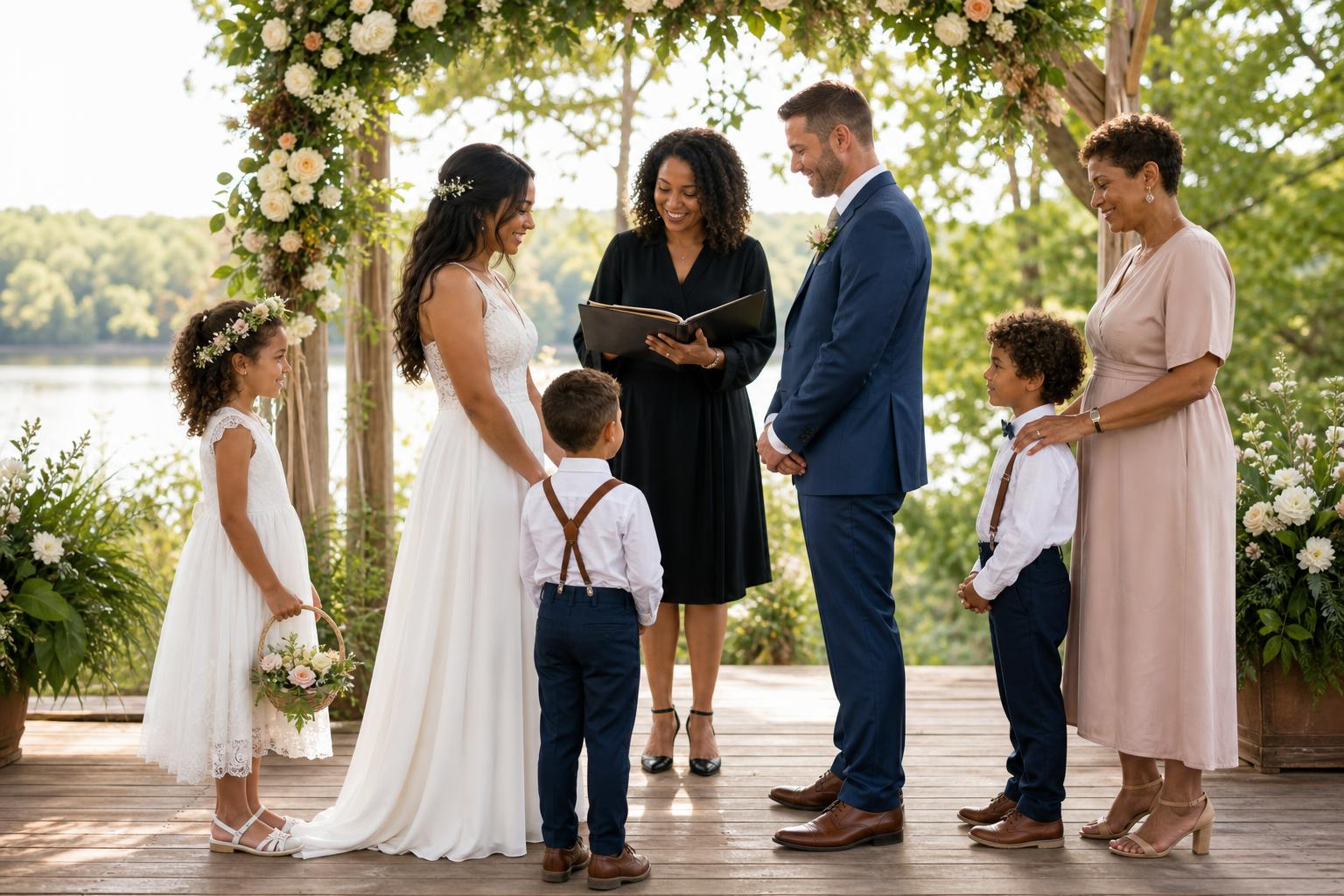
How to Include Children in a Wedding Ceremony
When a couple includes children in a wedding ceremony, the goal is not to create one more performance for the day. It is to help children feel seen, respected, and connected to what is happening. The best role is the one that fits the child, the family, and the tone of the ceremony.
Some children enjoy being in front of a crowd. Others would rather carry a small object, choose a reading, sit with a trusted adult, or participate privately. As the officiant, your job is to make room without making pressure. A thoughtful conversation before the rehearsal can prevent a lot of wedding-day worry.

The American Academy of Pediatrics recommends involving children in conversations about remarriage and allowing them to have a role in the celebration when they want one. Its guidance also emphasizes that family relationships develop gradually, not all at once. Read the American Academy of Pediatrics guidance on blending families.
Start with the child, not the ceremony script
Before suggesting a role, find out what the child actually wants. Adults often picture a charming flower girl, ring bearer, reader, or vow participant. The child may picture something entirely different—or may not want a public role at all.
Ask questions in a calm, private setting. Avoid asking in front of relatives or guests, where the child may feel obligated to say yes.
Useful questions include:
- Would you like to be part of the ceremony, or would you rather enjoy it as a guest?
- Would you feel comfortable walking in front of people?
- Would you rather speak, carry something, help with music, or participate quietly?
- Who would help you feel calm if you became nervous?
Example: “We are thinking about a few ways you could be part of the ceremony, but you do not have to choose a speaking role. You can help us decide what feels comfortable.”

Short answer: Ask first; assign second.
Choose an age-appropriate role
There is no single age chart that works for every child. Confidence, attention span, mobility, family relationships, and the ceremony setting all matter. A five-year-old who loves an audience may manage a visible role better than a quiet ten-year-old who dislikes public attention.
| Child’s comfort level | Possible ceremony roles | Planning note |
|---|---|---|
| Enjoys a simple task with little speaking | Flower child, ring bearer, processional helper, sign carrier | Keep instructions short and provide a trusted escort. |
| Likes participating but not being the focus | Reader with an adult, candle or sand helper, program assistant | Use a backup plan if the child freezes or changes their mind. |
| Comfortable speaking or leading | Reading, welcome, musical contribution, family blessing | Rehearse gently and allow notes or a co-reader. |
| Older child or teenager | Attendant, usher, reader, processional partner, ceremony assistant | Give the role real responsibility without treating the child like a prop. |
| Unsure, anxious, or resistant | Private family moment, photograph, pre-ceremony helper, guest | Participation can happen without being visible during the ceremony. |
The Knot also recommends asking children how they would feel most comfortable taking part and offers ideas such as wedding-party roles, unity ceremonies, vows, processional roles, readings, and traditional flower-child or ring-bearer duties. Review The Knot’s ideas for including children in a wedding.
Remember that a child’s role does not have to match a traditional title. An older child might serve as a ceremony attendant or help cue the music. A younger child might hold a parent’s hand during the processional rather than walk alone.
Use readings, music, and family words thoughtfully
Readings can be a lovely way to include children, especially when the selection reflects family, friendship, courage, belonging, or hope. A child does not need to read an entire passage. You can divide a short reading between siblings, pair a child with an adult, or invite the child to select the piece while someone else reads it.
Make speaking roles easier
- Choose a short passage with familiar language.
- Print the words in large type or place them in a simple folder.
- Let the child stand beside a trusted adult.
- Tell guests that a pause, mistake, or quiet voice is perfectly acceptable.
- Keep an adult ready to finish the reading if needed.
Music is another flexible option. A child might sing with a group, play an instrument, choose a processional song, or help create a playlist for the reception. If the child is not ready to perform, their musical choice can still be acknowledged in the program or by the officiant.
Example: “This reading was chosen by the couple’s children because it reflects the kind of home and family they hope to build together.”
Short answer: Let children contribute meaning, not pressure.
Consider family vows and unity rituals
Family vows can acknowledge children without asking them to make adult commitments. The couple may promise to offer patience, respect, support, and a welcoming home. The officiant can then invite the children to listen, receive a small token, or respond with a simple phrase only if they genuinely want to.
Keep the wording clear. A child should not be asked to promise that the new family will always be happy, that they will love a stepparent immediately, or that they will take responsibility for keeping adults connected. Those are burdens no child should carry during a wedding.
Low-pressure ritual ideas
- Family candle: Each person lights a candle or places a flame near a central candle with adult supervision.
- Sand ceremony: Each family member pours a different color of sand into one container.
- Family tree or artwork: Children contribute a drawing, written word, or small symbol to a display that the couple keeps afterward.
- Ring blessing: Children briefly hold the rings before the ceremony and offer a private wish for the couple.
- Family promises: The couple makes promises about kindness and care while the children simply stand with them.
For candles, glass vessels, sand, water, or other objects, plan the movement carefully. Decide who holds each item, where it goes next, and how the officiant will transition back into the ceremony. Small logistical details make the ritual feel calm rather than improvised.
Protect children from adult family tension
Weddings can bring complicated family relationships into the same room. A child may feel loyalty to a biological parent, uncertainty about a stepparent, sadness about a previous family structure, or discomfort with being presented as proof that everyone is now perfectly blended.
Use language that welcomes the child without claiming more than the family is ready to promise. “We are learning how to care for one another as a family” may be more honest than “We are now one happy family.” Steady language gives children room to have mixed feelings.
If another parent or guardian is actively involved in the child’s life, the couple should consider how the child’s role may affect that relationship. This is not a matter for public discussion during the ceremony. Handle sensitive decisions privately and respectfully, and avoid asking the child to take sides.
As officiant, you can also help the couple keep the ceremony focused. Do not include private family history, divorce details, custody disputes, or jokes about an absent parent. The ceremony should honor the people present without embarrassing or blaming anyone who is not.
Before the rehearsal, confirm:
- The child has agreed to the role freely.
- The child knows exactly what will happen and where to stand.
- A trusted adult is available to help.
- There is a simple backup plan.
- The wording does not ask the child to choose sides or make adult promises.
- The couple and officiant know how to proceed if the child opts out.
Build a backup plan that feels normal
Children may change their minds. They may become tired, shy, distracted, overwhelmed, or simply interested in something else on the wedding day. That is normal. A strong officiant plans for flexibility without making the backup feel like a failure.
Practical backup options
- Have an adult carry the rings while the child walks beside them.
- Let the child start the reading and have the officiant finish it.
- Move the child’s participation to a private moment before or after the ceremony.
- Seat the child with a trusted person instead of keeping them at the altar.
- Use a recorded song, family photo, or printed dedication if a performance is no longer comfortable.
At rehearsal, practice the route and the general sequence, but do not demand perfection. Children need to know what is expected, not feel that the ceremony depends on them getting every step right.
Example: “If you decide you do not want to walk down the aisle, that is okay. We can have you sit with Aunt Maya, and we will still be glad you are here.”
Short answer: Prepare alternatives without making them dramatic.
Keep the ceremony balanced
Including children should add warmth without making them responsible for the emotional center of the ceremony. The couple is still making the marriage commitment. Children can be honored as beloved family members without being asked to perform the role of spouse, witness to private promises, or mediator between adults.
A balanced ceremony might include a short acknowledgment, one child-friendly role, and a family ritual. That is often enough. More is not automatically more meaningful.
As you edit the script, check every sentence involving a child. Is it understandable? Is it kind? Does it leave room for the child’s real feelings? If the answer is yes, keep it. If it sounds like pressure, rewrite it.
For couples planning a ceremony that also involves state marriage requirements, direct them to the OrdainedPro state information map as a starting point. State rules and officiant requirements can vary, so legal details should be verified with the appropriate government authority before publication or ceremony planning.
Frequently Asked Questions
What are good ways to include children in a wedding ceremony?
Children can serve as flower children, ring bearers, readers, attendants, procession partners, music contributors, or helpers in a unity ritual. They can also participate privately through a family blessing, photograph, or keepsake.
Should children make vows at a wedding?
Children should never be pressured to make vows or adult-style promises. If the family wants to include children in the wording, the couple can make promises about care and respect while allowing the children to listen, respond briefly, or participate in a separate low-pressure way.
How can an officiant include a shy child?
Offer a role that does not require public speaking, such as standing with a trusted adult, helping with a unity ritual, carrying a sign, choosing a reading, or participating in a private family moment.
What should happen if a child changes their mind on the wedding day?
Use the backup plan without making the child feel guilty. An adult can take over the task, the child can sit with a trusted person, or the role can move to a private moment before or after the ceremony.
Can children from blended families participate together?
Yes. Children can share a reading, participate in a family ritual, walk together, or hold different parts of one symbolic item. The most important consideration is that each child is comfortable and is not being asked to represent a perfect or instant family bond.