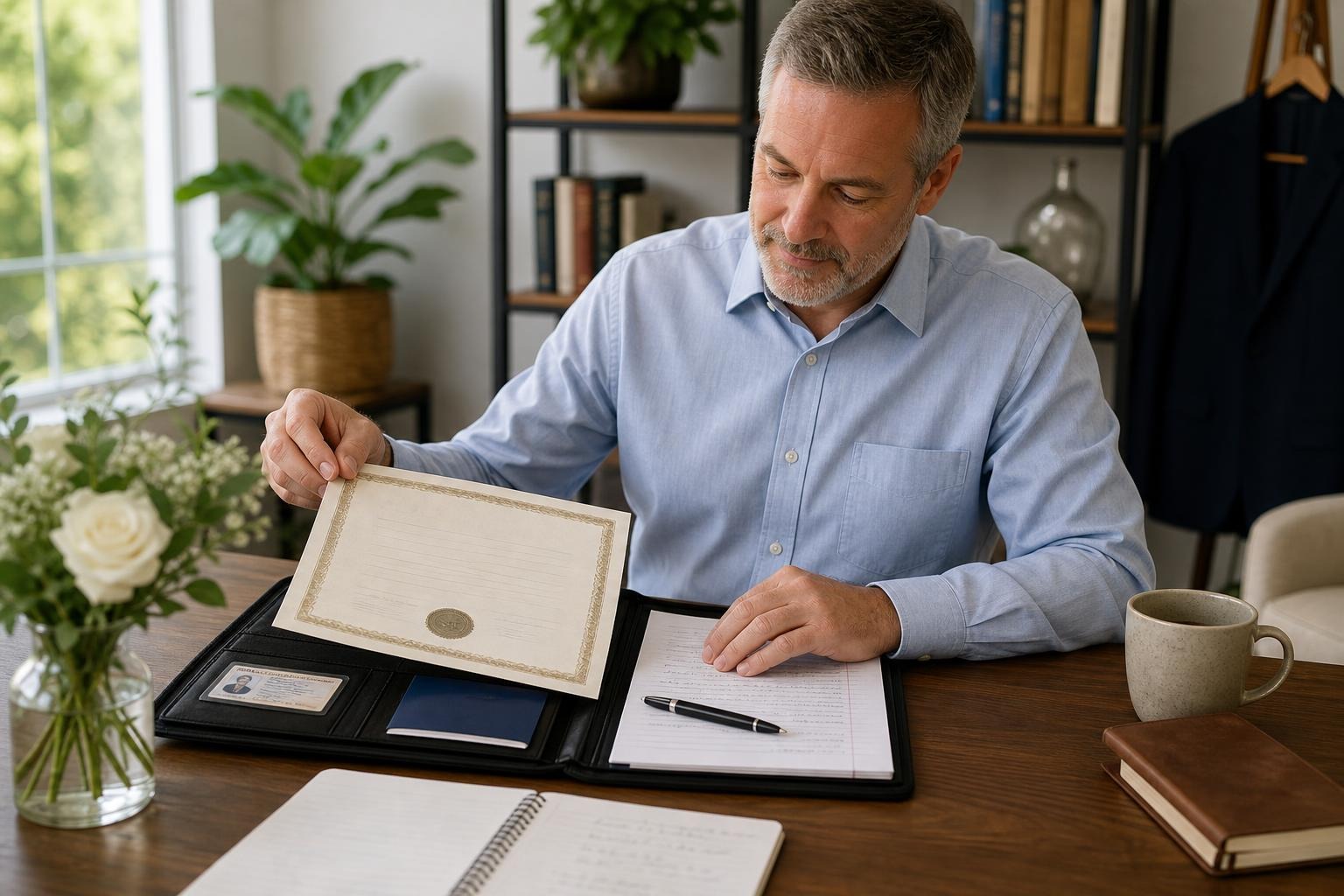
Getting ordained is an important first step, but it may not be the last step before you can legally officiate a wedding. Depending on where the ceremony takes place, you may need to register with a state, county, city clerk, or other marriage authority—or you may not need separate registration at all.
This guide will help you figure out what applies, prepare the right documents, and speak with the correct office before the ceremony date. It is general educational information, not legal advice. Marriage rules can change, so confirm the current requirements with the government office handling the couple’s marriage license.

First, understand the difference between ordination and registration
Ordination establishes your religious or organizational status. Registration, when required, is a separate civil or administrative step that may allow a government office to recognize you as an officiant for marriage ceremonies.
Those two steps often get blended together online, which is why newly ordained officiants can be surprised by a county-clerk form, a city registration process, or a request for proof of authority. Having an ordination certificate does not automatically answer every question about whether you may solemnize a marriage in a particular location.
Registration rules are local. Some jurisdictions require every eligible officiant to register before performing a ceremony. Others recognize certain categories of officiants without a separate registration process. Some places may require a one-time registration, while others may have a ceremony-specific license or filing.
For a general starting point, USA.gov directs people to the vital records or marriage authority in the state where the marriage is taking place. OrdainedPro users can also begin with the OrdainedPro marriage requirements map, then confirm the result directly with the appropriate government office.
Find the office that controls the ceremony location
Start with the place where the couple will marry, not necessarily where you live. The relevant office may be a county clerk, recorder, register of deeds, probate court, city clerk, vital records office, or another marriage-license authority.

Ask the couple where they plan to obtain their marriage license. The issuing office is usually the best place to ask how officiant eligibility and registration are handled. If the ceremony will take place in a different county from the license office, ask which location’s rules control the officiant’s responsibilities.
Questions to ask the clerk
- Does this jurisdiction require an officiant to register before performing the ceremony?
- If registration is required, is it statewide, countywide, city-specific, or limited to one ceremony?
- What documents are accepted as proof of ordination or authorization?
- Does the office require notarization, an application fee, identification, or a background check?
- How long does approval usually take, and when is registration considered effective?
- Is there a public lookup or confirmation number that the couple can keep with their marriage records?
- After the ceremony, where must the signed marriage license be returned, and who is responsible for sending it?
Example: A couple plans a ceremony in a city that handles marriage matters through its own clerk’s office. You may need to follow that city’s process even if your ordination organization is recognized nationally.
Short answer: Ask the license-issuing office first.
New York City offers a clear example of a jurisdiction-specific process: NYC311 states that a person must register with the Office of the City Clerk to perform a marriage ceremony in New York City, and it lists an application, notarized signature, identification, supporting documents, and a fee as part of the process. Requirements in another state, county, or city may be different. Review the NYC marriage officiant registration instructions.
Use this county-clerk verification checklist
Do not rely on a generic online checklist. Use the following questions while speaking with the clerk or reading the official government page for the ceremony location.
County-clerk verification checklist
- Confirm the exact ceremony city, county, and state.
- Identify the office issuing the couple’s marriage license.
- Ask whether officiant registration is required before the ceremony.
- Ask whether your ordination organization or credential is accepted.
- Confirm whether an ordination certificate, letter of good standing, or other document is required.
- Confirm whether documents must be original, certified, notarized, or translated.
- Record the application fee, payment method, mailing address, and office hours.
- Ask how long processing takes and whether expedited service exists.
- Request written confirmation, a registration number, or a link to a public record when available.
- Confirm the deadline and delivery method for returning the completed marriage license.
- Save the clerk’s name, the date of your conversation, and the instructions you received.
Keep a paper trail. If a clerk explains the process by phone, politely ask whether the same information is available on an official website or in an email. Rules can be misunderstood, and a written source gives you something practical to review with the couple.
Prepare the documents an officiant may be asked to provide
Gather your documents before submitting anything. The exact list varies, but an officiant registration application may ask for some combination of the following:
- Government-issued photo identification
- Ordination certificate or credential
- Letter from the ordaining organization
- Organization name, address, website, and contact information
- Proof of current authorization or membership
- Completed application form
- Notarized signature
- Application or registration fee
- Contact information for the couple
- Marriage-license details, if the process is ceremony-specific
Match names exactly. Use the same legal name on your application, identification, ordination document, and any marriage-license paperwork unless the clerk tells you how to handle a difference. A middle initial, suffix, or spelling variation can create avoidable delays.
Some jurisdictions may ask for information about the couple or the marriage license before approving an officiant. New York City’s one-day officiant process, for example, requires information about the parties to be married and says the application may be submitted only after the couple has obtained its marriage license. Read the New York City one-day officiant license instructions.
That example is not a nationwide rule. It simply shows why you should ask whether the process is general registration or tied to one specific couple and license.
Choose the right registration path
There are several possible paths after ordination. The clerk’s answer should tell you which one applies.
| Possible path | What it may mean | What to confirm |
|---|---|---|
| No separate registration | The jurisdiction may recognize an eligible officiant category without a pre-ceremony filing. | Whether your ordination and role meet the local eligibility rules. |
| General officiant registration | You may need to register with a state, county, city clerk, or marriage authority before officiating. | Application documents, fee, approval timing, renewal, and geographic scope. |
| One-day or ceremony-specific authorization | A person may receive permission for one named couple or one marriage license. | When to apply, whether the couple needs a license first, and when the authorization expires. |
| Organization-based recognition | The jurisdiction may require evidence that you are authorized by a qualifying religious or organizational body. | What proof is accepted and whether the organization must provide a letter. |
Do not select a path based only on the word “ordained.” Read the government office’s language carefully. “Ordination,” “registration,” “license,” “authorization,” and “solemnization” can describe different parts of the process.
Also confirm whether the approval applies to the location where you will officiate. An authorization issued by a city clerk may be limited to that city, a particular couple, or a particular license. A statewide rule may still be administered by a local office.
Build a simple timeline before the wedding
Work backward from the ceremony date. Give yourself enough time for questions, mail delivery, notarization, corrections, and the couple’s marriage-license schedule.
Suggested planning sequence
- As soon as you are booked: Confirm the ceremony location and ask where the couple will obtain the marriage license.
- Before the couple applies: Contact the relevant clerk and ask whether officiant registration is required.
- After you know the process: Gather identification, ordination documents, forms, and payment.
- Before submitting: Check every name, date, address, and signature against the clerk’s instructions.
- After approval: Save the confirmation, registration number, receipt, or authorization letter.
- At the rehearsal or final meeting: Review who has the marriage license, who signs it, and where it must be returned.
- After the ceremony: Follow the clerk’s instructions promptly and keep proof of delivery when available.
Leave room for uncertainty. A clerk’s office may have processing times, limited appointment availability, or document requirements that are not obvious from a short webpage. Starting early is a professional courtesy to the couple.
USA.gov explains that marriage-license and marriage-certificate procedures are handled by the state where the marriage occurs and directs people to the relevant vital records office for current instructions. Review USA.gov’s marriage-record guidance.
Protect the ceremony by handling the paperwork carefully
Your job does not end when the vows are complete. In many ceremonies, the officiant has responsibilities involving signatures, witnesses, dates, and returning the completed license. The exact duties depend on the jurisdiction and the form itself.
Before the ceremony, inspect the license for blank fields and instructions. Ask the couple who is responsible for the witness signatures. During the ceremony, use the names and dates exactly as printed, and avoid filling in a field based on memory or assumption.
Afterward, check the form before it leaves your hands. Look for missing signatures, incorrect dates, skipped sections, or illegible writing. Then return it using the method and deadline supplied by the issuing office.
A professional final check
- Confirm that the ceremony date matches the license.
- Confirm that both parties signed where required.
- Confirm that witnesses signed where required.
- Confirm that your officiant information is complete and legible.
- Confirm the correct return address or electronic submission process.
- Keep a secure copy or receipt only if the issuing office permits it and privacy can be protected.
When in doubt, stop and ask. It is better to call the clerk before mailing a document than to guess after the ceremony. You are not expected to know every local procedure from memory; you are expected to verify the procedure and follow it carefully.
Common mistakes to avoid after getting ordained
Assuming national ordination means nationwide authority
Ordination organizations may serve people across the country, but marriage authority is governed by applicable law and local administration. Confirm the ceremony location’s rules every time.
Waiting until the week of the wedding
Late planning leaves little time to correct missing documents, obtain notarization, or clarify whether a registration is ceremony-specific.
Using a third-party summary as your final answer
Blogs and forums can help you find questions to ask, but the clerk or government marriage authority should provide the final instructions.
Forgetting the return deadline
A beautiful ceremony can still create problems if the completed license is not returned correctly. Put the deadline and delivery method on your calendar.
Promising the couple that everything is approved
Until you have confirmed the applicable process and completed any required registration, use careful language: “I am verifying the officiant requirements for your ceremony location.” That is honest, professional, and reassuring.
Frequently Asked Questions
Do I have to register as a wedding officiant after getting ordained?
Not always. Some jurisdictions require registration, licensing, or ceremony-specific authorization, while others do not require a separate registration for every officiant category. Contact the government office that issues the couple’s marriage license and verify the current local process.
Where do I register as a wedding officiant?
The responsible office may be a state, county, city clerk, recorder, register of deeds, court, or vital records office. Start with the office handling the couple’s marriage license and confirm which authority controls officiant registration for the ceremony location.
What documents might I need to register?
Possible requirements include government-issued identification, an ordination certificate, a letter from your ordaining organization, an application, a notarized signature, organization contact information, and a fee. The exact list varies by jurisdiction.
Can I officiate anywhere after becoming ordained?
You should not assume that ordination alone gives you authority everywhere. Marriage rules can differ by state, county, city, or ceremony type. Verify the requirements for each ceremony location before making promises to a couple.
Does the officiant have to return the marriage license?
Often, the officiant has responsibilities related to completing and returning the marriage license, but the exact duty and deadline depend on the issuing authority. Ask the clerk before the ceremony and follow the instructions printed on the license.
How early should I start the registration process?
Start as soon as you know the ceremony location and before the wedding is close. This gives you time to contact the clerk, gather documents, obtain notarization if required, correct errors, and understand the post-ceremony filing deadline.