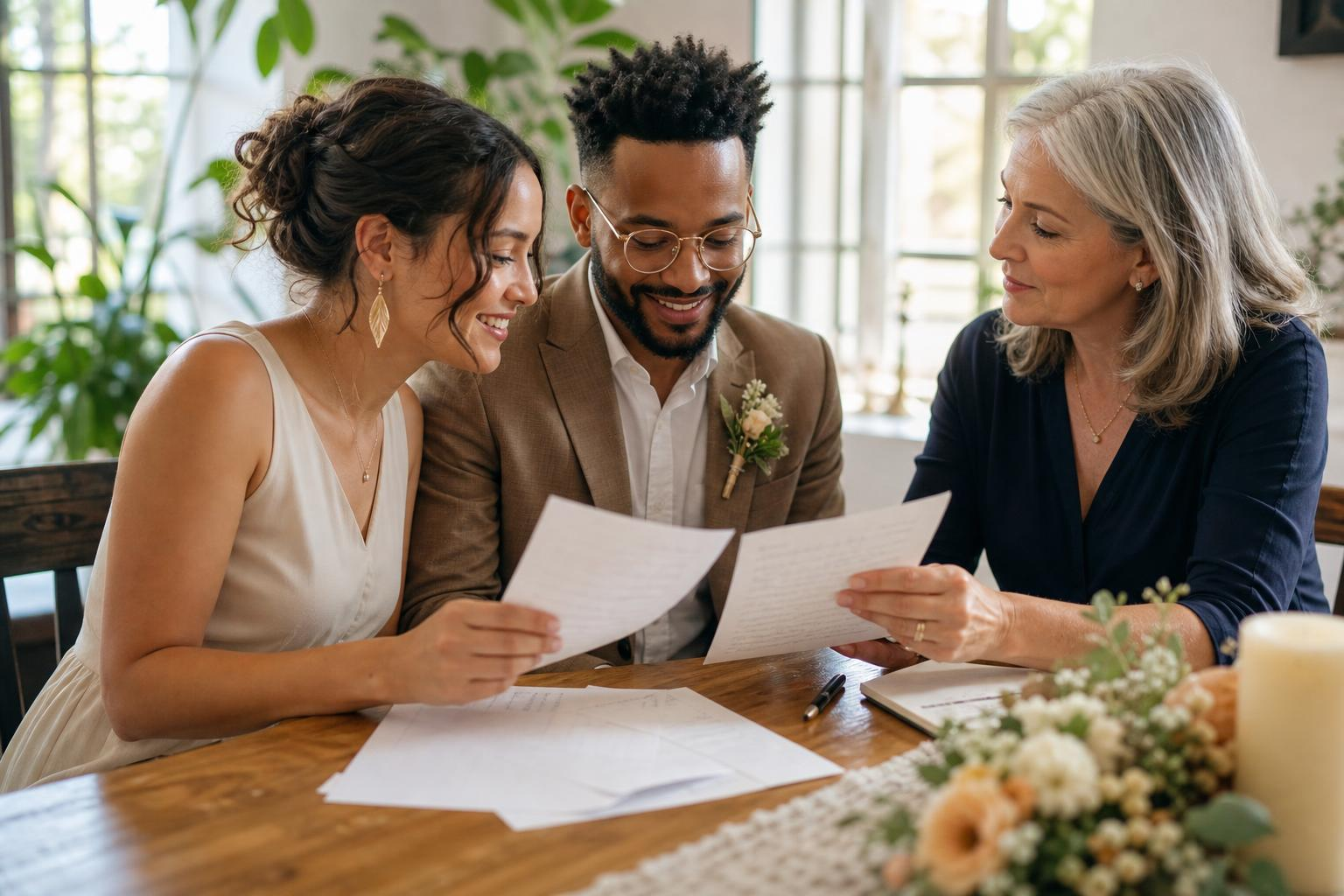
How to Help a Couple Write Personal Wedding Vows
When couples ask how to write wedding vows, they usually are not asking for a perfect poem. They want help saying something honest, meaningful, and manageable in front of the people they love.
As an officiant, your job is not to write the vows for them or turn the ceremony into a writing workshop. Your job is to give them a steady process, useful prompts, and enough structure that their own voices can come through. A little guidance can take a great deal of pressure off.

This guide covers prompts, length, tone, private review, and delivery practice so you can help couples create vows that sound like real promises rather than borrowed speeches.
Start by explaining what personal vows need to do
Personal vows work best when they combine three things: a specific appreciation, a clear commitment, and a hopeful statement about the life ahead. They may be funny, tender, spiritual, practical, poetic, or a mixture of several tones. The strongest vows are usually recognizable as the couple’s own words.
Before anyone starts drafting, clarify the purpose of the vows. These are not the complete history of the relationship, a reception toast, or a list of every reason the couple is grateful. They are spoken promises made during the ceremony.
A simple three-part framework
- Begin with connection. Name what you love, admire, or remember about your partner.
- Move into promises. Describe how you intend to show up in ordinary days and difficult seasons.
- Close with commitment. End with a sentence that looks toward the shared future.
A couple might begin with a memory of being welcomed into one another’s lives, continue with promises about patience and partnership, and finish with a direct statement such as, “I choose you, today and every day.” The wording should fit them, not a template.
Use prompts that lead to specific answers
Many people freeze when asked to “write something romantic.” Better prompts give them a place to begin. Encourage each partner to answer privately before trying to shape the answers into a ceremony-ready draft.

Prompts about the relationship
- What was one early moment when you realized this relationship mattered?
- What ordinary habit or quality makes you feel especially loved?
- What challenge have you handled together?
- What have you learned from your partner?
- What do you hope remains true about your relationship ten years from now?
Prompts about promises
- What do you promise to protect in your shared life?
- How will you show care when one of you is tired, worried, or discouraged?
- What everyday responsibilities are you willing to share?
- What value do you want to keep returning to?
- What kind of spouse or partner are you working to become?
Ask for concrete answers rather than broad declarations. “I promise to love you forever” may be sincere, but “I promise to make room for your quiet mornings and to bring you coffee when the week has been rough” gives the promise a shape people can feel.
Planning question: What do you want guests to understand about the way this couple loves one another?
Example: We want guests to see that our relationship is playful, dependable, and built around showing up for one another in ordinary life.
Short answer: Playful, dependable, everyday commitment.
Give couples practical word-count and timing guidance
Length is one of the most useful things an officiant can address early. Couples often write too much because they are trying to include every memory. They may also write too little because they are afraid of becoming emotional.
A useful working target is about 250 to 300 words, which often takes roughly two minutes to speak at a comfortable pace. The Knot offers similar guidance for personal wedding vows, while Toastmasters recommends keeping ceremonial remarks focused and brief. These are planning benchmarks, not rules. A couple may need more or less time depending on the ceremony format, reading pace, translation needs, and whether the officiant is guiding them line by line.
| Draft stage | What to aim for | What to do |
|---|---|---|
| Brainstorm | As many honest ideas as needed | Write memories, qualities, promises, and hopes without editing. |
| First draft | More material than the final version | Arrange the strongest ideas into a beginning, middle, and ending. |
| Final vows | About 250–300 words as a useful benchmark | Read aloud, remove repetition, and keep the promises easy to follow. |
| Delivery copy | Comfortable to hold and read | Use large type, clear spacing, and marked pauses. |
Have each partner read the draft aloud with a timer. If one person’s vows take four minutes and the other’s take one minute, do not treat that as a character flaw. Help them decide whether to balance the lengths, share a common time limit, or let each person speak naturally within the ceremony plan.
Help the couple match tone without making the vows identical
Couples do not need matching writing styles. One person may be direct and conversational while the other prefers imagery or gentle humor. The goal is not identical wording; it is a shared emotional temperature and a similar sense of occasion.
Common tone choices
- Warm and conversational: Best for couples who want the vows to sound like an intimate promise spoken naturally.
- Lightly humorous: Works when the humor is affectionate, understandable to the whole room, and followed by a clear commitment.
- Poetic: Helpful for couples who enjoy imagery, rhythm, or literary language. The Poetry Foundation’s wedding-poem collections can provide inspiration without requiring the couple to imitate a poet’s voice.
- Spiritual or religious: Appropriate when it reflects the couple’s beliefs and fits the ceremony’s agreed structure.
- Simple and direct: Often the strongest choice for someone who feels uncomfortable performing emotion in public.
One helpful exercise is to ask each partner to choose three words for the desired tone. For example: “tender, grounded, hopeful” or “funny, honest, steady.” Review the drafts against those words. If a joke is clever but makes the vows feel less tender, it may belong in the reception toast instead.
Offer a private review process that protects the surprise
Couples often want help without having their partner see the vows beforehand. You can support that preference by offering clear review options at the beginning.
Three workable review arrangements
- Shared review: Both partners send drafts to you, and you check timing, ceremony fit, and clarity.
- Separate private review: Each partner sends vows individually, and you review them without sharing wording or personal details with the other person.
- Structure-only review: You give both partners the same outline and checklist but do not read the drafts.
When reviewing privately, focus on practical matters: length, repeated ideas, unclear references, microphone needs, and whether the vows contain promises the speaker genuinely intends to keep. Do not rewrite the couple into your preferred style.
You can also ask whether they want the vows to contain the same number of promises, mention the same themes, or remain completely independent. Some couples want a coordinated exchange. Others want the surprise of hearing each person’s words for the first time.
If a draft includes a private joke, a story involving another guest, or a sensitive reference, ask the writer to consider whether everyone in the room will understand and feel comfortable. You are not censoring the couple; you are helping them avoid an awkward moment that cannot be taken back once spoken.
Teach delivery skills before the wedding day
Good vows can lose their impact when they are printed in tiny type, practiced only in the writer’s head, or delivered too quickly. Toastmasters International recommends practicing speeches aloud and paying attention to pacing, pauses, volume, and clarity. Those same habits are especially useful for wedding vows.
A short practice plan
- Read once for meaning. The couple should notice which lines feel most important.
- Read again aloud. Mark places where a natural pause or breath is needed.
- Time the reading. Check the length at a realistic speaking pace.
- Practice with the ceremony copy. Use the same font size, paper, phone, or vow book they expect to use.
- Rehearse with emotion. A pause is not a mistake. Give the speaker permission to stop, breathe, and continue.
Encourage couples to use a printed backup even if they plan to read from a phone. Ask them to bring large type, wide line spacing, and page numbers if the vows run onto more than one page. Avoid putting the entire speech on a small screen that may lock, dim, or become difficult to read outdoors.
On the ceremony day, remind the couple to look at one another rather than only at the page. They do not need to memorize every word. A calm, sincere reading is more important than a flawless performance.
Use a final checklist before approving the vows
Personal vow checklist:
- Does the draft sound like the person who wrote it?
- Does it include at least one specific appreciation or memory?
- Are the promises clear and realistic?
- Is the tone appropriate for the ceremony and audience?
- Has the couple removed private information they do not want public?
- Has the draft been read aloud and timed?
- Is the final copy easy to hold and read?
- Does the ending clearly express commitment?
If the answer to most of these questions is yes, the couple is probably ready. Do not keep editing simply because the vows are not “perfect.” At some point, additional polishing can make the words less natural.
Know when to step back
The couple owns the vows. Your role is to create a safe container for the process, not to decide what love should sound like. Offer prompts, explain ceremony logistics, and point out practical concerns. Then let the couple choose.
If one partner does not want to write personal vows, that is also a valid decision. They might use traditional wording, repeat vows after the officiant, exchange letters privately, or make shorter promises. Personal does not have to mean original, lengthy, or highly public.
The best support is often reassuring and simple: “You do not have to perform. Say what you mean, keep the promises clear, and give yourself room to breathe.”
Help them finish with confidence
When you help a couple write wedding vows, give them a process they can trust: brainstorm privately, choose a tone, shape the promises, trim the draft, review it in the way they prefer, and practice aloud.
Keep the focus on sincerity rather than spectacle. A few well-chosen words, spoken steadily and meant completely, can carry more weight than a polished speech that does not sound like the couple. Your calm guidance can help them arrive at the ceremony feeling prepared, respected, and ready to make their promises in their own voices.
For broader ceremony-planning support, couples and officiants can explore OrdainedPro ceremony resources.
Sources for writing and delivery guidance: The Knot’s guide to writing personal wedding vows, Toastmasters International public-speaking tips, and the Poetry Foundation’s love-poem collection.
Frequently Asked Questions
How long should wedding vows be?
About 250 to 300 words is a useful planning benchmark for many couples, often taking around two minutes to deliver. The couple should also consider the ceremony schedule, speaking pace, and whether the officiant will guide them line by line.
What should personal wedding vows include?
A strong structure usually includes a specific appreciation or memory, several clear promises, and a closing statement of commitment or hope for the future.
Should couples show each other their vows before the wedding?
There is no single right choice. Couples may share drafts, keep them private for a surprise, or agree on the same themes and length without reading the exact wording.
How can an officiant help without rewriting the couple’s vows?
Offer prompts, timing guidance, tone feedback, and delivery practice. Focus on clarity, ceremony fit, and practical concerns while preserving the couple’s natural voice.
What if one partner is not comfortable writing personal vows?
They can use traditional vows, repeat a shorter set of promises after the officiant, exchange private letters, or choose another ceremony format that feels sincere and comfortable.
How should couples practice saying their vows?
They should read the vows aloud several times, time the reading, mark pauses, practice with the final copy, and use large, easy-to-read text. Memorization is optional.