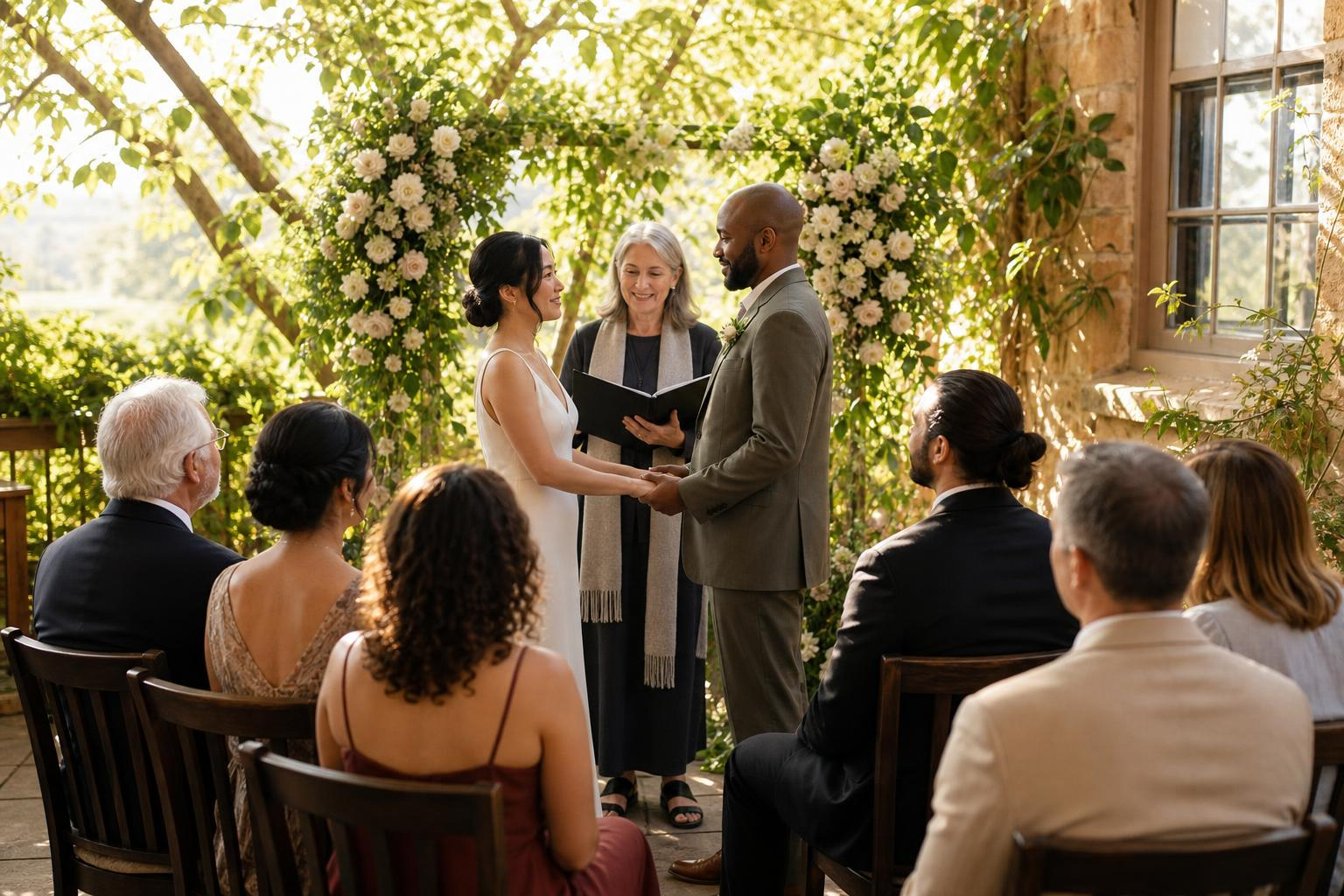
A small wedding does not need to feel like a shortened version of a large one. In fact, a limited guest list can give you room to slow down, speak more personally, and let the people in the room feel genuinely included.
For an officiant, that is the real opportunity. Your job is not to fill every quiet moment or make the ceremony sound grander than it is. Your job is to help the couple name what matters, guide the gathering with confidence, and create a ceremony that feels complete.

This guide walks through how to write and deliver a micro wedding ceremony script that feels personal, warm, and unhurried—without becoming rambling or overly formal.
Small celebrations still benefit from thoughtful planning, a clear timeline, and attention to details such as music, transportation, weather, and ceremony flow. A smaller guest count creates flexibility, but it does not eliminate logistics. The Knot’s micro-wedding planning guidance makes the same practical point: intimate weddings work best when the couple intentionally plans the experience rather than simply removing guests from a traditional format.
1. Start with the feeling, not the wording
Before you write the opening welcome, find out what the couple wants the ceremony to feel like. “Short” is not a complete vision. A ceremony can be short and still feel rushed, or it can be brief and deeply meaningful.
Ask the couple to choose a few words that describe the atmosphere they hope to create. Useful choices might include:
- peaceful
- joyful
- lighthearted
- spiritual
- family-centered
- simple
- romantic
- adventurous
Practical planning question: What should the guests feel they were invited into—not merely allowed to watch?

Example: “We want everyone to feel like they are part of a relaxed gathering where our closest people are witnessing the promises we have already been living out together.”
Short answer: Included, relaxed, and personally connected.
Use the couple’s answer as your writing filter. If they want a peaceful ceremony, avoid constant jokes and elaborate transitions. If they want something playful, allow a little personality in the welcome. If they want a spiritual ceremony, ask which traditions or readings feel authentic rather than assuming what belongs.
Small weddings are especially well suited to custom touches such as handwritten notes, family-style meals, meaningful music, and personal readings. These details can make the day feel designed for the people present rather than copied from a standard template. (theknot.com)
2. Make the guest count feel intentional
A small room can feel either intimate or empty depending on how you frame it. As the officiant, you can help the couple present their guest list as a deliberate circle of support.
That begins with language. Instead of saying, “Thank you all for coming to this small wedding,” try wording that gives the gathering purpose:
“Today, surrounded by the people who know and love them best, [Name] and [Name] have chosen to make their promises in a setting that reflects what matters most to them: presence, trust, and the shared life they are building.”
This approach does not apologize for the size of the celebration. It explains it.
Ways to include the people in the room
- Name the circle: Acknowledge that the guests represent family, friendship, history, or chosen community.
- Invite a shared response: Ask the guests whether they will support the couple, then give them a simple response such as “We will.”
- Give loved ones a role: Include a reading, blessing, short reflection, ring presentation, or community vow.
- Allow room for recognition: If appropriate, mention absent loved ones without turning the ceremony into a memorial service.
Keep participation simple. In a small ceremony, every person is visible, so an elaborate audience exercise can feel uncomfortable. One sincere response is usually stronger than several forced moments.
3. Use a clear, original ceremony outline
A micro wedding ceremony script can be concise while still containing all the emotional beats a couple expects. The following outline gives you a reliable structure. Adjust it for the couple’s beliefs, culture, relationship, and local requirements.
| Section | Purpose | Suggested approach |
|---|---|---|
| Welcome | Settles the room and names the occasion | Warm, direct, and no longer than a few minutes |
| Meaning of the gathering | Explains why this small circle matters | Connect the guests to the couple’s shared life |
| Relationship reflection | Offers a glimpse of the couple’s story | Use one or two specific qualities, not a full biography |
| Vow or promise section | Centers the couple’s commitments | Include personal vows or guided repeat-after-me vows |
| Ring exchange | Creates a visible symbol of commitment | Keep the wording simple and easy to hear |
| Community blessing | Invites support from those present | Use a brief reading, prayer, blessing, or spoken response |
| Pronouncement and closing | Brings the ceremony to a confident finish | Pronounce the couple clearly, then direct guests to the next moment |
Here is an original ceremony outline you can adapt:
Welcome
“Welcome, everyone. We are gathered here to celebrate the marriage of [Name] and [Name]. They have chosen to make these promises in the company of the people whose love, encouragement, and presence have helped shape their lives.”
Why this gathering matters
“A ceremony like this is not made meaningful by its size. It is made meaningful by the care gathered in the room. Each of you is here because you hold a particular place in their story, and today your presence becomes part of the promises they are making.”
Reflection on the couple
“[Name] and [Name], the life you are joining is not beginning from nothing. It is built from the ordinary choices that brought you here: listening, showing up, making room for one another, and choosing each other again.”
Declaration of intent
“[Name], do you take [Name] to be your spouse, to share your life with honesty and care, and to stand beside them through the seasons ahead?”
“I do.”
Repeat for the other partner.
Personal vows
Invite each partner to read personal vows. Give them a time range in advance, such as two to three minutes each, so the ceremony remains balanced and easy to follow.
Ring exchange
“These rings are small reminders of a lasting promise. As you place the ring on [Name]’s hand, please repeat: ‘I give you this ring as a sign of my love, my respect, and my promise to walk beside you.’”
Community blessing
“Will all of you gathered here support [Name] and [Name] in their marriage, encourage them in difficult seasons, and celebrate with them in joyful ones?”
Guests respond: “We will.”
Pronouncement
“With the promises you have made and the love you have shared here, I am honored to pronounce you married. You may seal your marriage with a kiss.”
Closing
“Friends and family, it is my joy to present [Name] and [Name]. Please join them in celebrating this beginning.”
4. Keep the ceremony personal without making it private
Personal does not mean every detail needs to be shared aloud. The best officiant writing chooses a few true details that help guests understand the couple while protecting the couple’s dignity.
Ask for three kinds of material:
- A quality they admire: patience, humor, steadiness, curiosity, generosity, or courage.
- A pattern in their relationship: how they solve problems, care for family, make decisions, or recover after hard days.
- A hope for marriage: the kind of home, partnership, or future they want to build.
Then turn those answers into a short reflection. For example:
“What stands out about [Name] and [Name] is not that they agree on everything. It is that they have learned how to remain on the same team while they work things out. That kind of patience is not flashy, but it is one of the sturdy materials from which a marriage is made.”
Notice what this does not do: it does not reveal embarrassing stories, list every milestone, or make claims about the couple’s future. It gives guests a meaningful lens through which to see the promises.
5. Build an unhurried pace
“Unhurried” does not mean excessively long. It means the officiant gives important moments enough space to land.
Simple pacing choices
- Pause after the welcome before beginning the reflection.
- Look at the couple during the declaration of intent instead of reading only from the page.
- Give each partner time to finish a vow without interrupting or rushing them.
- Pause briefly after the ring exchange.
- Let the guests respond fully before moving to the pronouncement.
Print the script in large type with generous spacing. Mark cues such as “pause,” “look up,” “invite response,” and “move to rings.” If music or a reading is included, confirm who begins each transition and where that person will stand.
For a small ceremony, seating and sound matter more than many first-time officiants expect. Guests may be close enough to hear a quiet voice, but outdoor spaces, restaurants, gardens, and rooms with hard surfaces can change the acoustics. Do a short sound check and identify a backup location if weather or noise could interfere.
Keep the flow visible: The couple should know when to stand, where to face, when to exchange rings, and what happens immediately after the pronouncement.
Officiant rehearsal checklist
- Confirm the couple’s preferred names and pronunciation.
- Print the final script and bring a backup copy.
- Mark every transition, reading, music cue, and guest response.
- Confirm who holds the rings.
- Check the ceremony location, seating, light, and sound.
- Review any paperwork responsibilities with the couple before the wedding.
- Arrive early enough to greet the couple calmly.
6. Add a reading, blessing, or moment of silence thoughtfully
A reading can give a small ceremony a beautiful center, but it should support the couple rather than interrupt the flow. Choose a passage that matches their worldview and ask whether they want a literary reading, prayer, blessing, poem, or moment of silence.
The Poetry Foundation’s love-poem collection can be a useful place to browse for inspiration. Rather than selecting a famous passage automatically, look for language that reflects the couple’s understanding of love: companionship, patience, delight, resilience, or shared responsibility.
If you use a poem, introduce it briefly. One sentence is enough:
“This reading speaks to the kind of love that becomes visible through ordinary days, and [Name] and [Name] have chosen it because that is the kind of love they hope to keep building.”
Do not stack multiple readings simply because the guest list is small. One well-chosen reading usually creates more impact than several disconnected ones.
7. Handle practical and legal details separately from the script
The ceremony script is only one part of the officiant’s responsibility. Before the wedding, make a separate checklist for documents, timing, witnesses, venue rules, and any requirements that may apply where the marriage will take place.
Marriage-license procedures, officiant qualifications, witness rules, filing deadlines, and acceptable ceremony language can vary by state, county, municipality, or other authority. Do not assume that a process used in one location applies somewhere else. The couple should confirm requirements with the appropriate government office, and you should verify any obligations connected to your role.
For a state or local starting point, the couple can review the OrdainedPro marriage-law map and then confirm details with the relevant government authority. OrdainedPro resources can help organize the research, but they should not replace official instructions.
Keep legal wording distinct from the emotional language of the ceremony. First confirm what must be included, then write the surrounding welcome, reflection, vows, and blessing in the couple’s voice. This gives you both confidence and warmth.
For additional context, an official Maine ceremony guide illustrates why officiants should review the actual license and follow local instructions rather than relying on a generic script. It discusses requirements involving the license, witnesses, signatures, physical presence, and filing. Those rules are specific to Maine and should not be generalized to other locations. Read the Maine Center for Disease Control and Prevention ceremony guide.
Conclusion: give the couple room to mean what they say
A strong micro wedding ceremony script does not try to compensate for a small guest list. It treats the small gathering as a strength.
Write from the couple’s actual values. Give loved ones a clear but modest role. Use personal details with discretion. Mark transitions carefully, and let the promises breathe when they are spoken.
Before the ceremony begins, take one quiet look at the couple and remember the central task: help them speak clearly, help their guests feel included, and guide the room toward a confident beginning. That is more than enough.
Frequently Asked Questions
How long should a micro wedding ceremony script be?
Many couples prefer a concise ceremony, but there is no single ideal length. Focus on complete emotional structure—welcome, reflection, vows, rings, community support, and closing—rather than cutting meaningful sections simply to make the ceremony shorter.
What should be included in a micro wedding ceremony?
A useful structure includes a welcome, an explanation of why the gathering matters, a brief reflection on the couple, a declaration of intent, vows, ring exchange, a blessing or community response, the pronouncement, and a closing.
How can an officiant make a small wedding feel special?
Treat the guest list as an intentional circle of support. Name the importance of the people present, invite one simple community response, and include personal details or a reading that genuinely reflects the couple.
Can a micro wedding ceremony include personal vows?
Yes. Personal vows often work especially well in an intimate ceremony. Give the couple a suggested time range and ask them to focus on specific promises, shared values, and the life they intend to build.
Should a micro wedding ceremony include a reading or prayer?
It can, if the reading or prayer reflects the couple’s beliefs and desired atmosphere. One carefully chosen piece is usually more effective than several unrelated selections.
Does the same ceremony script work in every state?
No. The emotional structure can be adapted broadly, but marriage-license procedures, officiant qualifications, witness rules, required wording, and filing responsibilities may vary by location. Confirm local requirements with the appropriate government authority.