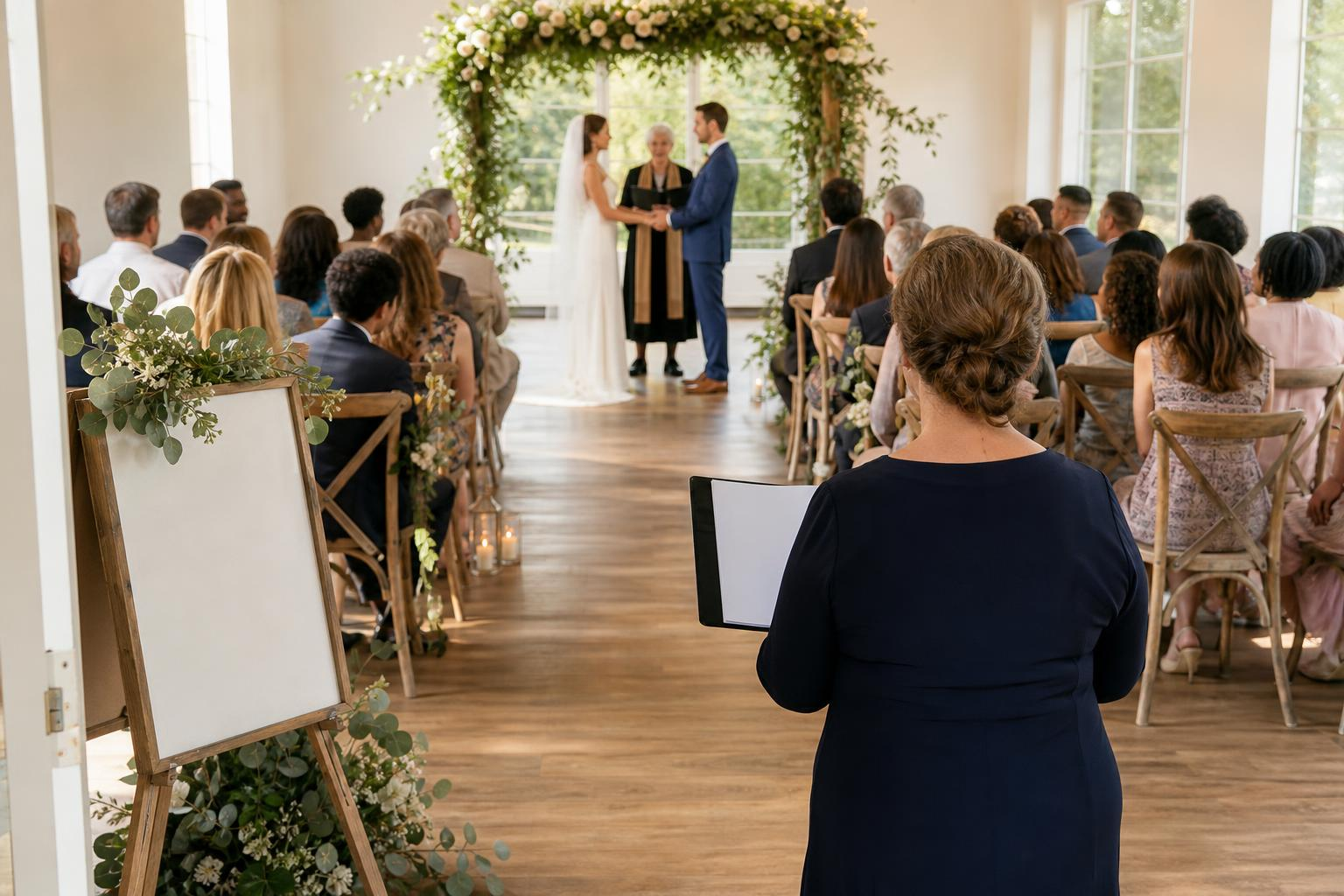
Unplugged Wedding Ceremony Announcement Examples
An unplugged ceremony gives guests one simple assignment: put away their phones, cameras, and tablets so they can be fully present for the vows. For an officiant, the challenge is not making the request—it is making it clearly, kindly, and at the right moment.
The best unplugged ceremony wording sounds like part of the couple’s welcome, not a scolding from the microphone. Keep the request specific, explain when it begins and ends, and coordinate with the planner, venue, photographer, and videographer before the processional starts.

Below are ready-to-use announcements in several tones, along with sign wording and a practical plan for helping the request succeed.
What an Unplugged Ceremony Usually Means
In most weddings, “unplugged” means guests are asked not to take photos, record video, livestream, or use their phones during the ceremony. The couple may still welcome guest photos at the reception or after the recessional. That boundary should be stated plainly so nobody has to guess.
Before you write the announcement, ask: Does the couple want devices away for the entire ceremony, or only during the processional and vows?
Example: The couple wants phones and cameras put away from the start of the processional until they have completed the recessional, but guests may take photos during the reception.
Short answer: Define the boundary before drafting.

Professional officiant guidance commonly recommends making the spoken reminder at the beginning of the ceremony rather than relying only on a website or sign. A guest may have missed the earlier message, while a brief announcement just before the processional reaches nearly everyone in the room. American Marriage Ministries offers additional officiant examples, and The Knot discusses common unplugged-wedding etiquette.
Gentle Unplugged Ceremony Announcement Examples
A gentle announcement works well when the couple wants the ceremony to feel intimate, welcoming, and emotionally present. Speak slowly, smile, and keep your tone warm rather than apologetic.
Warm and heartfelt
“Before we begin, [Name] and [Name] have one small request. They invite you to put away your phones and cameras during the ceremony so they can see your faces and feel your presence as they make these promises. Please silence your devices and enjoy this moment with them. Photos are welcome again after the ceremony. Thank you for being fully here.”
Simple and sincere
“The couple has chosen an unplugged ceremony. Please silence your phones and keep cameras and other devices put away until the ceremony has ended. Your attention and presence mean a great deal to them. Thank you.”
Focused on the guests’ role
“Today, your job is wonderfully simple: witness, listen, and celebrate. [Name] and [Name] kindly ask that phones and cameras remain put away during the ceremony. Let the professional photo team handle the recording while you share this moment with the couple in real time.”
These versions explain the reason without making guests feel guilty. That matters. Most people are not trying to be disruptive; they are excited and may instinctively reach for a phone when the processional begins.
Lightly Humorous Wording That Still Gets the Point Across
Humor can soften the request, but it should never make the couple’s wishes sound optional. Use a joke only if it matches the couple’s personality and the overall mood of the ceremony.
Friendly and playful
“Before the ceremony begins, please silence your phones and tuck away your cameras. [Name] and [Name] would love to see your smiling faces instead of a sea of screens. The professional photographers are on duty today, so you may relax and leave the picture-taking to them. Your only assignment is to be present—and try not to outshine the happy couple.”
Short and witty
“Quick housekeeping: phones silent, cameras down, eyes up. [Name] and [Name] have hired professionals to capture the ceremony, and they would much rather see your faces than your screens. Thank you for giving them your full attention.”
For a relaxed outdoor wedding
“We are about to begin, so please silence your phones and put away cameras and tablets. The birds, the breeze, and the professional photographers have this covered. Please enjoy the ceremony with your own eyes, and save the photo-taking for afterward.”
Firm but Respectful Announcement Examples
Some ceremonies need a clearer boundary, especially when the couple has hired a photographer or videographer whose sightlines could be blocked. Firm wording does not have to sound harsh. State the request once, state the time limit, and move on confidently.
Direct and polished
“At the request of [Name] and [Name], this will be an unplugged ceremony. Please silence and put away all phones, cameras, tablets, and recording devices from this point until the ceremony concludes. No guest photography, video recording, or livestreaming is requested during the ceremony. Thank you for respecting their wishes.”
Clear about the start and end
“Before the processional begins, please place your phones and cameras on silent and keep them put away until [Name] and [Name] have completed their recessional. Once the ceremony is over, you are welcome to take photos and celebrate with them.”
When a professional team is present
“The couple has asked for an unplugged ceremony so the professional photography and videography team can work without blocked aisles or screens in the images. Please keep all personal devices put away until the ceremony ends. Thank you for helping us protect this part of the day.”
Notice the difference between firm and controlling language. “Please keep devices put away” is clear. “Anyone caught taking a photo will be removed” may be technically forceful, but it puts the officiant in the role of enforcer and can sour the atmosphere.
Sign, Program, and Website Wording
The officiant’s announcement should be the final reminder, not the only reminder. A sign can introduce the request as guests arrive, while the wedding website or program gives enough room for a little explanation.
Short sign wording
- “Welcome to our unplugged ceremony. Please silence and put away phones and cameras until the ceremony ends.”
- “Your presence is the present. Please keep devices tucked away during the ceremony.”
- “Look at us, not your screens. Please enjoy an unplugged ceremony.”
- “Phones down, hearts open. Photos are welcome after the ceremony.”
Program wording
“We are grateful to have you here. To help everyone remain present and to keep the ceremony space clear, we kindly ask that phones, cameras, and recording devices remain put away until the ceremony concludes.”
Wedding website wording
“We have chosen to keep our ceremony unplugged. Please silence your phones and keep cameras, tablets, and recording devices put away from the processional through the recessional. We cannot wait to celebrate with you and take photos together afterward.”
If the couple plans to share professional images later, only promise that if they have actually made that plan with the photographer. A safer phrase is “We look forward to sharing memories after the wedding,” unless a specific gallery or sharing arrangement is confirmed.
Coordinate the Request With the Wedding Team
A good announcement can still be undermined by a missed handoff. Before the wedding, confirm who will place the sign, who will remind guests at the entrance, and when you will speak.
| Planning touchpoint | What it should accomplish | Who should own it |
|---|---|---|
| Wedding website or invitation details | Gives guests advance notice and explains the couple’s preference | Couple or planner |
| Entrance sign | Catches guests as they arrive at the ceremony space | Planner, venue, or usher |
| Pre-ceremony reminder | Reinforces the request immediately before the processional | Officiant, planner, or venue team |
| Spoken officiant announcement | Creates one clear, shared understanding before the ceremony begins | Officiant |
| Photographer and videographer briefing | Clarifies permitted professional equipment and aisle expectations | Planner or couple |
Ask the planner or venue coordinator where guests will enter and whether the ceremony space has a sound system. If guests are seated in multiple areas, make sure the announcement can be heard by everyone.
Also confirm whether there are practical exceptions. A guest may need a phone available for a medical, caregiving, or accessibility reason. The couple can decide how to handle those needs privately, without announcing personal details to the room.
A simple coordination checklist
- Confirm whether “unplugged” includes photos, video, livestreaming, and social posting.
- Confirm when devices may come out again.
- Give the officiant the final wording in the ceremony script.
- Place a short sign where guests can read it before seating.
- Brief the planner, venue team, photographer, and videographer.
- Decide privately how to support guests who need access to a phone.
- Choose one person other than the officiant to handle any guest reminders.
How to Deliver the Announcement Well
The words matter, but delivery matters just as much. A nervous officiant often rushes housekeeping details. Take a breath, wait for the room to settle, and speak as though you are welcoming guests into an important shared moment.
- Place it before the processional. This is usually the cleanest moment because guests are seated and the ceremony has not yet gathered momentum.
- Use ordinary language. “Please put away your phones and cameras” is easier to understand than a long explanation of digital etiquette.
- Name the end point. Tell guests whether devices may come out after the ceremony, after the recessional, or only at the reception.
- Do not overexplain. One short paragraph is usually enough. The couple’s request should be clear without becoming the opening speech.
- Move on confidently. After the announcement, transition directly into the processional or welcome.
If a guest raises a phone during the ceremony, the planner or designated family member should handle it when possible. The officiant should avoid interrupting the vows unless the device is creating an immediate problem.
Choose the Right Tone for the Couple
The strongest wording sounds like the couple. A formal ceremony may need polished language; a backyard ceremony may welcome a joke. If the couple is unsure, choose the middle path: warm, direct, and brief.
For literary inspiration, couples may enjoy browsing the Poetry Foundation’s collection of love poems. You do not need to quote a poem in the announcement. Sometimes a poetic idea—being present, witnessing love, or seeing the people in front of you—can guide the tone without turning a housekeeping note into a reading.
As the officiant, your job is to protect the couple’s wishes while keeping the room comfortable. A calm voice, clear timing, and a little kindness will usually do more than a stern warning ever could.
Final Takeaway for Officiants
Write the request in plain language, repeat it at the right moment, and coordinate it with the people managing the ceremony space. Whether you choose gentle, humorous, or firm unplugged ceremony wording, make sure guests know what to put away, when to do it, and when photos are welcome again.
Then take a breath and begin the ceremony. Once the phones are down, the room is ready for the part everyone came to witness.
Frequently Asked Questions
What should an officiant say for an unplugged ceremony?
Ask guests to silence and put away phones, cameras, tablets, and other recording devices during the ceremony. Explain when the request ends, and thank guests for being present.
When should an unplugged ceremony announcement be made?
The clearest time is immediately before the processional or at the beginning of the ceremony, after guests are seated and before the ceremony gets underway.
Should an unplugged ceremony announcement be funny?
It can be lightly humorous if that matches the couple’s personality. Keep the request unmistakable and avoid jokes that sound threatening or make compliance seem optional.
Is a sign enough for an unplugged ceremony?
Usually, a sign works best as one part of a larger communication plan. Pair it with advance wording on the wedding website or program and a brief spoken reminder from the officiant.
Should guests be allowed to take photos after an unplugged ceremony?
Many couples allow photos after the recessional or during the reception, but the couple should decide the exact boundary and state it clearly in the announcement.
Who should enforce an unplugged ceremony request?
The planner, venue coordinator, usher, or a designated family member is usually better suited to handle individual reminders. The officiant should focus on leading the ceremony unless a device becomes a serious disruption.