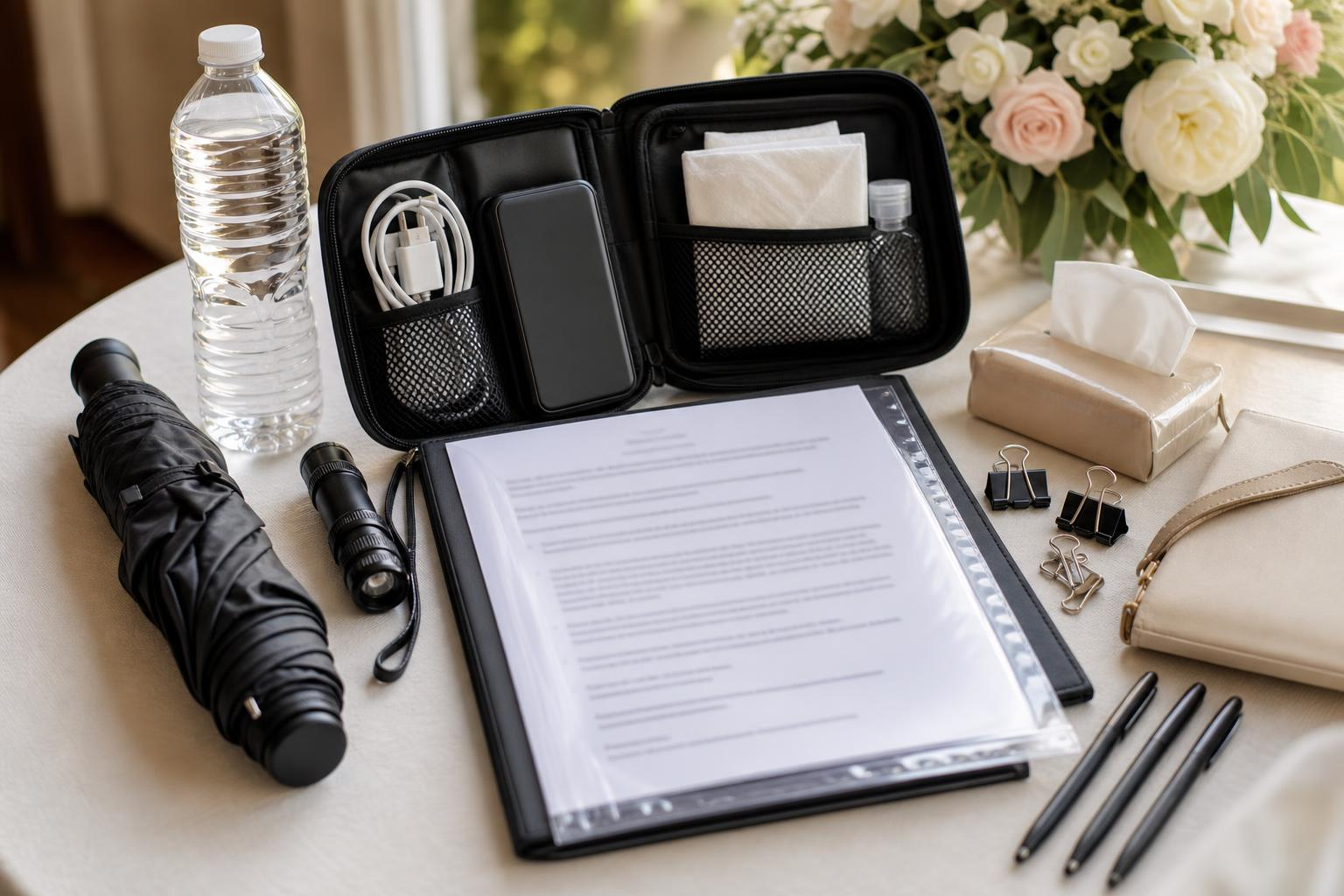
Most ceremonies do not need a dramatic rescue. They need a calm officiant with the right small item at the right moment: a printed script when the tablet fails, a fresh pen when the first one disappears, or tissues when happy tears arrive early.
A wedding officiant emergency kit is not about carrying half your home to every venue. It is a compact, organized backup system that protects the ceremony, the paperwork, and your ability to stay composed when the day takes an unexpected turn.

This guide focuses on practical preparation. Marriage-license requirements and officiant duties vary by location, so confirm the couple’s instructions and the issuing authority’s requirements before the ceremony. For a starting point, use the OrdainedPro state marriage-law map.
1. Start with the ceremony essentials
Your first layer should contain everything you need to conduct the ceremony if technology, venue staff, or last-minute changes create trouble. Keep these items together in a clearly labeled folder or pouch rather than scattering them through a larger bag.
- Printed ceremony script: Bring a clean, readable paper copy with comfortable spacing. Print the final version, not an early draft.
- Offline digital backup: Save the script as a file on your phone or tablet so it can open without Wi-Fi. Do not rely on a cloud link alone.
- Vow and reading copies: If the couple, family members, or readers have approved text, carry a backup copy of each important reading.
- Pronunciation notes: Mark names, cultural terms, and unfamiliar words clearly. A small note can prevent an avoidable stumble.
- Order-of-ceremony outline: Include the processional, welcome, readings, vows, ring exchange, pronouncement, and recessional in a quick-scan format.
- Contact sheet: Keep the couple’s phone number, coordinator’s number, venue contact, and backup contact in one place.
Make the script easy to use under pressure
Use large enough type, clear headings, and page numbers. Mark the exact point where you should invite the couple to repeat vows or exchange rings. If the ceremony includes a responsive reading, label the congregation’s part so you are not searching while standing in front of everyone.
Before leaving, read the script aloud once. This catches awkward transitions, missing names, and sentences that look fine on a screen but feel clumsy when spoken.
2. Pack power, light, and writing supplies
Many officiants remember their speech and forget the tools that keep the day moving. A dependable kit includes simple supplies that are easy to replace and useful in more than one situation.

- Fully charged phone and tablet, if used
- Charging cables for each device
- Portable power bank
- Wall charger and, when appropriate, a compact extension cord
- Small flashlight or phone light backup
- At least two reliable pens, preferably black ink
- Pencils for temporary notes
- Binder clips, paper clips, and a small roll of clear tape
- Sticky notes for marking pages
- Small scissors
- Microfiber cloth for a screen or glasses
Test your power bank before the wedding. A charger in a bag is not much help if the battery pack is empty or the cable does not fit your device. Keep cords in a small pouch so you can find them without turning your bag upside down.
Keep one pen separate. Place it in your jacket pocket or officiant folder rather than in the bottom of the kit. That gives you an immediate backup if the ceremony coordinator needs a signature or the couple asks you to make a quick note.
3. Protect the paperwork and license supplies
Paperwork deserves its own section because it is both important and easy to mishandle during a busy day. Carry only the documents you are authorized and expected to handle, and keep them protected from rain, spills, makeup, food, and curious guests.
Your paperwork pouch may include:
- The marriage license or other documents provided by the couple or issuing authority
- Instructions supplied with the license
- A printed contact number for the issuing office or county clerk, when appropriate
- A hard writing surface, such as a thin clipboard
- Extra black pens
- Protective sleeves or a sealable waterproof envelope
- A checklist for reviewing required fields before leaving the venue
Do not guess about who completes a field, which title to use, where signatures belong, or how a document must be returned. Those details can vary by jurisdiction and by document. Follow the instructions supplied with the license and confirm uncertain points with the relevant government office.
For state-specific preparation, begin with the OrdainedPro marriage-law map, then verify the final requirements with the appropriate government marriage authority. This article is general preparation guidance, not legal advice.
4. Prepare for weather and outdoor conditions
Outdoor ceremonies can change quickly. Your emergency kit should help you protect the script, protect yourself, and respond sensibly when the venue changes the plan.
Pack weather protection based on the location and season:
- Compact umbrella or rain poncho
- Waterproof folder or zippered document pouch
- Small towel or absorbent cloth
- Sunscreen and lip balm
- Hat or visor that will not block your face from the couple or guests
- Hand warmers for cold-weather ceremonies
- Light gloves that still allow you to hold papers
- Breath mints and water
Check the forecast before you leave and again before the ceremony begins. The National Weather Service provides hazard guidance for thunderstorms, lightning, heat, wind, flooding, and winter weather through its weather safety resources.
If thunder is audible, treat the situation seriously. The National Weather Service advises moving indoors or into a hard-topped vehicle during lightning threats rather than continuing an outdoor activity. An officiant should not try to “push through” dangerous weather for the sake of a schedule. Coordinate with the venue and couple, and follow the site’s emergency plan.
For outdoor events, the National Weather Service also recommends planning how much time is needed to notify attendees and move them to shelter. That is useful for officiants because a weather decision is not only about your own safety; guests, vendors, older relatives, and children may all need time to relocate.
A simple weather decision guide
| Condition | Pack or prepare | Practical response |
|---|---|---|
| Light rain or drizzle | Waterproof script sleeve, towel, umbrella | Protect papers and confirm whether the ceremony can move under cover. |
| Heat or strong sun | Water, sun protection, breathable clothing | Ask about shade, shorten standing time when possible, and follow venue guidance. |
| Wind | Binder clips, weighted folder, secure clothing | Clip pages and move to a less exposed location if papers or décor become unsafe. |
| Thunder or lightning threat | Indoor relocation plan, charged phone | Stop the outdoor ceremony plan and move to a substantial building or hard-topped vehicle. |
| Cold weather | Layers, hand warmers, gloves | Keep hands functional and confirm a warm backup location. |
5. Add comfort and personal-care items
A few modest comfort items can keep a long ceremony day from becoming unnecessarily difficult. These are not glamorous supplies, but they help you stay focused and present.
- Sealed bottle of water
- Tissues
- Breath mints
- Unscented hand sanitizer
- Small packet of tissues or blotting paper
- Bandages
- Basic personal medications you normally carry
- Spare glasses or contact-lens supplies, if applicable
- Stain-removal wipe
- Small snack for before the ceremony
Choose quiet packaging. A crinkly wrapper or noisy bottle can become surprisingly noticeable during a pause. Drink water before the processional, but do not bring a large cup that you must manage while holding the microphone or script.
It is also wise to pack for the room, not just yourself. A few tissues for a reader, a bandage for a child, or a stain-removal wipe for a ring bearer can solve a small problem without turning it into a production.
6. Organize the kit so you can find things quickly
The best emergency kit is not the biggest one. It is the one you can open calmly and use without rummaging. Divide it into labeled sections: ceremony, paperwork, power, weather, and personal care.
Quick packing checklist
- Printed and offline script backups
- Names and pronunciation notes
- Phone, charger, power bank, and cables
- Two or more pens, clips, tape, and sticky notes
- Waterproof paperwork sleeve
- License instructions and secure document pouch
- Water, tissues, mints, and a small snack
- Weather protection suited to the venue
- Venue, couple, and coordinator contact information
- Final forecast and relocation plan checked
Ask yourself: What is the most likely problem at this particular ceremony, and what is the smallest useful backup I can carry?
Example: We are officiating in a garden with a long walk from the parking area, possible wind, and no nearby indoor room, so we will bring a waterproof script sleeve, binder clips, water, a charged phone, and a confirmed shelter plan.
Short answer: Match the kit to the venue.
Do a final check the night before, then a smaller check before leaving the vehicle. Replace dead batteries, refill consumables, and remove old drafts. If you officiate regularly, keep a standard kit packed and create a short event-specific add-on list for weather, travel, or special ceremony needs.
7. Use the kit to stay calm and professional
An emergency kit is useful only when it supports good judgment. If a problem appears, pause, identify what actually needs attention, and handle one thing at a time. Most guests will remember your steadiness more than the fact that a page blew off a table or a microphone needed a reset.
- Secure the ceremony: Keep the couple, guests, and paperwork safe.
- Communicate clearly: Tell the coordinator or couple what changed and what you recommend.
- Use the simplest backup: Switch to paper, move under cover, replace the pen, or take a brief pause.
- Resume with confidence: There is no need to narrate every small problem to the guests.
Preparedness is not about pretending nothing can go wrong. It is about giving yourself enough margin to respond without panic. Pack the essentials, protect the paperwork, watch the weather, and arrive ready to serve the couple well.
Final action: Put together your wedding officiant emergency kit this week, label each section, and test the complete setup at home by conducting a short ceremony using only what you packed.
Frequently Asked Questions
What should every wedding officiant carry?
Every officiant should carry a printed ceremony script, an offline digital backup, pens, clips, phone and charger, a portable power bank, water, tissues, weather protection, contact information, and a secure pouch for any marriage-license supplies they are expected to handle.
Should I bring a paper copy of the ceremony script?
Yes. A paper script is a dependable backup if a device fails, loses power, cannot connect to the internet, or becomes difficult to read outdoors. Use a final, proofread copy with page numbers and clear headings.
How should an officiant protect the marriage license?
Keep the license and related instructions in a secure, waterproof document sleeve or envelope. Follow the issuing authority’s instructions, do not leave the document unattended, and verify uncertain requirements with the relevant government office.
What weather items belong in an officiant emergency kit?
Useful items include a waterproof script sleeve, compact umbrella or rain poncho, towel, sunscreen, water, lip balm, hand warmers, gloves, and a confirmed indoor relocation plan. Choose supplies based on the venue, season, and forecast.
What should I do if lightning threatens an outdoor ceremony?
Stop treating the ceremony as an outdoor activity and follow the venue’s safety plan. The National Weather Service advises seeking shelter in a substantial building or hard-topped vehicle when lightning threatens. Coordinate with the couple and venue rather than continuing in an unsafe location.
How often should I restock my officiant emergency kit?
Check it before every ceremony. Replace used tissues, snacks, batteries, and pens; recharge the power bank; remove outdated script drafts; and update contact information or event-specific notes.