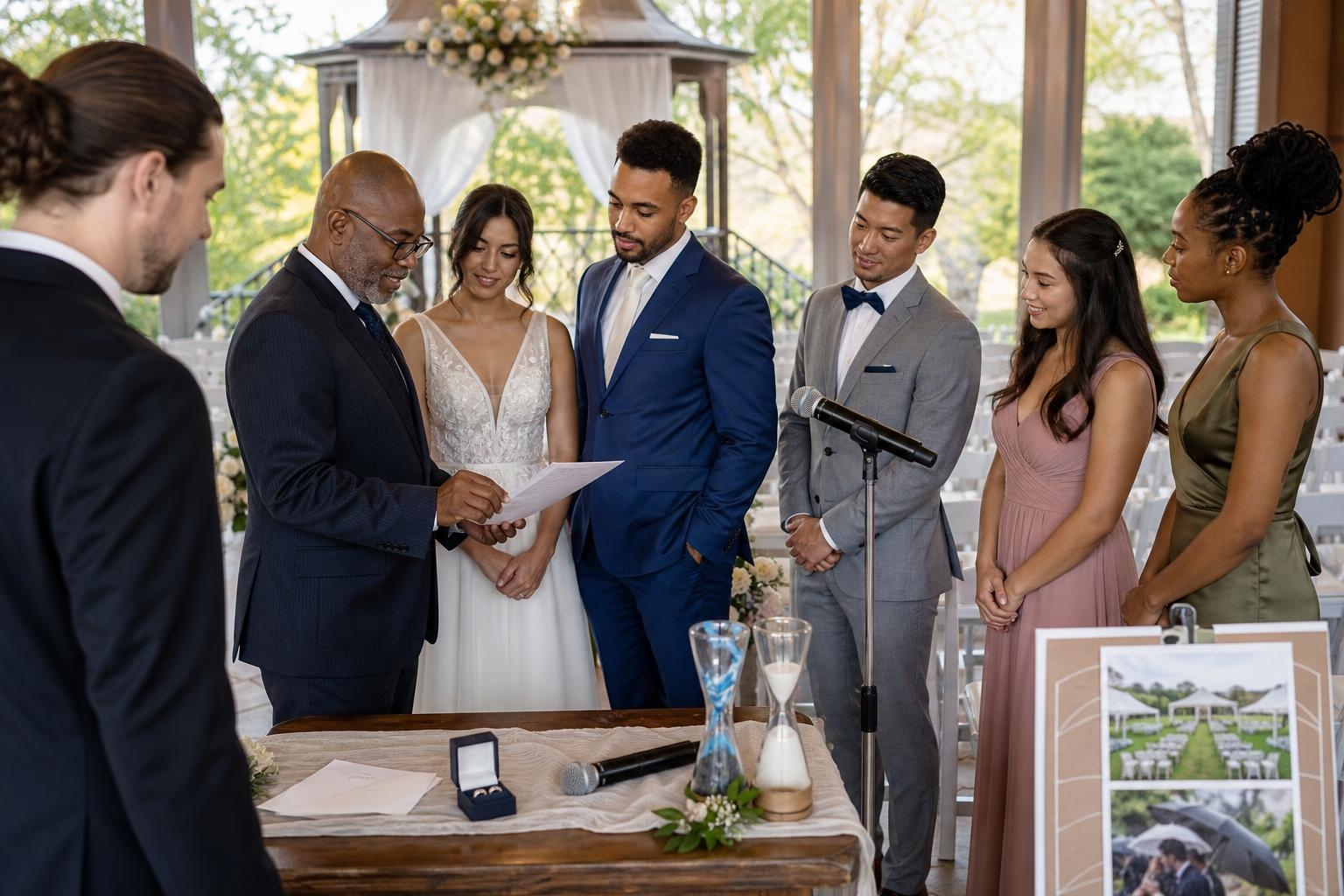
A wedding rehearsal is not the time to deliver the whole ceremony twice. It is the time to remove uncertainty. Your job as the officiant is to help everyone understand where to stand, when to move, what to hold, and what to do if the day does not go exactly as planned.
This wedding rehearsal checklist gives you a practical way to walk the couple and wedding party through the ceremony without making the evening feel stiff. Keep the tone calm, use plain instructions, and rehearse the moments most likely to cause confusion.

1. Prepare before everyone arrives
Start with the ceremony plan. Before the rehearsal, confirm the ceremony location, the direction guests will face, the couple’s final standing positions, and who is responsible for day-of coordination. If a planner or venue coordinator is present, agree on who gives movement cues. Two people giving different instructions is how a peaceful rehearsal becomes a small traffic jam.
Review the ceremony script and mark the moments that require movement or handoffs. Common examples include the processional, greeting, readings, vows, ring exchange, unity ceremony, pronouncement, kiss, and recessional.
Confirm the people involved. Make a list of the couple, attendants, flower child or ring bearer, readers, musicians or DJ, parents or other honored guests, and anyone participating in a cultural or unity ritual. Do not assume every participant knows whether they are walking, standing, sitting, speaking, or leaving.
Ask the couple one useful planning question:
What should guests notice most during the ceremony: a smooth formal procession, the couple’s vows, a family or cultural ritual, or a relaxed sense of connection?

Example: The couple wants the ceremony to feel warm and conversational, while still keeping the processional organized and the vows easy for every guest to hear.
Short answer: Warm tone, clear movement, strong audio.
2. Walk the lineup and processional
Line people up physically. Do not merely describe the order from the front. Put everyone in the place where they will actually begin. Confirm who enters first, how much space each person needs, and whether anyone needs a slower pace, an escort, a chair, or an alternate route.
Then rehearse the processional one segment at a time:
- Identify the first person or group to enter.
- Show each person where to pause, turn, or stand.
- Confirm whether attendants stand in a straight line, angled toward the couple, or in another arrangement.
- Practice the couple’s entrance separately if it has a special cue.
- Walk the recessional in reverse order before ending the rehearsal.
Give short cues. “Walk when the music begins,” “pause at the last row,” and “stand on the marked spot” are more useful than a long explanation about timing. If music is involved, identify the exact song, section, or signal the musician should use.
Also discuss what happens if someone is late, a child stops walking, or a piece of music ends early. A backup instruction such as “continue to the front and I will keep the ceremony moving” helps people avoid freezing.
3. Test microphones, vows, rings, and readings
Test the microphone at standing height. The couple may be seated during a sound check, but they will speak while standing, turning, smiling, and sometimes looking down at vows. Test the microphone in the actual positions they will use. Confirm whether the officiant, couple, readers, and musicians use separate microphones.
Ask the couple to read one or two lines of their vows at a natural volume. Check whether the microphone is too close, too far away, pointed at the wrong angle, or picking up clothing noise. If the venue has a sound technician, establish who will adjust volume during the ceremony.
Decide how vows will be held. Printed cards, a binder, a phone, or a tablet may all work, but the couple should know where to look and how to hold the material without covering the microphone. If the couple is repeating vows after you, confirm whether you will say one phrase at a time or read the full passage first.
Assign the rings. Name the ring keeper and decide exactly when the rings move from that person to the officiant or the couple. If there are multiple rings, place them in a clearly labeled container or on a tray. Practice the handoff. A ring that is “somewhere with the family” is not a reliable plan.
For readings, confirm the reader’s location, microphone, printed copy, pronunciation questions, and whether the reader returns to their seat or remains standing.
4. Rehearse the ceremony moments that need precision
Practice the transitions, not every word. The goal is to make the sequence familiar. Walk through the greeting, opening remarks, readings, vows, ring exchange, unity ceremony, pronouncement, kiss, and recessional at a steady pace.
Unity props deserve special attention. Candles, sand, wine, cords, flowers, cultural objects, and written promises should be placed where they can be reached without someone crossing in front of the couple. Decide who brings each item forward, who removes it, and where it goes afterward.
Clarify the kiss cue. Tell the couple exactly when you will pronounce them married and whether you will say a phrase such as “You may kiss.” If the couple prefers not to kiss, agree on an alternative such as an embrace, hand squeeze, or shared smile. The important thing is that the cue matches the couple’s wishes and the photographer’s expectations.
Walk the recessional. Identify who exits first, whether the couple pauses for photographs, and whether attendants leave in pairs or individually. Make sure the aisle remains clear and that readers, parents, or musicians know whether they exit immediately or remain in place.
| Ceremony moment | What to confirm at rehearsal | Day-of backup |
|---|---|---|
| Processional | Order, starting point, pace, music cue, standing positions | Coordinator signals the next person if timing changes |
| Vows | Printed or memorized, repeat-after-me format, microphone position | Officiant keeps a clean backup copy |
| Rings | Ring keeper, handoff, ring order, placement | Designated backup person holds the rings |
| Unity ritual | Props, participants, table location, cleanup | Skip or simplify the ritual if access or timing changes |
| Kiss and recessional | Pronouncement, kiss cue, exit order, photo pause | Officiant gives one clear verbal cue and keeps the aisle moving |
5. Check the marriage license and ceremony paperwork
Ask whether the couple has the marriage license. Do not assume that a rehearsal conversation means the legal paperwork is ready. The couple should confirm the issuing authority’s requirements, expiration rules, waiting periods, signatures, witnesses, officiant registration, and return process for the location where the marriage will take place.
Requirements vary by jurisdiction. USAGov explains that a marriage license legally allows a couple to marry and directs couples to the vital records office in the state where the marriage will occur for local instructions. Review the official USAGov marriage license guidance, then verify details with the appropriate state, county, or municipal office.
Keep the paperwork plan separate from the ceremony script. Decide who brings the license, where it will be stored, when it will be signed, and who is responsible for returning it. If the couple has a local deadline or special form, write it on your private officiant checklist rather than relying on memory.
For a state-by-state starting point, send the couple to the OrdainedPro marriage-law map. Treat it as a research starting point, not a substitute for the issuing authority’s current instructions.
6. Build accessibility and weather into the rehearsal
Ask what would make participation easier. Accessibility planning should be specific and respectful. Confirm routes, seating, standing time, lighting, sound, captions or interpretation, and whether anyone needs a quiet place or a different entrance. The Department of Justice explains that effective communication depends on the nature, length, complexity, and context of the communication, along with the person’s usual method of communication. You can review the ADA effective communication resource when coordinating with a public venue or service provider.
At rehearsal, walk the actual route. Look for stairs, loose gravel, narrow aisles, glare, cables, uneven flooring, or a microphone stand that blocks a mobility device. Ask before changing someone’s assistance arrangement; the person participating usually knows what works best.
Make the weather plan concrete. For an outdoor ceremony, identify who monitors the forecast, who can authorize a move indoors, where guests go, and how the couple and wedding party will be notified. The National Weather Service Event Ready Guide recommends planning for hazards, sheltering and evacuation options, alert methods, and the time needed to notify and move people. Review the NWS Event Ready Guide with the venue team.
If thunder is part of the concern, do not treat a tent as automatically safe shelter. The National Weather Service advises moving into a substantial enclosed building or a hard-topped vehicle when lightning threatens and waiting at least 30 minutes after the last thunder before resuming outdoor activity. Those decisions belong in the venue’s safety plan, not in a last-second debate at the altar.
Final rehearsal checklist
- Lineup, processional, and recessional are confirmed.
- Standing positions and aisle routes are clear.
- Microphones, music cues, and readings are tested.
- Rings and unity props have assigned keepers.
- Vows and ceremony script copies are ready.
- License and paperwork responsibilities are understood.
- Accessibility needs and alternate routes are addressed.
- Weather watcher, shelter, and communication plan are named.
- Kiss cue, pronouncement, and photo pause are agreed upon.
- Everyone knows the one person giving day-of instructions.
7. End with a simple day-of briefing
Finish by repeating only the essentials. Tell the wedding party where to gather, when to arrive, who gives the first cue, where the rings will be, and what to do if they forget a step. Reassure them that the officiant and coordinator will guide the ceremony; nobody needs to memorize every movement.
Send the couple a short written recap after the rehearsal. Include the processional order, key cues, paperwork responsibility, weather decision-maker, and any last-minute changes. Keep the final version easy to scan from a phone.
The best rehearsal is not the longest one. It is the one that leaves people confident about their next action. Walk the route, test the important tools, clarify responsibility, and leave room for the couple’s ceremony to feel like their own.
Use this wedding rehearsal checklist as your working outline, then adapt it to the venue, the couple, and the people standing beside them. Calm preparation is one of the most generous things an officiant can bring to a wedding day.
Frequently Asked Questions
What should an officiant bring to a wedding rehearsal?
Bring the current ceremony script, a one-page ceremony map, processional and recessional order, notes about readings and vows, ring and unity-ceremony instructions, contact information for the coordinator, and a backup pen. If the couple has provided paperwork or special ceremony materials, confirm where they will be kept.
Should the officiant rehearse the entire wedding ceremony?
Usually, the officiant should rehearse the movement, timing, cues, handoffs, and transitions rather than reciting every word in full. Practice enough of the vows, readings, and pronouncement for everyone to understand the sequence and sound requirements.
What license details should an officiant check before the rehearsal?
Confirm that the couple knows which government office issued the license, when it expires, whether a waiting period applies, who must sign it, whether witnesses are required, and how it must be returned. These rules vary by jurisdiction, so verify them with the relevant state, county, or municipal authority.
How should an officiant handle an outdoor wedding rehearsal?
Identify the weather watcher, shelter location, communication method, and person authorized to move or pause the ceremony. For lightning concerns, follow the venue’s safety plan and National Weather Service guidance rather than making an improvised decision at the ceremony site.
What accessibility details belong on a wedding rehearsal checklist?
Check the route, seating, standing time, lighting, sound, microphone placement, captions or interpretation, and alternate entrances. Ask participants what support works for them, and rehearse the actual route so barriers can be corrected before the wedding day.