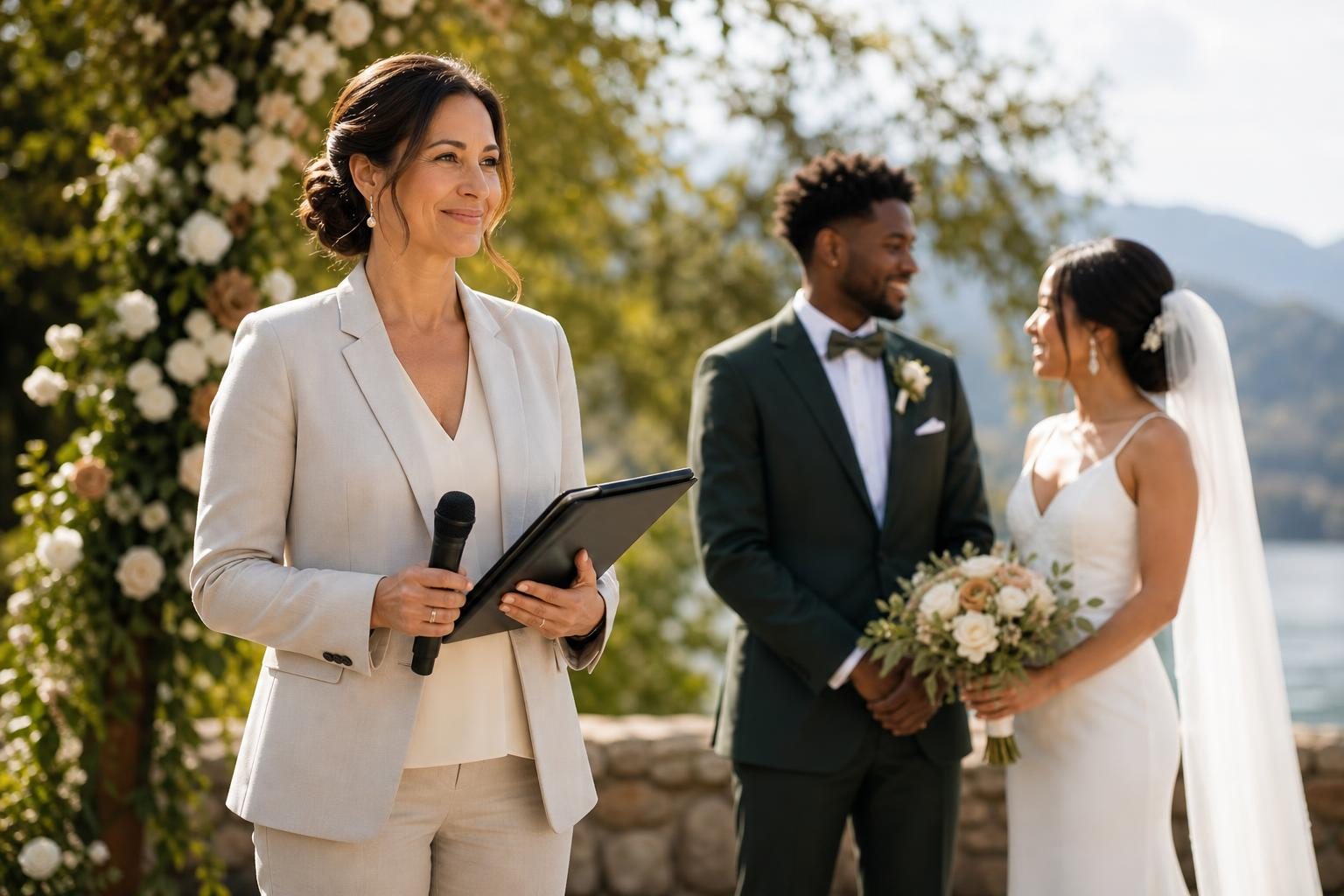
What should a wedding officiant wear? The short version is this: dress with the couple’s vision, the ceremony setting, and your responsibilities in mind. You want to look polished and appropriate without becoming the visual center of the day.
That sounds simple, but officiants often have more to consider than guests do. You may stand in one place for a long time, appear in nearly every ceremony photo, manage a microphone, move across grass or uneven ground, and work within religious or cultural expectations. The right outfit helps you do the job calmly and professionally.

Use this guide as a practical starting point, then ask the couple for clear direction before you buy or alter anything.
Start with the couple’s dress code and overall vision
Begin with alignment, not assumptions. The invitation may say “formal,” “cocktail,” “garden party,” or “casual,” but the couple may have a more specific picture in mind for the officiant. A professional officiant should ask early rather than arrive in an outfit that feels out of place.
Useful questions include:
- What level of formality are you planning?
- What will the wedding party wear?
- Would you like my outfit to coordinate with the wedding colors?
- Are there colors, patterns, or styles you would prefer me to avoid?
- Will the ceremony be indoors, outdoors, religious, cultural, or held in a house of worship?
- Will I need to move, kneel, sit, or stand on a platform?
Planning question: What should your outfit communicate about your role in this ceremony?
Example: “We want the officiant to look formal and trustworthy, coordinate with the wedding party, and remain visually distinct from the couple.”

Short answer: Polished, coordinated, and unobtrusive.
The Knot’s guidance for officiants also recommends asking the couple what they want the officiant to wear, especially because the officiant appears prominently in ceremony photographs. You can review its practical planning questions for officiants and couples.
Match the formality without competing with the couple
Dress one step below the couple’s level of visual prominence. That does not mean looking plain or careless. It means choosing clothing that supports the ceremony instead of pulling attention toward you.
For a formal wedding, a dark suit, tuxedo-appropriate outfit, elegant dress, formal jumpsuit, or refined equivalent may work well. For a semi-formal ceremony, consider a tailored suit, blazer and trousers, polished midi dress, dressy separates, or another structured outfit. For a casual outdoor wedding, a neat blazer, dress shirt, tailored trousers, dress, jumpsuit, or coordinated separates can be appropriate.
| Wedding setting or dress code | Practical officiant direction | Usually best to avoid |
|---|---|---|
| Formal or black tie | Choose a refined, tailored outfit in a classic fabric and polished color. | Casual shoes, loud novelty pieces, wrinkled fabrics, or visibly informal clothing. |
| Semi-formal or cocktail | Wear a dressy suit, coordinated separates, elegant dress, or polished jumpsuit. | Beachwear, athletic shoes, distressed denim, or overly flashy embellishment. |
| Outdoor garden or daytime ceremony | Prioritize breathable fabric, secure footwear, and a finished look that suits the venue. | Thin heels on grass, heavy layers in heat, or fabrics that wrinkle immediately. |
| Casual or intimate ceremony | Choose clean, professional clothing that still looks intentional in photographs. | Clothing with slogans, visible wear, or a “running errands” appearance. |
Emily Post’s attire guide offers a useful framework for understanding how formality changes from casual to white tie. As an officiant, use that framework as a baseline, then adjust for the couple’s preferences and the setting.
Choose colors and patterns that photograph well
Think about the camera, not just the mirror. You may be standing between or beside the couple for processional, ceremony, signing, and recessional photos. Your outfit should look good from several angles and under changing light.
Solid colors, subtle textures, and classic neutrals are generally dependable choices. Navy, charcoal, medium gray, deep green, burgundy, muted blue, taupe, and other subdued tones can work well when they suit the wedding palette. If the couple wants coordination, you might echo a wedding-party color without wearing an exact matching outfit.
Ask before wearing white, ivory, champagne, or a color strongly associated with one member of the wedding party. Some couples welcome those shades; others prefer that you avoid them. Do not guess.
For photographs, check:
- Whether the fabric becomes shiny under flash or direct sun.
- Whether the pattern creates visual noise on camera.
- Whether the color blends too closely with the background.
- Whether the outfit has distracting logos, slogans, or oversized hardware.
- Whether the neckline, hemline, and jacket stay in place while you speak.
The Knot’s officiant attire guidance recommends coordinating with the wedding party and being cautious with busy prints because they can compete with the visual rhythm of ceremony photographs. Its examples are especially useful when helping a couple decide between a neutral outfit and a coordinated color.
Prioritize comfort, movement, and footwear
Comfort is part of professionalism. A ceremony may be brief, but preparation, guest arrival, processional timing, photographs, and document handling can keep you on your feet much longer than expected.
Choose clothing that lets you stand naturally, turn toward both partners, reach a microphone, hold a script, and step aside when needed. Test the outfit at home before the wedding. Read several paragraphs aloud, gesture with your hands, bend slightly, and walk at a measured pace.
Footwear deserves special attention. For grass, gravel, sand, cobblestones, or uneven lawns, select shoes with stable soles and a heel that will not sink. For indoor ceremonies, confirm whether the venue requires shoes to be removed or whether the floor is slippery. Break in new shoes well before the wedding day.
Do not rely on an outfit that requires constant adjustment. If you keep pulling at a sleeve, checking a neckline, or managing a slipping waistband, that distraction can affect your delivery and the couple’s experience.
Plan for weather and the ceremony environment
Outdoor officiating requires a weather plan, not just a weather-appropriate outfit. Consider temperature, direct sun, wind, humidity, rain, mud, snow, and the time of day. The National Weather Service recommends identifying potential hazards, sheltering options, communication methods, and decision points for outdoor events in its Event Ready Guide.
For warm weather, breathable fabrics, lighter colors, sun protection, and access to water may help you remain focused. The National Weather Service’s weather safety guidance also emphasizes preparation for heat and other hazardous conditions.
For cooler weather, use layers that can be removed or added without creating a bulky silhouette. A polished coat, wrap, vest, or structured cardigan may be more practical than one heavy garment. Keep your ceremony script protected from wind and moisture.
Ask the venue or couple:
- Will the ceremony surface be grass, sand, stone, flooring, or a raised platform?
- Is there shade or shelter?
- Will wind affect the microphone, papers, veil, or decorations?
- Is there an indoor backup location?
- How far will you walk from the staging area to the ceremony site?
Account for microphones, scripts, and officiant duties
Your outfit needs to work with your equipment. Before the ceremony, find out whether the venue or DJ will provide a handheld microphone, lavalier microphone, stand, or other amplification. The Knot’s officiant planning guidance recommends confirming microphone and audio arrangements in advance through its questions for couples and officiants.
A jacket can provide a secure place for notes, but pockets should not bulge or create noise when you move. If you wear a dress or outfit without pockets, use a slim folio, discreet clipboard, or have a coordinator hold your materials. Avoid bracelets, necklaces, or loose accessories that may tap against a microphone.
Test your clothing with the actual microphone when possible. A lapel microphone may clip awkwardly onto delicate fabric. A long necklace may catch on a cord. A loose sleeve may brush a handheld microphone. These are small details, but solving them before guests arrive makes the ceremony feel smoother.
Officiant outfit checklist
- Couple approved the overall look.
- Outfit matches the ceremony formality.
- Colors and patterns photograph well.
- Shoes are stable and broken in.
- Clothing works with the microphone.
- Weather and venue surfaces were considered.
- Script, pen, and backup supplies are ready.
- Outfit was tested while standing and speaking.
Respect cultural and religious expectations
When tradition is part of the ceremony, ask for specific guidance. Expectations may involve modesty, head coverings, sleeve length, hemline, footwear, colors, jewelry, or whether certain garments are appropriate in a sacred space. The couple, venue, religious leader, cultural advisor, or ceremony coordinator should be your source for those instructions.
Do not assume that a general wedding dress code answers these questions. A ceremony may have requirements that are not obvious from the invitation. If you are uncertain, ask respectfully and follow the direction you receive.
It is also wise to ask about practical movement. Some ceremonies involve standing in a particular position, sitting on the floor, removing shoes, covering the head, or moving through a prayer space. Your outfit should allow you to participate respectfully without repeated adjustments.
If the couple asks you to wear a specific cultural or religious garment, clarify who is providing it, how it should be worn, and whether there are any preparation or handling instructions. When in doubt, defer to the appropriate authority rather than improvising.
Use a simple final approval process
Send the couple a clear outfit summary well before the wedding. A short message can prevent last-minute confusion:
- Describe the outfit, including color and level of formality.
- Share a photo or link to the exact item when practical.
- Confirm shoes and any outer layer.
- Ask whether there are colors, symbols, or styles to avoid.
- Confirm whether the ceremony setting requires anything specific.
For example: “I am planning a charcoal suit, white shirt, muted blue tie, and brown dress shoes. I will bring a dark weatherproof coat for the outdoor portion. Does that fit the wedding-party colors and ceremony setting?”
That kind of message is professional because it gives the couple something concrete to approve. It also gives you time to make changes without rushing.
Conclusion: dress to support the moment
The best officiant outfit is polished, comfortable, photograph-friendly, and appropriate to the couple’s ceremony. Ask early, confirm the dress code, test your clothing with your equipment, and plan for the actual weather and ground under your feet.
When your outfit is settled, you can give your attention to what matters most: speaking clearly, honoring the couple’s story, and helping the ceremony feel steady from beginning to end.
Frequently Asked Questions
Should a wedding officiant match the wedding party?
Not necessarily. An officiant can coordinate with the wedding-party colors without wearing an identical outfit. Ask the couple whether they prefer a matching shade, a complementary neutral, or a distinct professional look.
Can a wedding officiant wear black?
Often, yes, if black suits the ceremony’s formality and the couple’s preferences. Confirm that black is appropriate for the venue, cultural expectations, and wedding-party palette before finalizing the outfit.
Should an officiant avoid white?
Many couples prefer officiants to avoid white, ivory, or champagne so the outfit does not compete visually with the couple. However, preferences vary, so ask rather than assuming.
What should an officiant wear to an outdoor wedding?
Choose polished clothing suited to the dress code, breathable or layered fabrics for the forecast, and stable footwear for the ceremony surface. Plan for sun, wind, rain, heat, cold, and an indoor or sheltered backup when appropriate.
What shoes are best for a wedding officiant?
Comfortable, polished shoes with stable soles are usually the safest choice. For grass, gravel, sand, or uneven ground, avoid footwear that sinks, slips, or makes walking difficult.
Should a wedding officiant wear religious clothing?
Only when appropriate to the officiant’s role and the ceremony’s expectations. Ask the couple and, when relevant, the responsible religious or cultural authority for specific guidance about garments, modesty, colors, head coverings, and footwear.
How early should an officiant ask about attire?
Ask during early ceremony planning, ideally before buying or altering an outfit. Confirm the final look again shortly before the wedding if the venue, dress code, weather, or wedding-party attire changes.