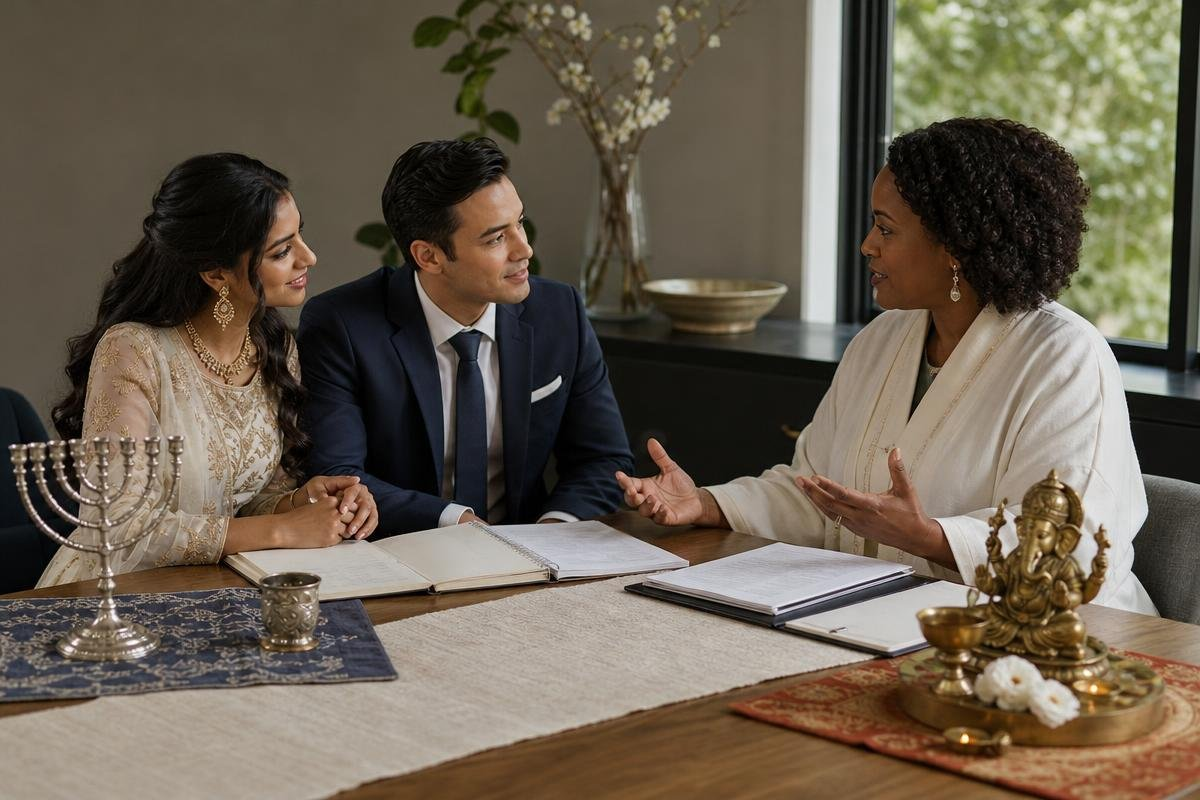
When a couple asks you to blend religions in a wedding ceremony, they are usually asking for more than a collection of readings and rituals. They are asking you to help two meaningful traditions stand beside each other without turning either one into decoration.
That takes patience, careful listening, and a willingness to say, “Let’s confirm that before we include it.” Your job is not to make every difference disappear. Your job is to create a ceremony where each tradition is represented honestly and the couple can recognize themselves in the promises they make.

Begin with the couple, not a list of rituals
Before choosing readings, symbols, or blessings, learn what each tradition means to the couple personally. “Religious background” can describe family history, active practice, cultural identity, spiritual belief, or a mixture of all four.
Ask each partner to identify the elements they consider essential, meaningful, optional, or uncomfortable. This gives you a better starting point than assuming that the most recognizable symbol is the most important one.
Useful planning question: Which parts of your traditions would you miss if they were absent from the ceremony?
Example: One partner may care deeply about a blessing spoken by a grandparent, while the other may care more about a communal prayer or a family-made ceremonial object than about formal wording.
Short answer: Start with meaning, not appearances.

It is also worth asking whether the couple wants one integrated ceremony, two distinct sections, or a civil ceremony with separate religious blessings before or afterward. There is no single correct structure. The right choice depends on the couple’s beliefs, family relationships, and the expectations of any participating religious leaders.
Get permission and knowledgeable guidance
A couple’s affection for a tradition does not automatically give an officiant authority to reproduce every part of it. Some elements are widely shared family customs. Others may be formal religious rites with specific words, roles, objects, settings, or participants.
When a ritual is central to a living faith, ask the couple to consult a qualified representative of that tradition. Depending on the faith and community, that person might be a clergy member, religious educator, cultural elder, ceremonial specialist, or trusted family authority.
The Harvard Pluralism Project describes interfaith engagement as a way to understand religious diversity within its real social and historical context. The United Religions Initiative similarly emphasizes respectful listening, equal participation, and avoiding the imposition of one tradition over another. These principles are useful for ceremony planning because they remind you that representation should be collaborative, not merely aesthetic.
Do not promise that a particular religious authority will approve the ceremony. Instead, help the couple prepare questions:
- Is this ritual appropriate for a wedding involving two traditions?
- Are there words, objects, foods, gestures, or spaces that should not be combined with another tradition?
- Does the ritual require a particular leader, language, sequence, or participant?
- Would it be more respectful to include the element at the rehearsal dinner, reception, family gathering, or another separate event?
Preserve the context behind each element
A ceremony feels respectful when guests understand what they are witnessing. That does not mean turning the wedding into a lecture. A sentence or two can provide enough context for an unfamiliar blessing, object, or gesture.
For example, instead of saying, “Now we will do a traditional ritual,” explain who traditionally participates, what the action expresses, and why the couple selected it. A short explanation can also prevent guests from treating a sacred moment like a photo opportunity.
Resources from 18Doors recommend explaining the traditions and rituals represented in an interfaith ceremony through the officiant’s words or a printed program. Reform Judaism also suggests using a personalized program to explain key rituals and symbols. Those ideas can be adapted for many faith combinations, provided the explanation is reviewed for accuracy by people connected to the tradition.
| Planning question | If the answer is yes | Officiant response |
|---|---|---|
| Is the element sacred or formally religious? | It may have boundaries or required wording. | Seek guidance from a qualified representative before adapting it. |
| Is it mainly a family or cultural custom? | The couple may have more flexibility. | Ask the family to explain its meaning and preferred presentation. |
| Would guests misunderstand its purpose? | The moment could feel tokenizing or confusing. | Add a brief explanation in the script or program. |
| Does it conflict with another tradition? | Combining the elements may create discomfort. | Separate the moments, revise the wording, or leave one out. |
Protect pronunciation, language, and sequence
Small details carry a great deal of weight. Practice names, sacred terms, blessings, and family languages until you can say them confidently. Ask the couple for a phonetic guide, an audio recording, or a trusted language speaker who can coach you.
Do not improvise a translation of a prayer or blessing because the words seem straightforward. A phrase that sounds like a general wish for happiness may carry theological meaning, covenant language, or a specific understanding of marriage.
Sequence matters, too. If a tradition has a customary order, do not move a central element simply to make the ceremony flow more smoothly. If the couple wants a creative adaptation, describe it honestly as an adaptation rather than presenting it as the traditional form.
Good practice: Place the exact wording, pronunciation notes, translation, speaker, and planned location in your ceremony workbook. Send the working script to the couple and any participating religious or cultural advisers well before the rehearsal.
Blended ceremony accuracy checklist
- Confirm the pronunciation of every unfamiliar name and sacred term.
- Identify who is authorized or expected to lead each formal element.
- Verify the meaning and translation of every prayer, reading, or blessing.
- Mark which parts are traditional, adapted, newly written, or family-created.
- Rehearse transitions so one tradition does not feel like an interruption to the other.
Build a shared arc instead of a spiritual mashup
The strongest blended ceremonies usually have a clear emotional progression: welcome, recognition of family and heritage, reflection on commitment, promises, symbolic actions, and blessing or farewell. The traditions do not need to become one theology to belong in one ceremony.
Think of the ceremony as a well-built bridge. Each tradition has its own foundation, and the shared vows create the crossing. Your connecting language should focus on the couple’s commitments—care, fidelity, responsibility, hospitality, hope, or service—without claiming that all religions teach exactly the same thing.
One practical structure might look like this:
- Welcome guests and name the importance of both traditions.
- Invite a reading, reflection, or blessing from the first tradition.
- Invite a reading, reflection, or blessing from the second tradition.
- Explain the couple’s shared understanding of marriage.
- Lead vows and any mutually acceptable symbolic action.
- Offer closing words that honor both families without flattening their differences.
Sometimes the most respectful choice is not to combine two sacred rites. Instead, you may place one religious ceremony before the wedding, include a separate family blessing, or create a civil-centered ceremony with carefully selected readings. A clear boundary is often kinder than a forced blend.
Give both traditions real weight
Balance does not always mean giving each tradition the same number of minutes. It means giving each one genuine dignity. A short but carefully explained blessing may carry more weight than several decorative references.
Look for balance across the whole experience: the opening, readings, music, family participation, visual symbols, vows, and closing. If one tradition supplies the central ritual, make sure the other is not reduced to a generic poem or a token color.
Invite family members to participate in ways that fit their comfort and authority. One person might read a passage. Another might offer a blessing. Someone else might prepare a ceremonial item or explain a family custom during the reception. Participation should be voluntary, and no one should be pressured to perform a religious act that conflicts with their beliefs.
When traditions cannot be placed side by side, consider shared values without disguising them as shared doctrine. You can speak about generosity, mutual care, gratitude, or responsibility while allowing each faith to define those values in its own voice.
Rehearse the transitions and the tone
A well-researched script can still feel awkward if the transitions are abrupt. Rehearse how you will move from one tradition to the next. Explain what is happening before guests need to guess. Make sure music, movement, seating, and microphones support the ritual rather than competing with it.
Use calm, precise language. Avoid jokes about religious differences, exaggerated descriptions of “ancient” customs, or phrases that make one tradition sound normal and the other unusual. Do not describe a practice as exotic, primitive, mysterious, or universal.
If two officiants are participating, decide who introduces each section, how names and titles will be used, and how you will hand off the ceremony. The couple should see one coordinated service, not two leaders quietly negotiating from the stage.
Before finalizing the script, ask the couple to read it aloud together. Listen for moments where one partner sounds like a guest in the other person’s ceremony. Revise until both can speak the promises naturally and without apology.
Know when to recommend a separate ceremony or adviser
Sometimes the honest answer is that a single officiant should not attempt to lead every religious component. A couple may benefit from co-officiants, a family blessing, a separate religious service, or a consultation with a specialist in one of the traditions.
This is not a failure of creativity. It is responsible care. The Harvard Pluralism Project and URI both emphasize listening, respect for difference, and attention to context. Those principles apply directly when a couple’s wishes meet the boundaries of a religious community.
Be especially careful when a couple uses terms such as “official,” “recognized,” “valid,” or “required.” Religious communities and civil authorities may use those words differently. Encourage the couple to confirm any religious or civil requirements with the appropriate authority rather than relying on a general ceremony template.
For broader planning support, couples can also review OrdainedPro’s officiant resources and ceremony planning options. If the couple needs to check local marriage requirements, begin with the OrdainedPro marriage requirements map and confirm details with the relevant government office.
Finish with clarity, care, and a workable script
Blending two religious traditions well is less about adding more and more elements. It is about choosing what the couple can explain, honor, and stand behind. Ask permission where permission is needed. Preserve context. Respect pronunciation and sequence. Give both traditions a real voice, and do not pretend that difference has disappeared.
Before the wedding day, send the final script to the couple and any approved advisers, rehearse every transition, and label adaptations clearly. When you do that work carefully, the ceremony can feel welcoming without becoming vague—and distinctive without misrepresenting either tradition.
Frequently Asked Questions
How do you blend two religions in a wedding ceremony?
Begin by identifying which elements are genuinely meaningful to each partner, then confirm the purpose and boundaries of any formal religious ritual with a knowledgeable representative. Build one clear ceremony arc while allowing each tradition to keep its own language, context, and identity.
Can an officiant combine religious rituals from two traditions?
Sometimes, but not every ritual should be combined or adapted. The couple should ask the relevant religious or cultural authority whether the element may be used, who should lead it, and whether it belongs in the ceremony or in a separate family or religious gathering.
How can an officiant keep an interfaith ceremony from feeling like a spiritual mashup?
Avoid treating religions as interchangeable symbols. Explain each element accurately, preserve its traditional meaning, use clear transitions, and connect the ceremony through the couple’s shared promises rather than claiming that every faith teaches the same thing.
Should an interfaith wedding have two officiants?
Two officiants can be helpful when each person brings recognized knowledge of one tradition or when a religious community expects a particular leader. A single experienced officiant may also work well for a ceremony centered on shared vows and carefully selected readings.
What should an officiant do if a couple wants to use a ritual they cannot verify?
Pause and ask for more information. Seek guidance from a trusted representative or cultural adviser, identify whether the ritual is sacred or customary, and consider leaving it out until its meaning, wording, and appropriate use are clear.