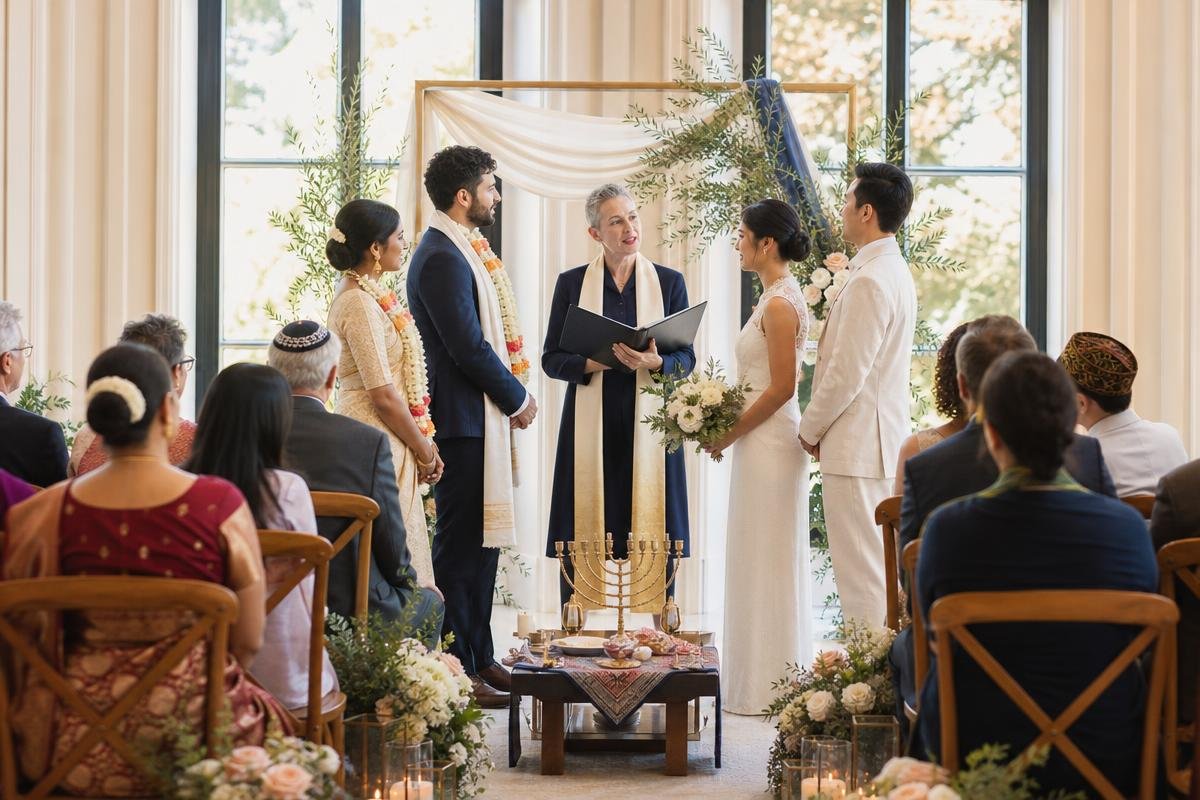
Building an interfaith wedding ceremony order is less about blending everything together and more about making room for each person, tradition, and family. Your job as the officiant is to create a ceremony that feels honest, welcoming, and easy for guests to follow.
A strong ceremony usually has a clear beginning, a meaningful middle, and a confident close. Within that structure, you can include two traditions without making either one feel like decoration. The key is careful listening, plain-language explanations, and transitions that help everyone understand what is happening.

Start with the couple’s shared center
Before drafting an interfaith wedding ceremony order, meet with the couple and identify the ideas they both want the ceremony to communicate. These may include devotion, family, hospitality, justice, gratitude, humility, or a commitment to building a home together.
This conversation helps you separate meaningful practice from familiar scenery. A ritual should have a reason for being included. If one partner wants a blessing because it connects them to a grandparent, that personal meaning matters. If a symbol is being added only because it appeared in a wedding magazine, it may not deserve ceremony time.
Planning question: What should guests understand about your marriage by the time the ceremony ends?
Example: “We want people to see that our marriage honors both of our families while creating a home shaped by shared compassion and responsibility.”
Short answer: Shared values guide the structure.

Invite each partner to name three nonnegotiable elements and three elements they are willing to adapt. Also ask whether either tradition has boundaries around who may lead a prayer, who may handle a sacred object, what language may be used, or whether a ritual requires a particular setting or religious authority.
The Pluralism Project’s interfaith resources are useful for background research, but they should not replace direct conversations with knowledgeable members of the traditions being represented.
Use a modular ceremony structure
A modular structure gives you a dependable frame while leaving room for the couple’s traditions. The following order works well for many ceremonies:
| Module | Purpose | Possible elements |
|---|---|---|
| Gathering | Welcomes guests and establishes the tone | Processional, opening words, acknowledgment of families |
| Meaning | Explains the couple’s commitment | Reflection, readings, sacred or humanist language |
| Tradition One | Honors one partner’s heritage or faith | Blessing, prayer, ritual object, family participation |
| Tradition Two | Honors the other partner’s heritage or faith | Reading, vow formula, symbolic action, blessing |
| Commitment | Centers the couple’s promises | Declarations of intent, personal vows, ring exchange |
| Community and close | Includes guests and completes the ceremony | Family blessing, legal declaration where required, pronouncement, recessional |
This modular approach prevents the ceremony from becoming a tug-of-war between two complete services. It also makes revisions easier. If a family member cannot participate, or a religious leader requests a change, you can adjust one module without rebuilding the entire ceremony.
Keep the order visible in your working draft. Label each section by purpose rather than by religion alone. For example, “Blessing of the Home” is often more helpful than “Christian Part” or “Jewish Part.” The first label tells you what the moment does; the second can make the ceremony feel divided into competing halves.
Write neutral transitions that explain without flattening
Transitions are the bridge between traditions. Without them, guests may feel as if the ceremony has suddenly changed languages, symbols, or expectations. A short explanation gives the audience a way to participate respectfully without pretending that every tradition means the same thing.
A useful transition has three parts:
- Name the element: Tell guests what is about to happen.
- Give its meaning: Explain why it matters to the couple.
- Offer an invitation: Tell guests whether they should stand, remain seated, listen, respond, or simply witness.
For example: “The couple will now share a blessing drawn from Maya’s family tradition. It expresses gratitude for the love that shaped her and a hope that their home will be generous to others. Guests are invited to listen in a spirit of respect.”
That wording does not claim that every guest shares the belief. It also avoids turning a sacred practice into a museum explanation. The couple’s own interpretation should lead.
The Interfaith America guide to faith-friendly events recommends asking when you are unsure rather than assuming you understand every tradition. That is sound officiant practice: research first, then confirm details with people who actually live within the tradition.
Place prayers, blessings, and readings with care
Some couples want two distinct prayers or blessings. Others prefer one shared reflection using language that both partners can affirm. Neither choice is automatically more inclusive. The right choice depends on the couple’s beliefs, their families, and the expectations of any participating religious leaders.
When using distinct prayers, let each one remain recognizable. Introduce it honestly, identify who is offering it, and avoid editing away the central meaning merely to make it sound generic. If one tradition addresses God in a particular way and the other uses different theological language, the ceremony can acknowledge that difference rather than hiding it.
When using a shared blessing, write it around values both partners genuinely hold. Words such as patience, fidelity, courage, hospitality, mercy, and mutual care can create common ground without pretending that the couple’s traditions are interchangeable.
The Pluralism Project’s discussion of sharing prayers and religious space highlights an important principle: interfaith gatherings may be most authentic when each tradition contributes in its own distinctive language, with participants choosing how they will listen or take part.
Readings require the same care. A poem or literary passage can serve as a bridge, especially when it reflects the couple’s values without claiming to represent either faith. If a passage comes from a sacred text, confirm the translation, pronunciation, and intended use with a trusted representative of that tradition.
Build vows and rings around mutual consent
Vows are the emotional center of most wedding ceremonies, and they are often the easiest place to create equality. Each partner should have a comparable opportunity to speak, promise, and receive a promise. The words do not need to be identical, but the commitments should feel balanced.
Offer the couple a few practical options:
- Write fully personal vows.
- Use a shared vow formula with individual additions.
- Repeat short promises after the officiant.
- Exchange traditional words from each partner’s background, with permission and accurate guidance.
For ring exchanges, explain what the rings represent in this ceremony rather than presenting one meaning as universal. The exchange may symbolize continuity, mutual responsibility, public commitment, or the promise to keep choosing one another.
Keep the language direct. Nervous couples often appreciate vows that are easy to say aloud and easy for guests to hear. Test every line for breath, rhythm, and clarity. A beautiful sentence that cannot be spoken comfortably is not finished yet.
Include family elements without assigning theological roles
Family participation can make an interfaith ceremony feel generous rather than divided. Parents, grandparents, siblings, children, and close friends might offer readings, carry symbolic objects, share a blessing, present rings, or contribute to a community vow.
Give participants clear instructions and avoid assuming that a family member can serve as a religious representative. A parent may be able to offer a personal blessing but not lead a formal prayer. A friend may read a passage but not explain its theological authority. Match the role to the person’s relationship with the couple and their standing within the tradition.
One flexible option is a family or community blessing in which guests respond to a simple promise, such as supporting the couple with honesty, respect, and practical care. Make participation optional if the wording is religious. Guests who cannot say the response can remain silent and still be part of the moment.
Officiant checklist
- Confirm the meaning and pronunciation of every religious term.
- Ask who may lead, touch, carry, or bless each sacred object.
- Explain each ritual in one or two accessible sentences.
- Give readers and family participants written instructions.
- Prepare a backup if a participant becomes unavailable.
- Rehearse transitions, not only the vows.
Handle the legal close separately from the sacred structure
The legal portion of a ceremony should be clear, accurate, and handled according to the requirements of the jurisdiction where the marriage takes place. Marriage licenses, expiration periods, officiant eligibility, witness rules, filing procedures, and required wording can vary by state or locality. The USAGov marriage-records guidance explains that couples should contact the vital records office in the place where they are marrying for local instructions.
For a state-specific starting point, direct the couple to the OrdainedPro marriage-law map, then encourage them to confirm current requirements with the appropriate government office. Do not promise that an online summary is complete or that an officiant’s ordination is accepted everywhere.
In the ceremony script, keep the legal declaration distinct from the religious or spiritual blessings. This makes the moment easier for guests to understand and gives you a clean place to verify the exact wording and signing process before the wedding day.
Best practice: Mark every legal sentence in your private script and review it with the couple well before the rehearsal. If a local authority, venue, or participating religious leader gives different instructions, pause and verify rather than improvising.
Rehearse the movement, not just the words
An interfaith ceremony can be meaningful on paper and confusing in the room if people do not know when to stand, where to go, or what to hold. During rehearsal, walk through the processional, each ritual, family participation, ring exchange, signing, and recessional.
Check practical details such as microphone position, lighting, table height, sacred-object placement, pronunciation notes, and whether a ritual needs water, wine, candles, a canopy, a book, or another item. Confirm who removes or carries each object afterward.
Finally, read the entire ceremony aloud at a calm pace. Listen for repeated explanations, abrupt changes in tone, and sections that sound like a lecture. Your goal is not to explain every detail of two faiths. Your goal is to help this couple make a sincere public commitment while honoring the people and traditions they bring with them.
Close with confidence and warmth
A well-built interfaith wedding ceremony order does not erase difference. It gives difference a respectful place inside a shared commitment. Use a modular structure, explain transitions, protect the integrity of each tradition, and keep the couple’s own promises at the center.
Before the wedding day, verify the legal requirements, confirm every ritual with an appropriate source of guidance, and rehearse the physical flow. Then stand up, slow down, and guide the room with steady confidence. The ceremony does not need to be perfect. It needs to be thoughtful, truthful, and ready to hold two lives together.
Frequently Asked Questions
What is a good order for an interfaith wedding ceremony?
A practical order is gathering and welcome, opening reflection, first tradition, second tradition, vows, ring exchange, family or community blessing, legal declaration where required, pronouncement, and recessional. The modules can be rearranged to fit the couple’s traditions.
How do you combine two religions in a wedding ceremony?
Start with the couple’s shared values, then include meaningful elements from each tradition with permission and accurate explanations. Keep distinct prayers or rituals recognizable rather than blending them into a generic version without guidance.
Should an interfaith wedding ceremony include two prayers?
It can, if both partners want that and the people leading the prayers are comfortable with the role. Another option is one shared blessing written around values the couple genuinely holds.
How can an officiant explain religious rituals to wedding guests?
Briefly name the ritual, explain what it means to the couple, and tell guests how they may participate. Keep the explanation respectful and avoid presenting one tradition as universal.
What legal steps should an interfaith wedding officiant confirm?
Confirm the marriage-license process, expiration period, officiant eligibility, witness requirements, required declarations, and document-return procedure with the relevant local government office. Requirements vary by jurisdiction, so do not rely on a general ceremony template alone.