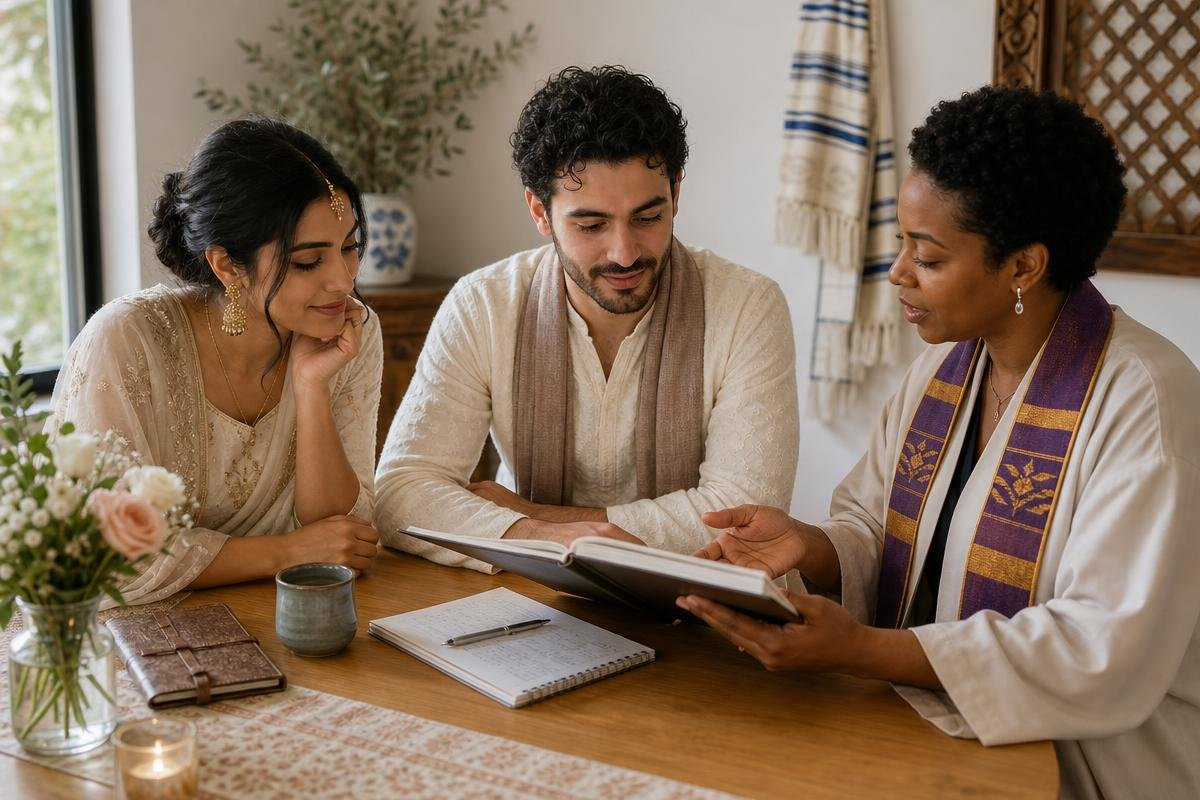
Choosing interfaith wedding readings is less about finding one perfect passage and more about creating a ceremony where both partners feel honestly represented. The strongest readings do not flatten religious differences or ask one person to quietly disappear. They create a shared point of meaning while respecting the traditions, boundaries, and family histories in the room.
As an officiant, your job is to help the couple make careful choices without turning the planning conversation into a theological debate. Start with the couple’s actual beliefs, confirm whether any religious authority or venue has requirements, and keep permissions and attribution in order before the ceremony script is finalized.

Begin with the couple, not a collection of famous quotes
A reading can sound beautiful and still feel wrong for the couple. Before offering suggestions, learn what they want the reading to accomplish. Some couples want a clearly religious passage. Others want language that acknowledges faith without naming a particular tradition. Some want a poem, a family blessing, or words written specifically for the ceremony.
Use a short planning conversation to establish four things:
- Religious identity: How does each partner describe their faith, practice, culture, or nonreligious worldview?
- Comfort level: Are either partner or their families sensitive to particular names for God, claims about salvation, gendered language, or references to religious authority?
- Ceremony setting: Will the ceremony take place in a house of worship, a private venue, outdoors, or online?
- Emotional purpose: Should the reading feel solemn, joyful, literary, devotional, intimate, or welcoming to guests from many backgrounds?
What do you want guests to understand about your shared life after hearing the reading?
Example: “We want our guests to hear that our marriage will be grounded in kindness, mutual responsibility, and respect for both of our families, without making either of us recite beliefs we do not hold.”
Short answer: Shared values, honest language, mutual respect.

Choose the right kind of reading
There is no single correct category for interfaith wedding readings. A useful way to narrow the field is to decide whether the couple wants a shared religious text, a tradition-specific passage, a public-domain work, an authorized modern work, or an original reading.
| Reading type | Best fit | What to confirm |
|---|---|---|
| Shared or overlapping sacred text | Couples whose traditions recognize the same text or themes | Translation, interpretation, and whether the passage is appropriate in the ceremony |
| Tradition-specific passage | Couples who want each faith named clearly | Permission from the relevant clergy, community, or venue |
| Public-domain work | Couples seeking poetry or literature with fewer copyright complications | That the specific edition, translation, or adaptation is public domain |
| Authorized modern work | Couples drawn to a contemporary poem, blessing, or literary excerpt | Whether performance, printing, recording, or online use requires permission |
| Original reading | Couples who want highly personal, neutral, or family-centered language | Who owns the text and whether the couple wants it printed or recorded |
For sacred-text research, the British Library’s sacred texts collection can help you understand how religious writings have been preserved and presented across traditions. For older literature, Project Gutenberg can be a useful starting point, but do not assume that every text, translation, or digital edition has the same rights status.
Respect permissions within each faith tradition
A passage can be publicly available and still be unsuitable for a particular religious setting. Some communities have expectations about which texts may be read aloud, who may read them, whether a translation is acceptable, and where a passage belongs in the order of service.
The couple should contact the appropriate clergy, celebrant, house of worship, or community authority when a reading comes from a living religious tradition. This is especially important when the ceremony is connected to a formal liturgy or when the couple hopes to include a prayer, blessing, scripture reading, or sacred language.
Guidance from 18Doors on inclusive wedding ceremonies recommends considering readings that are shared between traditions, not tied to one tradition, or not offensive to either partner. It also encourages couples to consult clergy when they have questions. That is a sensible standard for officiants: do not guess when a respectful conversation can prevent hurt or confusion.
Likewise, Reform Judaism’s guidance on inclusive weddings suggests considering readings from no particular faith tradition or readings shared between faiths, while also encouraging guidance from a rabbi or cantor. The point is not to treat one community’s approach as universal. The point is to confirm what is appropriate for the people actually represented in the ceremony.
Handle public-domain, authorized, and original options carefully
Public-domain works
A public-domain work is generally no longer protected by copyright, which can make it easier to perform, print, or adapt. The U.S. Copyright Office explains that works enter the public domain when copyright protection has expired or when the material was never protected in the first place.
Still, check the exact version you plan to use. An older poem may be public domain while a modern translation, editorial arrangement, or adaptation is protected. Keep a record of the author, title, edition, translator, and source you reviewed.
Authorized modern works
Contemporary poems, books, song lyrics, readings from websites, and commissioned blessings may require permission even when the couple intends to use only a short selection. The Copyright Office notes that there is no fixed number of words or percentage that automatically makes a use fair. Fair use depends on the circumstances, so it should not be treated as a shortcut for ceremony planning.
If the work is modern and the rights holder is identifiable, ask for permission in writing. Include the title, author, exact portion, ceremony date, whether the reading will be printed in a program, and whether the ceremony will be recorded or livestreamed.
Original readings
An original reading written by the couple, a family member, or the officiant is often the cleanest option. It can name the couple’s values without borrowing language that carries religious or cultural assumptions they do not share.
Ask the writer whether the text may be edited, printed, recorded, and reused in a keepsake. If an officiant writes the passage as part of a paid service, clarify expectations in the service agreement. You do not need to make the conversation complicated; a simple written note can prevent disagreement later.
Make the reading feel balanced without forcing symmetry
Interfaith does not always mean that every element must be divided into equal halves. A ceremony can honor both partners without placing one Christian passage beside one Jewish passage, one Muslim passage, or one Hindu passage as though traditions were interchangeable pieces.
Instead, look for a thoughtful structure. One partner may choose a sacred reading while the other chooses an original blessing. A family member may read a public-domain poem, followed by a short explanation from the officiant. The couple may choose one shared reading and include brief spoken acknowledgments of both traditions elsewhere in the ceremony.
Balance meaning, not mathematics. The test is whether both partners recognize themselves in the ceremony and whether each tradition is represented accurately enough to be treated with respect.
Keep explanations brief and useful
If guests may not recognize the language, ritual, or tradition, add a one- or two-sentence introduction. Explain what the reading means to the couple, not every historical detail about the faith. A clear introduction can prevent guests from treating a sacred passage as decorative poetry.
For example: “This next reading comes from a tradition that has shaped Jordan’s family. The couple chose it because its call to compassion reflects the promises they are making today.”
Prepare the reader and the ceremony script
Once the reading is selected, help the person delivering it succeed. A meaningful passage can lose its impact if the reader is unfamiliar with pronunciation, pacing, microphone technique, or the emotional weight of the words.
- Confirm the final text: Use one approved version in the script, reader copy, and program.
- Mark pronunciation: Ask a qualified speaker, clergy member, or community representative to review unfamiliar names and sacred terms.
- Practice aloud: Check the length, sentence structure, and breath points.
- Plan the handoff: Tell the reader where to stand, when to approach, and whether the officiant will introduce the passage.
- Protect the tone: Avoid rushing a solemn reading or overperforming a quiet blessing.
- Confirm recording plans: If the ceremony will be livestreamed or posted online, revisit permissions for modern works.
Interfaith reading checklist
- Both partners approved the exact text.
- Religious or venue permissions were confirmed where needed.
- The author, title, translator, and source are documented.
- Copyright status or written permission is recorded.
- Pronunciation and delivery have been practiced.
- The ceremony program uses the same approved version.
Know when to recommend a different choice
Sometimes the kindest officiant advice is to set a reading aside. A passage may be beautiful but too strongly associated with conversion, exclusivity, gender roles, a particular doctrine, or a family conflict. A couple may also discover that a text they thought was neutral has a very different meaning in its original context.
You do not need to criticize the passage. Say what you observe and offer a practical alternative: “This text has language that may sound like a religious commitment to one tradition. Would you like to compare it with an original blessing or a reading centered on shared vows?”
If one partner is uncertain, pause. A reading should not be included because someone feels embarrassed to object. Give the couple time to read it aloud, discuss it privately, and consult the appropriate religious authority when the issue is tradition-specific.
When the right passage is hard to find, a short original blessing can be more honest than a famous quotation that does not quite belong. The ceremony will feel stronger when the words match the couple’s real life.
Finish with clarity and care
Before the wedding day, send the couple a final reading packet containing the approved text, attribution, permission notes, pronunciation guidance, reader instructions, and program wording. Keep the paperwork with the ceremony script so a last-minute substitution does not create confusion.
Interfaith wedding readings work best when they are chosen with humility. Listen closely, verify what needs verification, and let the couple’s shared values guide the search. A careful reading can welcome both families into the ceremony without pretending that their traditions are identical.
Next step: Ask each partner for three words they want the reading to express, then compare the lists before choosing a passage.
Frequently Asked Questions
What makes a good interfaith wedding reading?
A good interfaith wedding reading reflects the couple’s actual values, avoids language that one partner cannot affirm, and fits the ceremony setting. It may come from a shared sacred tradition, a secular literary work, an authorized modern text, or an original blessing.
Can we use a religious reading from only one partner’s tradition?
Sometimes, but the couple should discuss the meaning openly and confirm that the reading is appropriate for the venue, clergy, and ceremony. A tradition-specific passage can work when it is included honestly rather than presented as if both partners share the same beliefs.
Are interfaith wedding readings protected by copyright?
Many modern poems, books, song lyrics, translations, and online readings may be protected. Public-domain status applies to the specific work or version, not automatically to every translation or adaptation. When in doubt, seek written permission and keep attribution records.
Where can couples find sacred-text reading ideas?
The British Library’s sacred-text collection can provide historical and cultural context, while Project Gutenberg can help locate older literature. Couples should still consult qualified representatives of the traditions involved and verify the rights status of the exact version they plan to use.
What if neither partner wants a religious reading?
Choose an original blessing, public-domain poem, family-written reflection, or contemporary reading that expresses the couple’s values. A ceremony can be interfaith in its family context without requiring a sacred text.