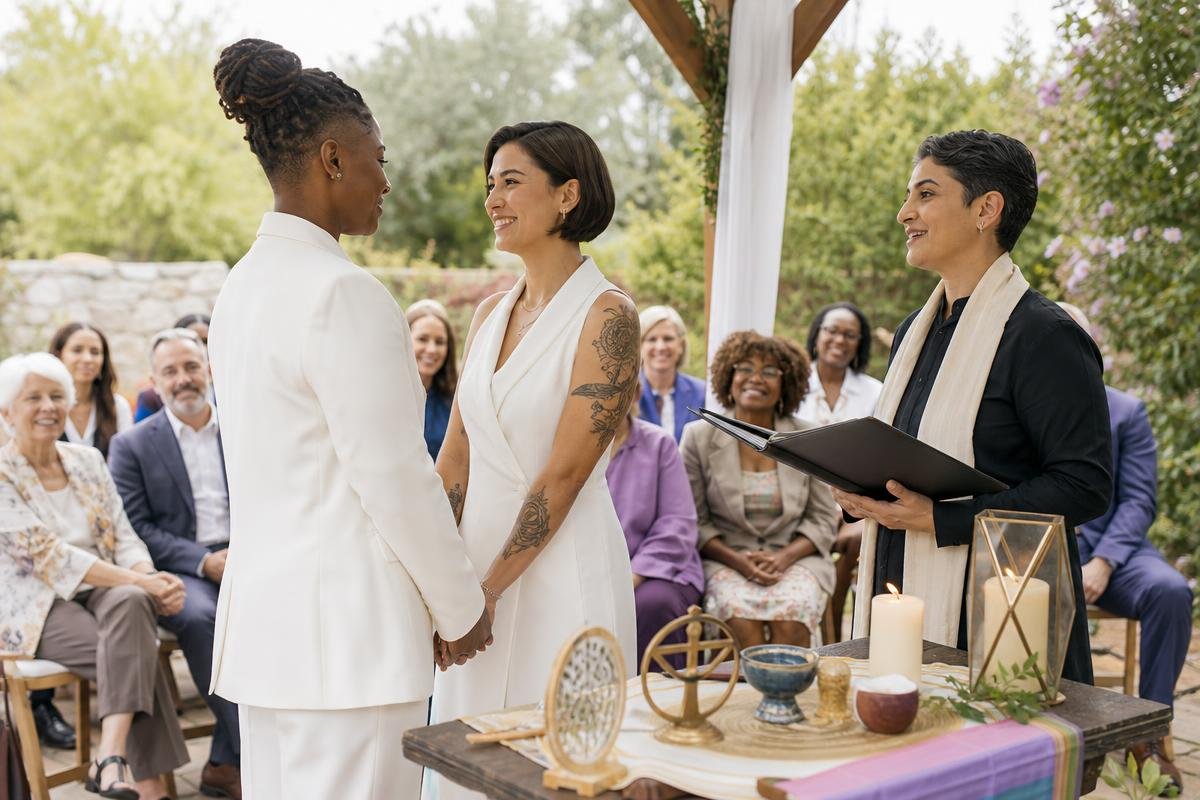
Creating an LGBTQ+ Interfaith Wedding Ceremony That Feels Fully Welcoming
An LGBTQ interfaith wedding ceremony asks you to do two important jobs at once: honor the couple’s identities and handle their faith traditions with care. The goal is not to create a ceremony that speaks for every denomination, family, or LGBTQ+ person. The goal is to listen closely, avoid assumptions, and build a service that sounds like this couple.
For an officiant, that starts well before the processional. Use the names and pronouns each partner gives you. Ask what their faith relationships mean to them today. Then shape the ceremony around shared commitments rather than forcing two traditions into a rigid formula.

Begin with the couple, not a template
A familiar wedding script can be a useful starting point, but it should never make decisions for the people standing in front of you. LGBTQ+ couples may not use traditional gender roles, and interfaith couples may relate to religion in very different ways. One partner may be deeply observant, while the other may be culturally connected, spiritually curious, or nonreligious.
Your first meeting should clarify four things:
- What names, pronouns, titles, and relationship terms should you use?
- Which faith traditions, communities, or family customs deserve recognition?
- Which prayers, readings, symbols, or rituals are welcome, optional, or off-limits?
- What should the ceremony say about the life they are choosing together?
Do not ask either partner to educate you about their identity in a way that feels invasive. You need ceremony preferences, not private medical history, a former name, or personal details they have not offered. The Trevor Project recommends using the names and pronouns people choose, confirming preferred honorifics, and avoiding assumptions based on appearance or gender expression. Read its guide to being an ally to transgender and nonbinary people before your planning meeting.
Planning question: What do you most want guests to understand about your marriage when the ceremony is over?
Example: “We want our families to see that our different faith backgrounds are not a problem to solve; they are part of the story we are bringing into one home.”

Short answer: Shared home, honest respect.
Use names, pronouns, and roles accurately
Small wording choices carry a surprising amount of weight. A partner who has carefully explained their name or pronouns should not have to correct the officiant during a rehearsal or ceremony. Put the information in your working notes, confirm it before printing programs, and review it again on the wedding day.
Build a reliable language sheet
Create a one-page reference for yourself and anyone helping with the ceremony. Include each partner’s:
- Full name as they want it spoken
- Pronouns and preferred honorific, if any
- Relationship terms, such as spouse, partner, wife, husband, or another term
- Preferred description of the couple, such as “brides,” “grooms,” or “partners”
- Names and roles of readers, parents, attendants, and other participants
Use neutral language while drafting until the couple tells you otherwise. “The couple,” “these partners,” and “the people before us” are often safer than filling in “bride” and “groom” from habit.
If you make a mistake: Correct yourself briefly, apologize without turning the moment into a performance, and continue. The Trevor Project advises a swift apology and better attention going forward rather than excessive guilt that makes the other person manage your feelings.
Respect both faith relationships without flattening them
“Interfaith” does not automatically mean “half of one religion plus half of another.” Sometimes the most honest ceremony includes a few carefully chosen elements from each tradition. Sometimes it uses shared values, family blessings, music, or personal vows instead of formal religious rites. Your responsibility is to help the couple make that choice knowingly.
Ask each partner what their tradition means to them personally. A religious symbol may represent prayer, family history, cultural belonging, or a complicated relationship with a community. Do not assume that a partner who identifies with a faith wants every familiar ritual included. Do not assume that a less observant partner wants no religious language at all.
Explain, translate, and give context
When you include a prayer, reading, blessing, or ritual in another language, explain its purpose in plain language. 18Doors recommends defining the traditions represented, acknowledging both faith backgrounds, translating non-English elements, and choosing readings or rituals that the couple considers respectful to everyone present. Its tips for inclusive wedding ceremonies offer practical ideas for programs, family participation, readings, and shared rituals.
A brief explanation can make a ritual feel welcoming rather than mysterious. For example: “This blessing comes from Jordan’s Jewish family tradition and speaks of joy, companionship, and a home filled with peace. Jordan and Casey have chosen it because those hopes belong to both of them.”
That wording describes the ritual without claiming that every Jewish person, Christian person, Muslim person, Hindu person, Buddhist person, or member of any other tradition understands marriage in the same way.
Choose rituals by meaning, not decoration
A ritual belongs in the ceremony because it expresses something the couple believes, values, remembers, or promises. It should not be added simply because it looks beautiful in photographs or seems like an easy way to make the ceremony appear “multicultural.” Sacred objects and practices deserve more care than that.
A simple decision guide
| Planning question | If the answer is yes | Officiant action |
|---|---|---|
| Does the ritual matter to one or both partners? | It carries personal or family meaning. | Ask the couple how they want it introduced and who should lead it. |
| Do both partners understand and welcome its meaning? | The ritual can support the shared ceremony. | Explain it briefly and avoid presenting it as universal. |
| Does the ritual require a particular religious authority? | A clergy member, community, or house of worship may have requirements. | Confirm those requirements before promising the ritual. |
| Would the ritual pressure someone to make a belief statement? | A guest or partner may feel excluded or misrepresented. | Offer a nonreligious alternative, a silent blessing, or a different role. |
| Is the idea mainly visual or trendy? | It may be decorative rather than meaningful. | Pause and ask whether it belongs in this couple’s story. |
Possible elements might include personal vows, a family blessing, a shared candle, a reading, a song, a handfasting, a canopy, a breaking of glass, a wine blessing, a moment of silence, or a community promise. The important question is not whether the elements can technically fit together. It is whether they create one coherent ceremony.
Keep the arc clear: welcome the guests, name the couple’s story, acknowledge the traditions and people that shaped them, invite promises, exchange vows and symbols, and pronounce the commitment in language the couple approves.
Write affirming language that does not overpromise
Affirming language is more than adding the phrase “love is love.” It makes room for the couple’s actual identities, history, and hopes without turning them into a lesson for the audience.
Useful wording choices
- “Today, Casey and Jordan gather as themselves, surrounded by people who have helped them become who they are.”
- “Their differences in faith are part of their story, and their shared commitments are part of the home they are building.”
- “They promise to make room for one another’s questions, practices, celebrations, and changing seasons.”
- “Marriage does not require either person to disappear. It asks them to practice love with honesty, patience, and courage.”
Avoid language that treats one partner as the “religious” person and the other as the “open-minded” person. Avoid jokes about who wears the dress, who is “the wife,” who is “the husband,” or who is expected to lead. Also avoid claiming that the couple’s relationship proves a particular theological point. Let the partners speak for themselves.
If the couple uses religious language, mirror their words rather than improvising beyond them. “May your marriage be blessed with compassion” is different from declaring what a particular deity, denomination, or religious authority supposedly requires of them.
Prepare family participation with care
Family involvement can make an LGBTQ interfaith wedding ceremony feel deeply connected. It can also create pressure if relatives are invited to speak for beliefs they do not share or if a family member’s participation is treated as proof of universal acceptance.
Offer roles that match each person’s comfort level. A relative might read a passage, carry a family object, offer a private blessing, sign a ketubah or other marriage document where appropriate, welcome guests, or simply stand in support. No one should be pushed into a public statement about sexuality, gender, religion, or family history.
Give readers the exact text in advance. Ask whether they are comfortable with the wording and pronunciation. If a family member cannot participate without making a hurtful comment, find another role or leave them out. The ceremony is not the place to test whether someone has changed.
Officiant review checklist
- Names and pronouns are confirmed.
- Gendered roles and titles are approved.
- Each included ritual has a clear meaning.
- Non-English or unfamiliar language is translated.
- Readers have approved their material.
- Religious requirements have been checked with the appropriate authority.
- The couple has approved the final script and pronunciation notes.
- Marriage-license responsibilities are being handled according to the applicable jurisdiction.
Handle legal and religious requirements separately
A beautiful ceremony and a legally recognized marriage are related, but they are not the same planning question. Requirements for the marriage license, officiant authority, witnesses, filing, deadlines, and ceremony wording can vary by location. Religious communities may also have separate rules about clergy, venues, premarital counseling, documentation, or approved rituals.
Do not make a universal statement such as “online ordination is valid everywhere” or “any officiant can sign the license.” Those are jurisdiction-specific and sometimes institution-specific questions. For a starting point, direct couples to the OrdainedPro marriage-law map, then encourage them to confirm details with the relevant government marriage office and, when needed, the couple’s religious authorities.
This article is educational and is not legal advice. As the officiant, keep a written checklist of what you have confirmed, what the couple must confirm, and what remains outside your role. That simple separation prevents a great deal of last-minute confusion.
Do a final rehearsal for belonging, not just timing
At rehearsal, practice more than entrances and ring exchanges. Listen for moments that may unintentionally exclude someone. Check whether the microphone changes a name’s pronunciation, whether a reader knows when to stand, and whether the ceremony uses a title that the couple did not approve.
Read the opening aloud exactly as written. Confirm how you will introduce the partners, how you will invite vows, and what you will say if a ritual takes longer than expected. Make sure the couple knows where to look, when to move, and what will happen if an item is misplaced.
Then ask one final, practical question: “Is there anything in this ceremony that sounds like someone else’s wedding instead of yours?” Give the couple time to answer. A small revision at rehearsal is far easier than an uncomfortable correction during the ceremony.
When the day arrives, be steady. Speak clearly, honor the language you agreed to use, and remember that welcome is created through hundreds of small choices. You do not need to perform expertise about every faith or identity. You need to be prepared, respectful, and willing to listen.
Frequently Asked Questions
How can an officiant make an LGBTQ interfaith wedding ceremony welcoming?
Begin by confirming each partner’s name, pronouns, titles, and preferred relationship language. Ask what each faith tradition means to them, identify rituals they welcome or do not want, and use affirming language that reflects the couple rather than traditional gender assumptions.
Do LGBTQ interfaith wedding ceremonies need to include rituals from both religions?
No. The couple may include rituals from both traditions, select a few shared elements, use personal vows and family blessings, or create a mostly secular ceremony. The right choice is the one that is meaningful and approved by both partners.
How should an officiant handle unfamiliar religious rituals?
Ask the couple to explain the ritual’s meaning and confirm whether a religious leader or community has requirements. Explain the ritual briefly for guests, translate unfamiliar language, and avoid presenting one family’s practice as universal to an entire faith.
What should an officiant do after misgendering a partner?
Correct yourself, apologize briefly, and continue using the correct name or pronouns. Avoid making the partner comfort you or turning the mistake into a long explanation. Review your notes and improve your preparation.
Can an officiant guarantee that a ceremony is legally valid?
No. Marriage-license and officiant requirements vary by jurisdiction, and religious institutions may have separate rules. Use the OrdainedPro marriage-law map as a starting point, then have the couple confirm current requirements with the appropriate government office and religious authorities.