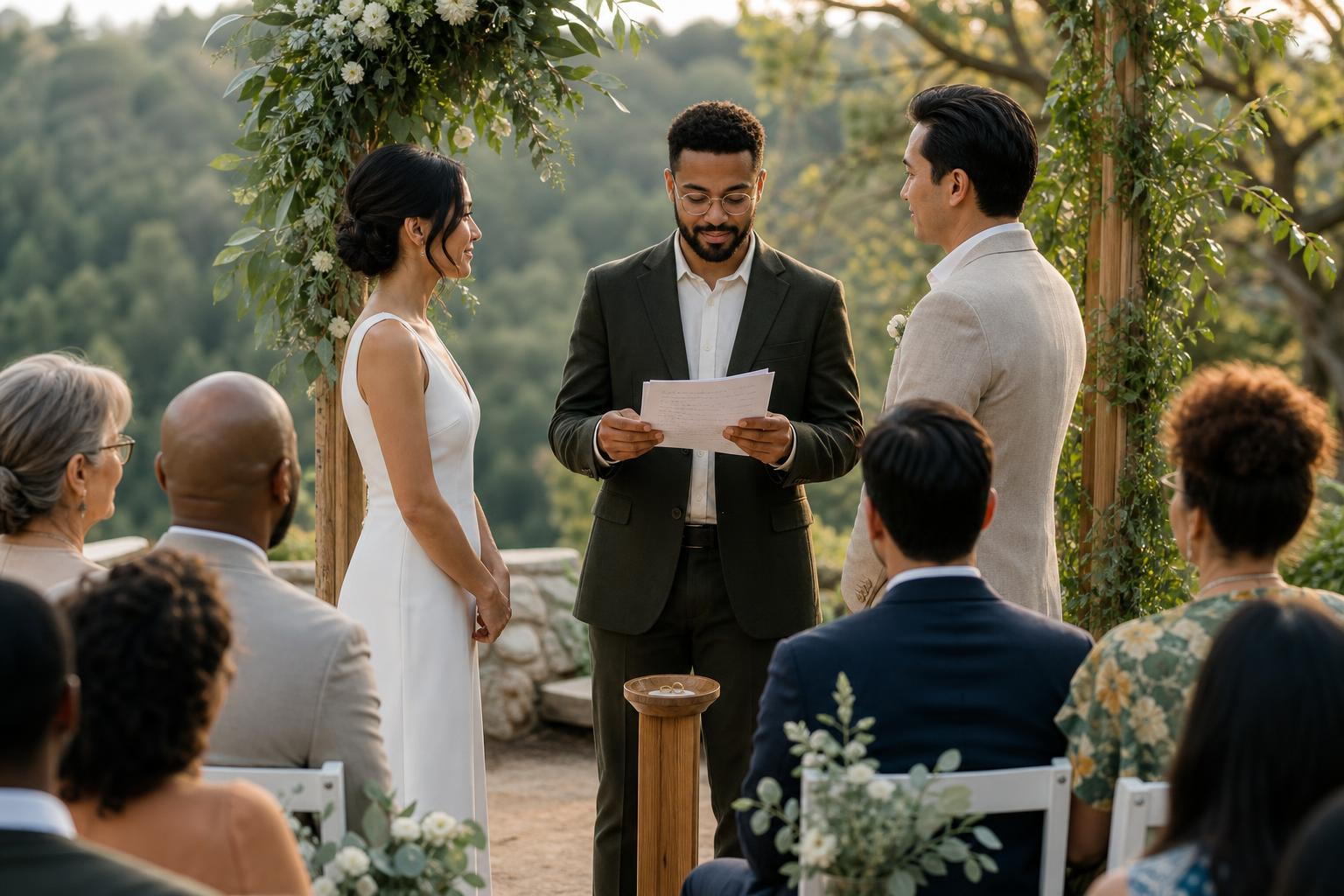
A nonreligious wedding ceremony can be deeply moving without relying on religious language. The heart of the ceremony comes from the couple’s partnership, the people who support them, the promises they choose, and the values they intend to practice together.
For a first-time officiant, the task may feel larger than it is. You do not need to sound like a poet, judge, or professional actor. You need a clear structure, honest words, and a steady hand when the couple gets emotional. This guide gives you an original nonreligious wedding ceremony script framework that you can adapt to the couple in front of you.

Use the script as a strong starting point, then replace general language with details that sound like the couple. A ceremony becomes meaningful when guests recognize the people being honored—not when every sentence sounds grand.
1. Decide what the ceremony should stand for
Before writing, identify the couple’s central message. A secular ceremony can focus on many things: friendship, teamwork, family, resilience, curiosity, humor, service, adventure, or the quiet work of showing up every day.
Ask the couple: What do you want your guests to understand about the life you are choosing together?
Example: “We want the ceremony to show that our marriage is built on friendship, patience, laughter, and making room for both of our families.”
Short answer: Friendship, patience, laughter, family.

Write the answer at the top of your notes. It becomes your filter. If a line does not support the couple’s message, remove it or rewrite it. That simple discipline keeps the ceremony from becoming a collection of attractive but unrelated phrases.
2. Use a dependable ceremony structure
A nonreligious ceremony gives you flexibility, but flexibility works best when it has a reliable frame. A practical order is:
| ceremony element | Purpose | Officiant focus |
|---|---|---|
| Processional and welcome | Settles the room and begins the shared moment | Speak slowly and acknowledge the people gathered |
| Reflection on the couple | Explains why this partnership matters | Use specific, respectful details |
| Community recognition | Honors family, friends, and chosen support systems | Invite attention without forcing participation |
| Declaration of intent | Gives the couple a direct opportunity to affirm the marriage | Ask clear questions with easy responses |
| Personal vows | Lets each partner make individual promises | Protect the pace and offer a prompt if needed |
| Ring exchange | Provides a visible symbol of commitment | Keep the wording short and easy to repeat |
| Pronouncement and recessional | Closes the ceremony with confidence and joy | Give the couple a clean transition into celebration |
This structure is consistent with common secular ceremony planning guidance, while still leaving room for readings, family participation, cultural traditions, or a unity ritual. For additional ceremony-order ideas, review The Knot’s guide to nonreligious wedding ceremony scripts.
3. Build the opening around welcome and belonging
The opening should help guests arrive emotionally. Avoid beginning with a long speech about marriage in general. Start with the people and the moment in front of you.
Original opening framework
Officiant: Welcome, everyone. Please be seated.
We are gathered here today to celebrate the marriage of [Partner A] and [Partner B]. They have invited us to witness their promises, share in their joy, and recognize the community that has helped bring them to this day.
Marriage is not a single promise made once and then set aside. It is a practice—a way of choosing one another through ordinary mornings, difficult decisions, unexpected changes, and the many small moments that make a life. Today, [Partner A] and [Partner B] are naming that choice in the presence of the people who care about them.
Thank you for being here, for the encouragement you have offered them, and for the support you will continue to give in the years ahead.
You can make this opening warmer by adding one or two details from the couple’s relationship. Keep them kind and relevant. A brief reference to how they met, what they admire in each other, or what they have built together is usually enough.
4. Speak about partnership without becoming generic
The reflection section is where the ceremony gains heart. The safest way to avoid clichés is to describe marriage through actions rather than abstract promises.
Instead of saying the couple will “be there for each other,” explain what that might look like: listening before solving, sharing responsibilities, telling the truth kindly, celebrating each other’s growth, or making decisions as a team.
Reflection framework
Officiant: [Partner A] and [Partner B], your relationship is made not only of the moments people see today, but also of the choices that brought you here: the conversations, compromises, celebrations, repairs, and ordinary acts of care.
You are promising to remain teammates while allowing each other to remain full and growing individuals. You are promising to build a home in the broadest sense—a place of honesty, respect, laughter, rest, and welcome.
The strongest partnerships are not measured by never facing difficulty. They are measured by how two people respond when difficulty arrives. May you keep learning how to listen, how to apologize, how to ask for help, and how to make room for joy.
As you customize this section, choose three values and connect each one to a behavior. For example, “respect” might mean giving one another room to change. “Adventure” might mean staying curious when life takes an unexpected turn. “Family” might mean making traditions that include the people who helped shape you.
5. Include the community in a natural way
A wedding is about two people, but it is also a gathering of people who have offered love, instruction, shelter, friendship, and perspective. Naming that support can make a secular ceremony feel grounded rather than purely romantic.
You can invite a community response:
Officiant: To everyone gathered here: Will you support [Partner A] and [Partner B] in their marriage, encourage them in hard seasons, celebrate with them in good seasons, and respect the life they build together?
Guests: We will.
If the couple prefers not to ask guests to speak, use a simple acknowledgment instead. You might say that marriage is strengthened by friends and family who offer honest advice, practical help, and a place to return to. This keeps the section inclusive without putting anyone on the spot.
6. Guide the declarations, vows, and rings
These moments carry the ceremony’s clearest promises. Keep the instructions unmistakable. Tell each partner when to face the other, when to repeat, and when to answer. Nervous couples are grateful for a calm officiant who does not make them guess what happens next.
Declaration of intent
Officiant to Partner A: [Partner A], do you choose [Partner B] as your spouse and partner, and do you enter this marriage freely, with the intention of sharing your life with care, honesty, and respect?
Partner A: I do.
Officiant to Partner B: [Partner B], do you choose [Partner A] as your spouse and partner, and do you enter this marriage freely, with the intention of sharing your life with care, honesty, and respect?
Partner B: I do.
Personal vows
Officiant: You may now share the promises you have written for one another.
Allow each partner to read personal vows, repeat prompted vows, or combine the two. If they are writing from scratch, suggest three parts: one specific appreciation, one promise for difficult days, and one promise about the future.
For a repeat-after-me option:
Officiant: I choose you as my partner and my friend. I promise to meet our life with honesty, patience, and courage. I will celebrate your happiness, respect your individuality, and work with you when life is difficult. I will keep learning, keep listening, and keep choosing our shared life, one day at a time.
Partner repeats: I choose you as my partner and my friend…
Ring exchange
Officiant: These rings are visible reminders of promises that cannot always be seen. As you wear them, may they call you back to the love, respect, and partnership you affirm today.
Partner A: I give you this ring as a symbol of my love and commitment. I choose you, today and in the days ahead.
Partner B: I give you this ring as a symbol of my love and commitment. I choose you, today and in the days ahead.
Couples may also use a short reading here. The Poetry Foundation’s love-poem collection can help you find inspiration for a secular reading. Use only text the couple has selected and confirm that any excerpt is suitable for the ceremony and intended use.
7. Close with confidence and a clear next step
The conclusion should not drift. Once the promises and rings are complete, give the guests a simple, unmistakable ending.
Officiant: [Partner A] and [Partner B], you have spoken your intentions, shared your promises, and exchanged rings as symbols of your commitment. In the presence of your community, I celebrate the partnership you have chosen and the life you will continue to build together.
By the authority granted to me, I now pronounce you married. You may share your first kiss as a married couple.
It is my joy to present [names]. Please welcome them with your applause.
Final officiant checklist
- Confirm the couple’s preferred names and pronouns.
- Check the ceremony order with the planner and venue.
- Print a large-font copy and keep a backup.
- Clarify who carries the rings and who gives readings.
- Verify local marriage-license and officiant procedures before the ceremony.
- Practice the declaration, vows, and pronouncement aloud.
Marriage paperwork and officiant requirements can differ by location. Before promising that a ceremony will be legally recognized, review the instructions from the appropriate local government office. OrdainedPro’s marriage-law and officiant-requirement map is a useful starting point for locating the right jurisdiction, but it should not replace the current primary government source.
A good nonreligious wedding ceremony does not need religious language to feel solemn, and it does not need extravagant language to feel profound. Give the couple a clear path, make room for their real values, and speak with enough calm that they can hear the promises they are making. That is the job, and it is a meaningful one.
Sources and further reading
Frequently Asked Questions
What should a nonreligious wedding ceremony include?
A practical secular ceremony usually includes a welcome, reflection on the couple, community acknowledgment, declaration of intent, personal vows, ring exchange, pronouncement, and recessional. Readings or unity rituals are optional.
How long should a nonreligious wedding ceremony script be?
The ideal length depends on the couple, venue, and number of participants. Focus on a ceremony that feels complete without making guests wait through repeated ideas. Reading the script aloud is the best way to judge its pace.
Can a nonreligious ceremony still feel meaningful?
Absolutely. Meaning comes from the couple’s promises, shared values, community, and the care taken with the words. A ceremony can be entirely secular while still feeling serious, tender, joyful, and memorable.
Should couples write their own vows?
They can write personal vows, repeat a prepared vow after the officiant, or use a combination. A helpful writing format is one specific appreciation, one promise for difficult days, and one promise about the future.
Do nonreligious ceremonies have legal requirements?
Legal requirements vary by the location where the marriage takes place. Couples and officiants should verify the current marriage-license, officiant, witness, filing, and ceremony requirements with the appropriate government authority.