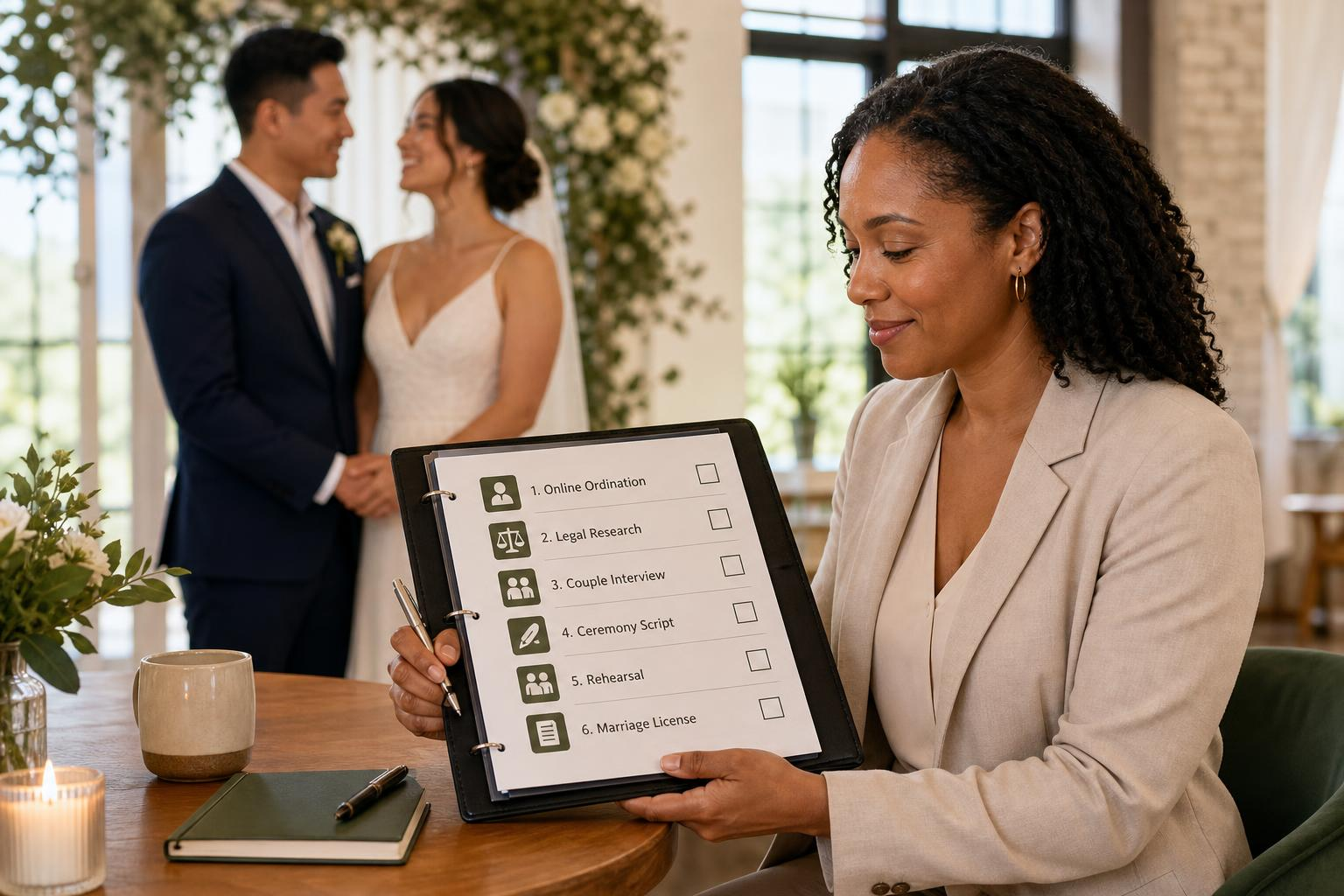
Planning to officiate a wedding for the first time? Online ordination can be one part of becoming ready for the role, but it is not the only step. You also need to understand the couple’s ceremony vision, research the marriage requirements where the wedding will take place, prepare a meaningful script, and handle the marriage license carefully.
This online ordination step-by-step guide gives you a practical checklist from ordination through license return. Marriage rules vary by location, so use the couple’s county or state marriage authority as the final source for legal requirements. This article is general information, not legal advice.
Online Ordination Step by Step: The Complete Checklist
- Complete the online ordination process.
- Save your ordination confirmation and related records.
- Research the marriage laws and officiant requirements for the wedding location.
- Confirm the couple’s ceremony preferences.
- Conduct a couple interview.
- Create and review the ceremony script.
- Coordinate the rehearsal and wedding-day logistics.
- Complete the ceremony and required declarations.
- Sign, witness, and return the marriage license according to local instructions.
- Keep copies of your records and follow up with the couple.
Step 1: Complete Your Online Ordination
Start by selecting an ordination organization whose process, beliefs, records, and support are appropriate for your role. Read the organization’s instructions carefully and complete every required field accurately.
After ordination, save your confirmation email, certificate, minister number, account information, and any other documents the organization provides. Create a digital folder with the couple’s names, wedding date, location, ordination records, legal research notes, ceremony script, and license instructions.
Important: Ordination by itself does not guarantee that you are authorized to solemnize a marriage in every location. Some jurisdictions may recognize certain officiants, require registration, request documentation, or apply special rules. Confirm the requirements with the appropriate government office before promising the couple that you can legally officiate.
Step 2: Research the Marriage Requirements
Ask the couple where the marriage license will be issued and where the ceremony will take place. Those details determine which government office and rules you need to review.
Begin with the official marriage information for the relevant state, county, city, clerk, probate court, or vital records office. USAGov explains that a marriage license legally allows a couple to marry and that license and certificate procedures are handled by the relevant state or local authority. Visit USAGov’s marriage license and certificate information for a starting point.
For state-by-state background research, you may also consult the National Conference of State Legislatures marriage officiant resource when available. Treat summaries as a research aid, not a substitute for the current instructions from the issuing authority.
Check these questions:
- Who may solemnize a marriage in this jurisdiction?
- Does an online-ordained officiant need to register or provide documentation?
- Must the officiant be physically present with the couple?
- Are witnesses required?
- What signatures, dates, titles, or identification details belong on the license?
- Who must return the completed license, and by what deadline?
- Are there special rules for ceremonies held outside the issuing jurisdiction?
For state marriage-law or officiant-requirement research, OrdainedPro’s starting point is the OrdainedPro marriage requirements map. Always verify the final answer with the issuing government office.
Step 3: Meet With the Couple
A couple interview helps you write a ceremony that sounds like them instead of a generic script. Schedule the conversation early enough to leave time for revisions.
Discuss the ceremony’s tone, length, religious or cultural elements, family participation, readings, vows, ring exchange, pronouncement, and any topics the couple wants you to avoid. Ask how they want to be introduced and whether they prefer traditional language, modern language, or a combination.
Useful interview prompts include:
- How did you meet, and what do you want guests to understand about your relationship?
- What qualities do you admire in each other?
- Which traditions, readings, or rituals matter to you?
- Will you write personal vows or repeat prepared vows?
- Who should participate in the ceremony?
- Are there family, privacy, religious, cultural, or accessibility considerations?
- How long should the ceremony be?
What kind of ceremony are you hoping to create?
Example: We are envisioning a warm, secular ceremony with a few personal stories, short vows, and a brief reading from a close friend.
Short answer: Warm, personal, secular, and concise.
Step 4: Build the Ceremony Script
Use the couple’s answers to create a clear outline before writing every word. A common ceremony structure includes the processional, welcome, statement of purpose, reading or reflection, remarks about the couple, declaration of intent, vows, ring exchange, pronouncement, first kiss if desired, and recessional.
The exact order should reflect the couple’s preferences and any religious or cultural requirements. Wedding-industry guidance commonly recommends discussing ceremony length, vows, participants, privacy, and religious or cultural elements before finalizing the script. See The Knot’s sample wedding ceremony scripts for planning ideas.
When writing, keep the language easy to speak aloud. Mark pauses, pronunciations, audience responses, movement cues, and places where the couple will repeat words. Avoid jokes or stories that could embarrass the couple or surprise their families.
Send the draft to the couple for approval. Ask them to confirm names, pronouns, readings, vows, religious language, family references, and the intended length. Prepare a printed copy and a backup digital copy for the wedding day.
Step 5: Prepare for the Rehearsal
Coordinate with the couple, wedding planner, venue, musicians, photographer, and wedding party. Confirm where everyone will stand, how the processional will work, who holds the rings, when guests should be seated, and how the recessional will end.
At the rehearsal, practice movement more than speeches. Walk through the processional, placement, vow and ring cues, readings, pronouncement, kiss, and recessional. If the couple is not holding a full rehearsal, schedule a short video call to review the sequence.
Bring a simple rehearsal checklist:
- Processional order and music cues
- Officiant position and microphone location
- Couple’s standing positions
- Readers and reading locations
- Vow and ring exchange cues
- Witness locations, if required
- Marriage license and pen plan
- Emergency contact information
- Weather or backup-location plan
Step 6: Conduct the Ceremony
Arrive early enough to check the ceremony space, sound system, script, rings, license, and key participants. Confirm that the couple is ready and that the people who need to sign the license know when and where to meet.
Speak slowly, make eye contact, and pause when the couple needs a cue. Keep the ceremony focused on the couple. If something unexpected happens, remain calm and continue with the next clear step in your outline.
Before the final pronouncement, make sure the required legal elements have been handled according to the applicable instructions. Do not improvise legal language or assume that a familiar ceremony format satisfies every jurisdiction’s requirements.
Step 7: Complete and Return the Marriage License
After the ceremony, review the marriage license for missing information, incorrect dates, incomplete signatures, or unclear entries. Follow the issuing authority’s instructions for returning the document. Depending on the jurisdiction, the couple, officiant, clerk, or another authorized person may have responsibilities connected with filing or returning the license.
USAGov notes that procedures for marriage records and certificates depend on the state or local vital records office. The couple should contact the appropriate office if they need confirmation about filing, certified copies, name changes, or record access. You can direct them to USAGov’s marriage certificate information as a general starting point.
Keep a private record of what you submitted and when, but do not retain unnecessary sensitive personal information. If the license contains personal data, store it securely and follow the couple’s instructions and applicable organizational policies.
First-Time Officiant Mistakes to Avoid
- Waiting until the wedding week to research the law: Requirements may involve registration, documentation, witnesses, deadlines, or location-specific rules.
- Using a script without couple approval: A ceremony should reflect the couple’s voice and boundaries.
- Forgetting pronunciation practice: Confirm names, places, readings, and cultural terms in advance.
- Ignoring logistics: Microphones, weather, lighting, entrances, and license handling can affect the ceremony.
- Assuming online ordination is universally accepted: Verify the current rule with the relevant government authority.
- Failing to check the license: Missing signatures or incorrect entries can create avoidable administrative problems.
A Simple Officiant Timeline
- Several weeks or months before the wedding
- Complete ordination, save records, identify the issuing authority, and begin legal research.
- Four to eight weeks before the wedding
- Interview the couple, outline the ceremony, and confirm any registration or documentation steps.
- Two to four weeks before the wedding
- Draft the script, collect feedback, confirm logistics, and coordinate with the planner or venue.
- One week before the wedding
- Finalize the script, practice aloud, confirm the license plan, and review the ceremony sequence.
- Wedding day
- Arrive early, conduct the ceremony, complete the required license steps, and secure your records.
- After the wedding
- Return or confirm filing of the license according to local instructions and follow up with the couple.
Conclusion
Becoming a first-time wedding officiant involves more than completing an online ordination form. The strongest preparation combines careful legal research, thoughtful communication with the couple, a well-rehearsed script, and accurate handling of the marriage license.
Use this checklist as a planning framework, then confirm all legal and state-specific details with the government authority responsible for the marriage license.
Frequently Asked Questions
Does online ordination automatically allow me to officiate a wedding?
Not necessarily. Whether you may solemnize a marriage depends on the law and administrative requirements of the jurisdiction where the marriage license is issued or the ceremony takes place. Confirm the current requirements with the relevant government office before the wedding.
What should I do immediately after becoming ordained online?
Save your ordination confirmation, certificate, minister number, and related records. Then identify the wedding location and research the officiant, registration, witness, signature, and license-return requirements that apply there.
What should I ask the couple during the officiant interview?
Ask about their relationship story, ceremony tone, desired length, vows, readings, religious or cultural traditions, family participation, pronunciation preferences, privacy boundaries, and any topics they want included or avoided.
How long should a wedding ceremony script be?
There is no universal required length for a ceremony script. The couple’s preferences, venue schedule, traditions, readings, vows, and local requirements should guide the final timing. Practice the complete script aloud to estimate the ceremony length.
Who returns the marriage license after the ceremony?
The responsible person and deadline vary by jurisdiction. Follow the instructions printed on the license or provided by the issuing clerk, and confirm the process with the appropriate government office.
Should a first-time officiant attend the wedding rehearsal?
Usually, attending or joining a rehearsal is helpful because it gives you a chance to practice movement, timing, entrances, readings, vows, ring cues, and the license-signing plan. If there is no formal rehearsal, schedule a shorter planning session.