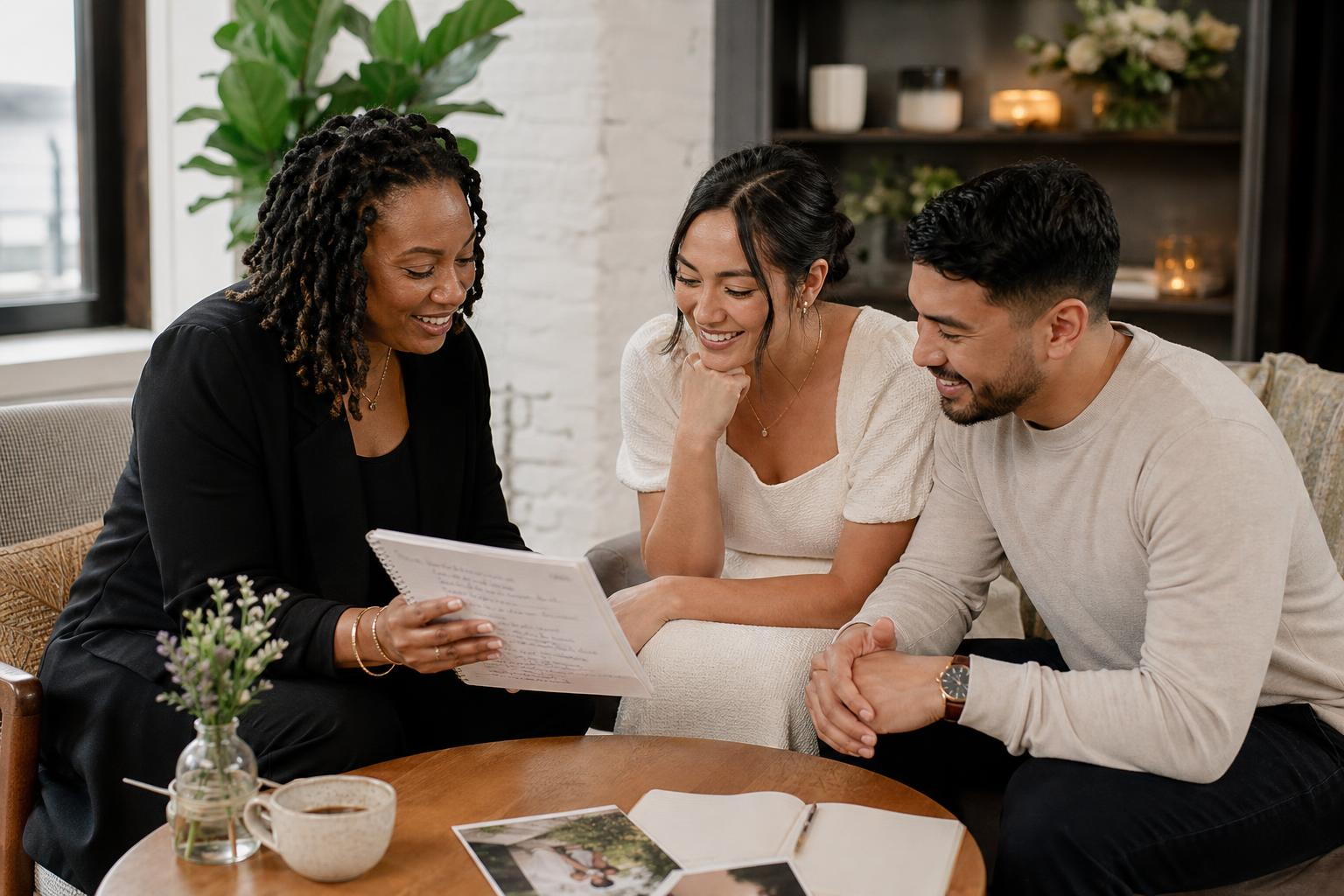
When a couple asks you to tell their love story during the ceremony, they usually do not need a dramatic biography. They need a clear, generous account of how two people became a team—and why the people gathered in the room should feel part of the moment.
The work begins before you write a single sentence. You listen carefully, sort meaningful details from private ones, find the relationship’s central theme, and shape the material into a story that sounds like the couple rather than like a speech written about them.

This guide will help you move from interview notes to a ceremony-ready love story with warmth, balance, consent, and a little well-placed humor.
For additional inspiration, the Poetry Foundation’s love-poem collection is a useful reminder that love can be described through ordinary details, lasting choices, friendship, humor, and change—not only grand declarations.
1. Start with an interview, not a questionnaire
A good love story is usually discovered in conversation. A form can collect dates and locations, but a relaxed interview reveals the details that give the story life: what surprised them, what made them feel safe, what they learned about each other, and which small habits still make them smile.
Wedding-industry guidance commonly recommends asking about how the couple met, the words they would use to describe their partnership, their day-to-day life, and the moments that matter most to them. The goal is not to gather every fact. It is to understand the couple’s emotional landscape.
Use open prompts such as:

- How did you first meet, and what do you remember about that day?
- When did the relationship begin to feel serious?
- What ordinary thing does your partner do that makes you feel loved?
- What challenge taught you something important about one another?
- What do you hope marriage will make room for?
- What should guests understand about the two of you?
StoryCorps recommends preparing questions while still allowing the conversation to move naturally. That is sound advice for officiants, too: when a meaningful detail appears, slow down and ask, “Tell me more about that.”
2. Find the story’s central thread
Once you have notes, look for the idea that connects the best moments. This is the story’s central thread. It might be friendship, steadiness, curiosity, adventure, patience, shared service, or the way the couple makes room for each other to grow.
Do not confuse the central thread with a slogan. “They are perfect for each other” is a conclusion, not a story. A stronger thread is demonstrated through specific moments:
- Friendship: They kept choosing long conversations before either called it romance.
- Steadiness: They learned how to stay kind while handling a difficult season.
- Adventure: They keep saying yes to unfamiliar places, projects, or possibilities.
- Care: They notice the practical needs that make daily life easier for each other.
Try summarizing the relationship in one plain sentence before drafting the ceremony remarks. If you cannot say what the story is really about, you probably need to listen to the interview again rather than add more decoration.
Example: “Their relationship grew through ordinary acts of attention: showing up, remembering the small things, and making room for each other’s changing dreams.”
Short answer: Small choices reveal lasting love.
3. Shape the material into a simple narrative arc
A ceremony story does not need a complicated plot. A simple arc gives guests enough context to follow the journey and enough meaning to understand why this day matters.
- Beginning: Introduce the setting, first meeting, or early impression.
- Turning point: Describe a moment when the relationship became more intentional.
- Development: Show how the couple built a life through shared choices, challenges, or discoveries.
- Present meaning: Connect those experiences to the commitment they are making today.
- Forward-looking close: Offer a warm transition into vows, rings, or the next ceremony element.
For example, a story may begin with two coworkers who became friends, turn when one quietly supported the other through a difficult move, develop through years of shared routines and travel, and arrive at the wedding with the understanding that love is not only excitement—it is dependable partnership.
Notice that the arc does not require a dramatic crisis. A relationship can be compelling because of how consistently two people care for each other.
| Story element | What to include | What to avoid |
|---|---|---|
| Beginning | A concrete first meeting or early impression | A long list of dates and locations |
| Turning point | A moment that changed how they understood one another | Private information the couple has not approved |
| Development | One or two examples of shared values in action | Every trip, hobby, or milestone |
| Present meaning | Why the relationship leads naturally to this commitment | Overstated claims about their future |
| Closing | A generous bridge into the next ceremony moment | A punchline that undercuts the emotion |
4. Get consent before you turn details into public words
Couples often tell an officiant more than they want guests to hear. Your interview notes may include family history, health information, past relationships, financial stress, arguments, private nicknames, or stories involving people who will not be present to give permission.
Consent should be specific. Before finalizing the script, ask the couple to review the details you plan to use. Do not assume that a story is acceptable simply because it was told during the interview.
It helps to sort every detail into three categories:
- Green: Safe to share publicly and clearly approved by both people.
- Yellow: Potentially usable, but only with revised wording or explicit approval.
- Red: Private, sensitive, embarrassing, disputed, or connected to someone else’s personal information.
StoryCorps emphasizes that people should agree to have their voices and stories shared, and that contributed stories should be handled with fidelity and care. A wedding ceremony is not an archival interview, but the principle transfers well: the people whose lives you describe should recognize the story and feel respected by it.
Before you publish the script
- Both partners reviewed the personal details.
- Private information has been removed or approved.
- Names and relationships are accurate.
- Humor does not embarrass either partner or a guest.
- The story sounds like the couple, not the officiant.
5. Balance the couple instead of making one person the narrator’s hero
A common mistake is telling one person’s version of the relationship as though the other person simply entered the story later. A ceremony should honor both partners. Look for balanced evidence of affection, effort, personality, and growth.
That does not mean every sentence must be perfectly symmetrical. It means the overall portrait should give each person dignity and presence. If one partner proposed, the other may have shown commitment through a different kind of decision. If one person is naturally funny, the other may be the calm presence who makes the household feel grounded.
Use details that reveal partnership:
- How they make decisions together.
- How they handle different personalities or preferences.
- What each person brings to the shared life.
- How friends or family experience them as a team.
- What they have learned from one another.
Avoid turning the story into a competition over who loved first, sacrificed more, or is supposedly the “better half.” The language of marriage should leave room for two complete people choosing one another.
6. Use humor as a welcome, not a weapon
Respectful humor can help guests relax and make the story sound natural. The safest humor usually comes from affectionate recognition: one person’s inability to choose a restaurant, a shared obsession with a particular snack, a harmless difference in morning routines, or the way both partners confidently got lost on the same road trip.
Humor becomes risky when it depends on humiliation, sexual details, old dating stories, family conflict, stereotypes, substance use, money, appearance, or a sensitive mistake. If the laugh requires one partner to lose dignity, it does not belong in the ceremony.
A reliable test is to ask whether the joke would still feel kind if the couple read it privately the next morning. If not, leave it out.
Keep the emotional purpose in view. A funny detail should reveal affection or character, then lead back to the relationship’s deeper meaning.
Example: “They still disagree about the correct way to load the dishwasher, but they have become remarkably skilled at building a life where both people feel heard.”
Short answer: Laugh with them, never at them.
7. Revise for the room, then rehearse aloud
A love story that reads beautifully on a screen may feel too dense when spoken. Read the draft aloud and listen for long sentences, repeated ideas, unclear pronouns, and places where the emotional turn arrives too late.
Use concrete nouns and active verbs. Replace broad statements with one telling detail. Instead of saying that a couple “loves adventure,” describe the late-night drive, the first attempt at a shared project, or the habit of making a plan and then changing it together.
Ask the couple to approve the final version, but do not ask them to edit every sentence into their own voices. Your job is to preserve their truth while giving the story a clean spoken shape.
As you rehearse, mark pauses after meaningful lines. Allow guests time to laugh, breathe, or recognize themselves in what they are hearing. Then create a natural handoff to the next part of the ceremony.
For example: “That is the pattern their story has made clear—not a perfect life, but a shared life built with attention. And today, they are ready to make that choice openly and with all of you as witnesses.”
Turn good notes into a generous ceremony moment
The strongest wedding love story examples are not the most elaborate. They are the ones that make a couple feel accurately seen and help guests understand the values beneath the celebration.
Listen for the central thread, build a simple arc, confirm consent, balance both partners, and use humor with a light touch. Then speak plainly, warmly, and with enough restraint to let the couple remain at the center.
That is the real assignment: not to perform a perfect story, but to help two people hear the meaning of the life they are choosing together.
Frequently Asked Questions
How long should a wedding love story be?
Keep it focused enough that guests can follow the emotional arc without losing sight of the ceremony. A useful rule is to include one clear beginning, one or two meaningful turning points, and a concise connection to the couple’s commitment.
What questions should an officiant ask before writing a love story?
Ask how the couple met, when the relationship became serious, what they admire in each other, what challenge they handled together, what ordinary habits show love, and what they want guests to understand about their partnership.
Should the couple approve the ceremony love story?
Yes. Couples should have a chance to review personal details, sensitive material, names, and jokes before the ceremony. Approval helps protect privacy and ensures the final story feels true to both partners.
How can an officiant make a love story sound personal?
Use specific details that reveal character and shared values. A small routine, meaningful decision, or ordinary act of care is often more memorable than a long list of milestones.
What kind of humor is appropriate in a wedding ceremony story?
Use affectionate humor about harmless habits, shared experiences, or gentle differences. Avoid jokes involving embarrassment, intimate information, former partners, family conflict, finances, or anything one partner would not want repeated publicly.
What if the couple does not have a dramatic story?
That is perfectly fine. Many moving ceremony stories are built around friendship, reliability, daily care, shared growth, and the small choices that show two people have learned how to build a life together.