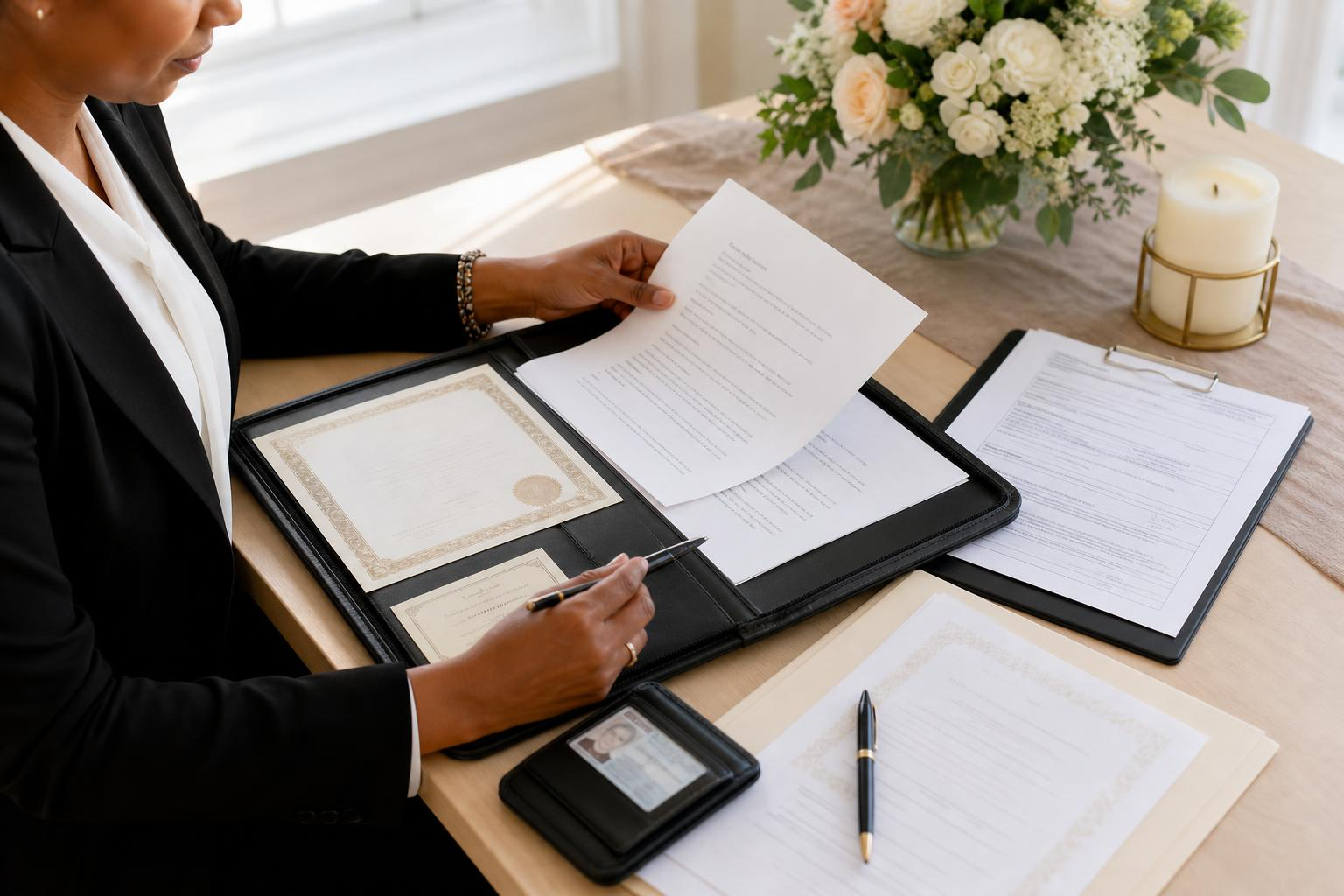
What Documents Does a Wedding Officiant Need?
Preparing the right wedding officiant documents helps you arrive organized, protect the couple’s information, and complete the ceremony paperwork correctly. Requirements vary by state, county, city, and ceremony type, so use this guide as a planning checklist rather than legal advice.
1. Ordination or authorization credentials
Many officiants keep proof of ordination, ministry appointment, religious authorization, or another document showing their role. The document may be called an ordination certificate, minister credential, letter of good standing, or authorization letter.
Whether an ordination is accepted for a legal marriage depends on the law and procedures of the location where the ceremony occurs. Some jurisdictions may require registration, additional documentation, or a specific type of authorization. Check the applicable government office before accepting the ceremony. For state marriage-law and officiant-requirement research, start with the OrdainedPro marriage-law map.
Keep a digital copy and a secure printed copy available. If a clerk asks for proof of authority, you should be able to provide the document without exposing unnecessary personal information.
2. Government-issued identification
A current government-issued photo ID, such as a driver’s license, state identification card, passport, or military ID, may be requested for registration, identity verification, notarization, or local filing. Requirements differ by jurisdiction.
For example, New York City requires marriage officiants to register with the Office of the City Clerk and lists proper identification among the application materials. The process also includes an application and notarized signature. Read the current NYC marriage officiant registration instructions if you are working there.
Before the ceremony, check that the name on your identification matches the name you use on registration forms and marriage paperwork. If your legal name or address has changed, confirm whether the local office requires an update.
3. Local registration documents
Some locations require an officiant to register before performing a marriage. Others may not maintain a central officiant registry, while still requiring the officiant to meet state eligibility rules. The correct process is location-specific.
Possible registration materials include an officiant application, ordination credentials, government ID, proof of address, notarized forms, registration fees, or a letter from a religious organization. Do not assume that a document accepted in one state or city will be accepted elsewhere.
Use the government office that issues marriage licenses or records in the ceremony location as the final source for current requirements. The USA.gov marriage-law resource can help you locate general marriage-law information, but it does not replace instructions from the relevant state or local authority.
4. The ceremony contract
A written ceremony contract is not usually a government filing, but it is an important business document for professional officiants. It can clarify the ceremony date, location, services, rehearsal expectations, payment schedule, cancellation terms, travel arrangements, ceremony customization, and what happens if the officiant becomes unavailable.
Keep the contract separate from the legal marriage paperwork. The contract describes your service relationship with the couple; it does not establish whether the marriage is legally valid.
Because contract rules and business obligations can vary, have your template reviewed by a qualified professional in your jurisdiction before using it. Avoid promising legal outcomes in the contract.
5. The ceremony script and planning notes
Your ceremony script is another essential item. Bring the final version, pronunciation notes, names of participants, readings, vows, ring-exchange instructions, cultural or religious elements, and any timing notes.
Keep a printed backup and an offline digital copy. Remove unnecessary personal details from copies shared with assistants or vendors. A simple folder can include the script, ceremony timeline, processional order, contact information, and weather or venue notes.
What kind of ceremony experience are you and the couple trying to create?
Example: We are envisioning a warm, secular ceremony with short personal vows, a family reading, and a relaxed tone that keeps guests engaged.
Short answer: Warm, personal, relaxed ceremony.
6. Marriage license and certificate paperwork
The couple generally obtains the marriage license from the appropriate state, county, city, or other authorized office. A marriage license authorizes the marriage, while a marriage certificate is the official record showing that the marriage took place. USA.gov explains the difference between a marriage license and marriage certificate.
Before the ceremony, the officiant should confirm that the license belongs to the couple, is complete enough to use, and is still within its valid period. The officiant may need to enter the ceremony date and location, sign the document, provide a title and mailing address, and obtain witness signatures if required.
The CDC National Center for Health Statistics marriage-registration handbook describes the officiant’s role in checking the license, completing the officiant section, obtaining required signatures, providing a copy to the couple when appropriate, and returning the completed record to the legally designated local authority. Current state and local instructions control because procedures and deadlines vary.
7. A secure document checklist
- Ordination certificate or authorization credential
- Current government-issued photo ID
- Local officiant registration or approval documents, if required
- Signed ceremony services contract
- Final ceremony script and timeline
- Marriage license and instructions from the issuing office
- Witness information, when applicable
- Return envelope or filing instructions for the completed license
- Secure backup copies of non-sensitive documents
Do not photograph or share the couple’s confidential information casually. Store paperwork securely, use the current forms supplied by the issuing authority, and follow the jurisdiction’s instructions for returning the original document.
Conclusion
The most useful wedding officiant documents combine proof of authority, identity documents, business records, ceremony materials, and marriage-license paperwork. Build a reusable checklist, verify local requirements for every ceremony, and confirm who is responsible for returning the completed license before the wedding day.
OrdainedPro can help officiants organize their credentials, ceremony preparation, and professional workflow. For location-specific research, begin with the OrdainedPro marriage-law map and then confirm details with the appropriate government office.
Frequently Asked Questions
What are the most common wedding officiant documents?
Common documents include ordination or authorization credentials, government-issued identification, local registration paperwork when required, a ceremony contract, the final ceremony script, and the couple’s marriage license.
Does a wedding officiant need proof of ordination?
A jurisdiction, clerk, couple, or religious organization may request proof of ordination or authorization. Acceptance depends on the location and applicable rules, so verify requirements with the office that issues or records marriage licenses.
Does a wedding officiant need a government-issued ID?
A government-issued photo ID may be needed for registration, identity verification, notarization, or local filing. Requirements vary, so check the instructions for the ceremony location.
Who handles the marriage license after the ceremony?
The officiant often completes and returns the marriage license or certificate to the designated local authority, but the exact responsibility, deadline, delivery method, and required signatures vary by jurisdiction. Confirm the instructions printed on the license or provided by the issuing office.
Should an officiant bring a printed ceremony script?
Yes. Bring the final printed script along with an offline digital backup, pronunciation notes, vows, readings, and a ceremony timeline. Keep private client information secure.
Can an officiant use the same documents in every state?
Not necessarily. Officiant eligibility, registration, witness rules, filing deadlines, and license procedures can vary by state and local authority. Confirm requirements for each ceremony location.