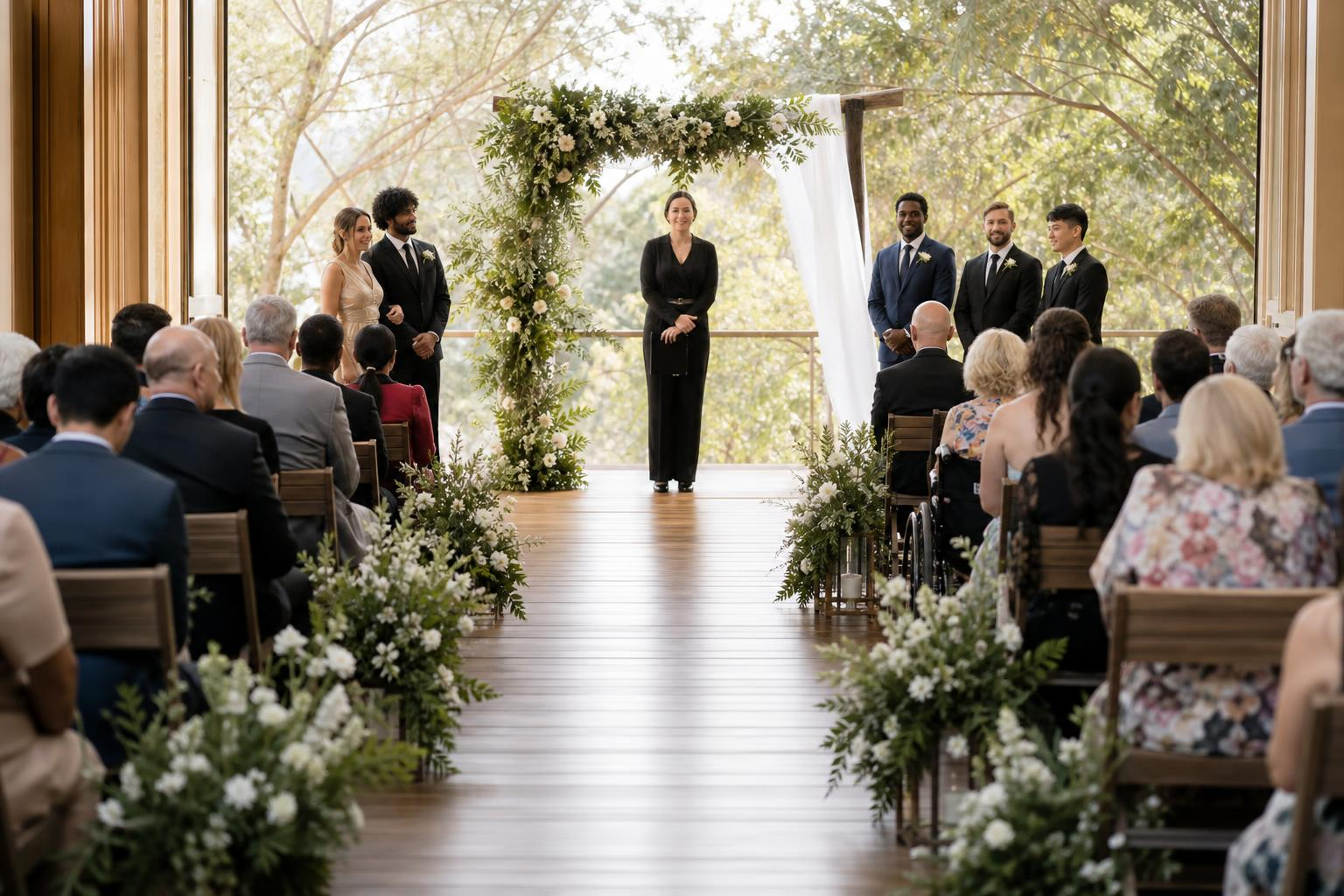
The wedding processional is the ceremony’s opening movement: the moment family, friends, attendants, and the couple take their places. It can feel simple on paper, but once you add divorced parents, blended families, children, two partners, grandparents, or a large wedding party, the question of who walks when can become surprisingly complicated.
The good news is that there is no single processional that every couple must use. A traditional order can give you a dependable starting point, but the best wedding processional order is one that honors the couple, respects the people involved, and works smoothly in the actual ceremony space.

As the officiant, your job is not to impose a formula. Your job is to help the couple make clear decisions, communicate them kindly, and rehearse the movement until everyone feels comfortable.
Start with the basic wedding processional order
A common modern ceremony procession follows a simple pattern: the officiant or ceremony leader takes a position, immediate family is seated or escorted, the wedding party enters, junior attendants walk, and the couple enters last or together.
One widely used outline places the officiant first, followed by parents or grandparents, the wedding party, flower children or ring bearers, and finally the couple. The Knot describes several versions of this structure, including options for couples who enter together or choose a nontraditional arrangement. Review The Knot’s wedding processional examples as a visual starting point.
| Processional element | Common placement | Planning note |
|---|---|---|
| Officiant | First or already at the front | Confirm whether the officiant walks in, enters from the side, or begins in place. |
| Grandparents and parents | Before the wedding party | Seat them near the front and decide who escorts whom. |
| Wedding party | Before the couple | People may walk individually, in pairs, or enter from the side. |
| Flower children and ring bearers | Immediately before the couple | Give children a simple job and a backup plan. |
| The couple | Last or together | Choose the entrance that best reflects the couple’s relationship and comfort. |
That outline is a framework, not a rulebook. Some grooms or partners wait at the front. Some couples enter together. Some attendants are already standing in place. Some families skip a formal processional entirely and begin with everyone seated.
Decide who belongs in the processional
Before arranging the order, make a complete list of people the couple may want to recognize. This usually includes:

- The officiant or ceremony leader
- Grandparents
- Parents and stepparents
- Siblings or other honored relatives
- Bridesmaids, groomsmen, attendants, or best people
- Flower children, ring bearers, or junior attendants
- The couple
Begin with meaning, then solve the logistics. Ask the couple who they want visibly included and who may be more comfortable being seated before the ceremony begins. An elderly grandparent may appreciate an escort but not a long aisle walk. A shy child may prefer to enter with a trusted adult. A parent who cannot attend can still be honored through a reading, reserved seat, photograph, or family ritual.
Which entrance will make the couple feel most like themselves?
Example: “We are envisioning a warm, family-centered ceremony where both partners enter with people who helped shape their lives, but we do not want the processional to feel overly formal.”
Short answer: Personal, family-centered, comfortably formal.
Choose a lineup for common family configurations
Traditional two-partner procession
For a familiar Western-style arrangement, the officiant may begin at the front or walk in first. Grandparents and parents follow, then the wedding party, junior attendants, and the final partner or couple entrance.
Some couples have one partner wait at the front while the other enters last with an escort. Others have both partners enter separately, giving each person a distinct moment. The processional can also include both sets of parents without suggesting that one family is more important than the other.
Couple entering together
Entering together is a clean, meaningful option for couples who want the ceremony to begin with a visible statement of partnership. A sample order is officiant, family, wedding party, junior attendants, and the couple walking side by side.
This option often works especially well when the couple wants to avoid assigning one person the role of “the one being given away.” It can also simplify the lineup because there is one final entrance instead of two separate arrivals.
Same-sex or nonbinary couples
There is no reason to force a same-sex or nonbinary couple into a bride-and-groom template. Each partner can enter separately, both can enter together, one can enter with parents while the other waits, or each can be escorted by chosen family members.
The Knot specifically notes that LGBTQIA+ couples may decide who enters first, whether to walk together, or whether parents and loved ones should flank either partner. Use a flexible processional model rather than assuming gendered roles.
Blended and complicated families
Blended families deserve careful planning because the processional can bring old sensitivities close to the surface. The couple may include biological parents, stepparents, foster parents, grandparents, siblings, adult children, or close friends.
There are several workable approaches:
- Seat all parent figures before the formal processional begins.
- Have each parent or parent figure enter with a partner or trusted escort.
- Let the couple enter with multiple people, such as both parents and a stepparent.
- Use a brief acknowledgment during the ceremony instead of including everyone in the aisle walk.
Keep the conversation private and direct. The officiant should not be the person who surprises relatives with a last-minute arrangement. Encourage the couple to explain the plan in advance, especially when escorts, seating, or family titles may be sensitive.
Arrange the wedding party and junior attendants
Wedding-party members can walk in pairs, individually, or from opposite sides of the ceremony space. If they are standing at the front, one common approach is to have the people taking the farthest positions enter first, followed by those standing closer to the couple. The maid of honor, best man, or lead attendants often enter near the end of the wedding-party section.
That arrangement helps each person move naturally into position rather than crossing in front of someone already standing at the altar. Still, the couple may prefer a different pattern for photographs, relationships, or cultural reasons.
Children need a simple plan
Flower children and ring bearers are often placed immediately before the couple, but they do not have to walk alone. A child may enter with a sibling, parent, junior attendant, or member of the wedding party. Children may also be seated with family before the processional and still be part of the ceremony in another way.
Give children one clear instruction, such as “walk to the front and stand beside Aunt Maya” or “walk to the first row and sit with Grandpa.” Avoid relying on a child to perform a complicated task while nervous guests watch.
Make the processional work in the room
A beautiful lineup can still fail if nobody has tested it in the actual venue. Walk the route before the rehearsal begins. Check the width of the aisle, the location of chairs, the position of the officiant, the lighting, and the distance between the entrance and the ceremony space.
Decide where people stop. Does each person walk to the front and remain standing? Do attendants step aside after being introduced? Does an escort seat a parent and then return to the back? Small decisions matter because they affect the next person’s timing.
Protect the aisle. Ask the coordinator or venue team to keep bags, cables, decor boxes, and cameras out of the walking path. If the ceremony is outdoors, look for uneven ground, wind, heat, rain, or steps. The couple should know whether they will need to manage a train, bouquet, mobility aid, or escort on the way in.
Coordinate music cues. The musician or DJ should have a written cue sheet. Include the song or track, who enters during it, whether the music changes for the final entrance, and who signals the start. One person should be responsible for the cue rather than leaving the decision to several people at once.
Processional rehearsal checklist
- Confirm every participant’s name and role.
- Mark the entrance point and final standing position.
- Practice walking speed and spacing.
- Test escorts, wheelchairs, canes, trains, and stairs.
- Confirm music cues and the person giving the signal.
- Choose a backup plan for children or late arrivals.
- Tell the wedding party where to wait before entering.
Know when tradition should yield to the couple
Tradition can be useful because it gives people a familiar shape to follow. It becomes unhelpful when it makes the couple explain themselves, exclude someone important, or perform a role that does not fit their values.
A processional can be intimate, joyful, playful, formal, brief, or highly ceremonial. A couple may walk in from the back of the room, enter through a garden path, begin already together at the front, or invite all guests to stand while they enter from opposite sides.
If the ceremony takes place in a house of worship or follows a particular religious tradition, encourage the couple to confirm the preferred format with the appropriate venue or religious leader before finalizing the script. Customs may differ by congregation, officiant, or ceremony rite. The admin-approved Brides processional guide also outlines several traditional and modern configurations.
As officiant, stay neutral and useful. You can say, “Here are three arrangements that would work well,” rather than, “This is the correct way.” Give the couple a clear recommendation, explain the practical reason, and leave room for their final choice.
Turn the plan into a calm ceremony-day briefing
On the wedding day, most participants do not need a history lesson. They need to know where to stand, when to move, and what happens if something goes differently.
Give the wedding party a short briefing before guests are seated. Identify the waiting area, the walking order, the person ahead of each participant, and the final position. If someone is nervous, pair them with a calm, dependable person rather than adding more instructions.
At the rehearsal, practice the full sequence at least once without stopping. Then repeat the sections that need attention. Do not rehearse until everyone is exhausted. The goal is familiarity, not perfection.
If someone is late, missing, or unable to walk, use the backup plan quietly. The ceremony should keep moving. Guests rarely notice a small adjustment when the officiant, coordinator, and musicians remain composed.
Final guidance for officiants
The wedding processional order is a storytelling choice supported by good logistics. Start with a standard outline, ask what the couple wants the entrance to communicate, and then adapt the order to the people, space, and ceremony style.
Before the final rehearsal, make sure the couple has approved the lineup, every participant knows the plan, the venue has no conflicting requirements, and the music team has the cues. A little preparation lets everyone walk in with confidence—and lets the couple focus on the people waiting to celebrate them.
For additional ceremony planning support, OrdainedPro readers can begin with the OrdainedPro officiant resources or explore the OrdainedPro ceremony and officiant map.
Frequently Asked Questions
What is the traditional wedding processional order?
A common traditional outline is the officiant, grandparents or parents, the wedding party, flower children or ring bearers, and the couple. The exact sequence varies, and couples may personalize every part of it.
Does the officiant walk down the aisle first?
Sometimes. The officiant may walk in first, enter from the side, or already be standing at the ceremony location. Confirm the choice with the couple, venue, and ceremony team.
Who walks down the aisle first in a same-sex wedding?
There is no required gender-based order. Partners may enter separately, together, with parents, with chosen family, or from opposite sides of the ceremony space.
Where do grandparents and parents fit in the processional?
They often enter before the wedding party and are seated in the front rows. Families can also be seated before the formal processional or included through another ceremony acknowledgment.
Should bridesmaids and groomsmen walk in pairs?
They can walk in pairs or individually. Pairs may make the procession efficient, while individual entrances can give each attendant a more distinct moment.
When do flower children and ring bearers walk?
They commonly walk immediately before the couple, but they can also enter with an adult, walk with another child, or be seated before the ceremony if that is more comfortable.
How can an officiant keep the processional from becoming confusing?
Prepare a written lineup, assign final positions, coordinate music cues, rehearse the route, and give every participant a short day-of briefing.