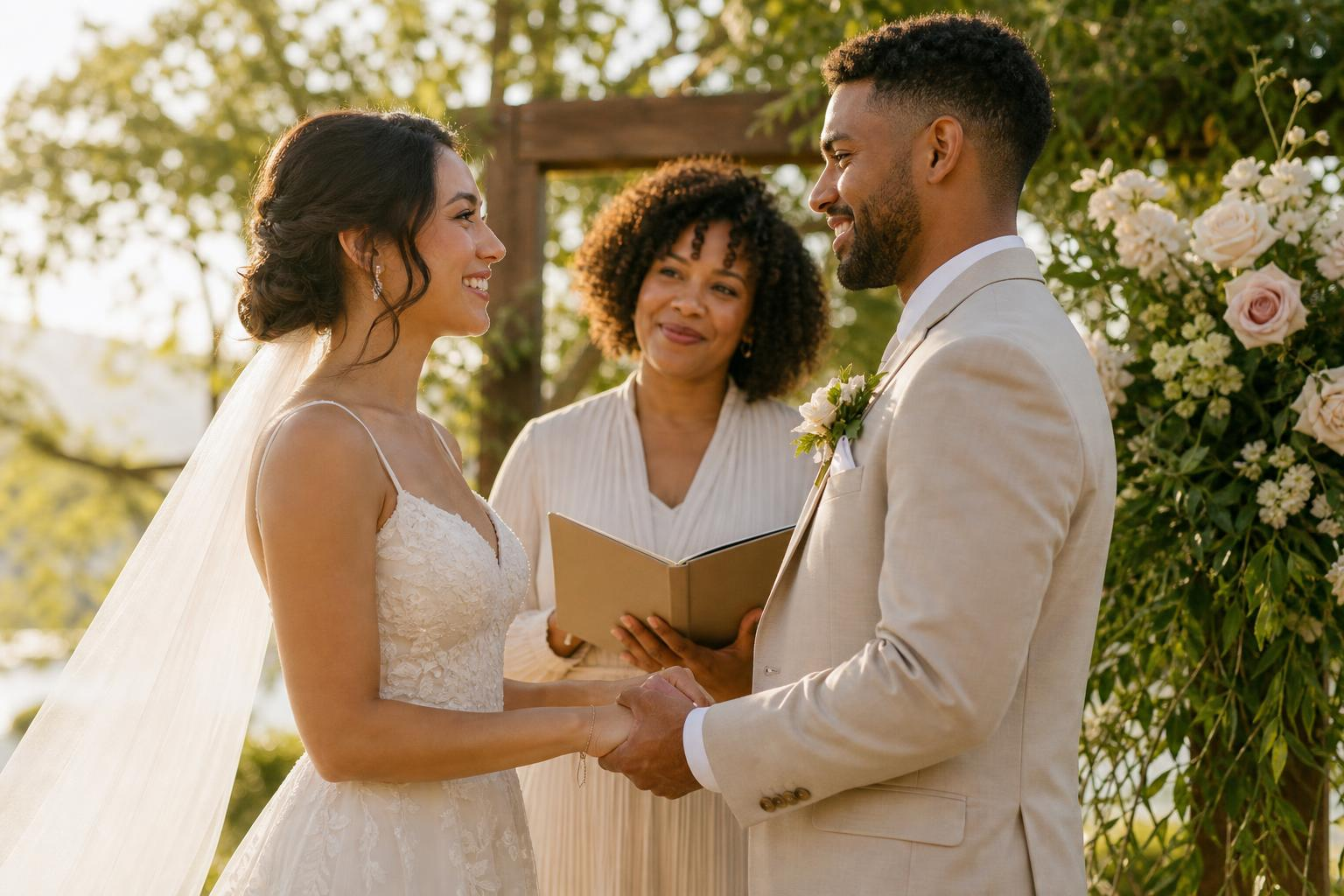
Wedding Vows: Traditional, Modern, and Personalized Options
When couples ask for wedding vows examples, they are usually looking for two things: words that feel meaningful and a ceremony format they can deliver without confusion. As the officiant, your job is not to make the vows sound like a performance. Your job is to help the couple make clear, sincere promises in a way that fits their relationship.
This guide compares four useful formats—repeat-after-me, question-and-answer, traditional, and personally written vows—and includes original examples you can adapt with the couple. For religious ceremonies, the couple should also confirm wording with the appropriate religious authority. The United States Conference of Catholic Bishops explains the role of consent in Catholic matrimony, while the Poetry Foundation’s love-poem collection can help couples find literary inspiration without copying a poem into their vows.

Start by choosing the right vow format
The best format is the one that helps the couple speak naturally and keeps the ceremony moving. Some couples want a classic sound. Others want modern promises that mention ordinary life, shared responsibilities, or a private sense of humor.
Ask the couple: Would you rather speak from a prepared script, answer your officiant directly, or write your own promises?
Example: “We want the ceremony to feel calm and traditional, but we also want each of us to include two personal promises about the life we are building.”
Short answer: Classic structure, personal meaning.
| Format | How it works | Best for | Officiant’s main task |
|---|---|---|---|
| Repeat-after-me | The officiant speaks one short line at a time, and each partner repeats it. | Couples who feel nervous or want guidance. | Use short lines, pause clearly, and keep the partners moving at a comfortable pace. |
| Question-and-answer | The officiant asks a formal or modern question, and each partner answers. | Couples who prefer concise vows or a classic ceremony rhythm. | Make sure both partners know the expected response before the ceremony. |
| Traditional | The couple recites established or classic-style promises. | Couples who value continuity, simplicity, or a formal tone. | Confirm any required religious or ceremonial wording in advance. |
| Personally written | Each partner writes and delivers original vows. | Couples who want their words to reflect their story and priorities. | Set expectations for tone, length, privacy, and balance between partners. |
Repeat-after-me vows: steady and easy to deliver
Repeat-after-me vows are often the safest choice for a nervous couple. The officiant controls the pace, and the partners do not have to memorize a long passage. This format also makes it easier to create equal-length vows for both people.

Original repeat-after-me example
Officiant: “Please repeat after me. I, [Name], choose you, [Name], as my partner and my home.”
Partner: “I, [Name], choose you, [Name], as my partner and my home.”
Officiant: “I promise to listen with patience, speak with honesty, and make room for your hopes and dreams.”
Partner: “I promise to listen with patience, speak with honesty, and make room for your hopes and dreams.”
Officiant: “I will stand beside you in the ordinary days, the difficult days, and the joyful days ahead.”
Partner: “I will stand beside you in the ordinary days, the difficult days, and the joyful days ahead.”
Officiant: “With love and intention, I give you my promise.”
Partner: “With love and intention, I give you my promise.”
How to coach the delivery
- Break long sentences into one meaningful thought at a time.
- Look at the partner, not only at the officiant or the printed page.
- Pause after emotional lines instead of rushing to fill the silence.
- Use phonetic notes or larger print if a name or phrase may be difficult to read.
Keep the wording natural. A line that sounds beautiful on paper may feel awkward when spoken aloud. Read the complete passage during rehearsal and revise anything that makes either partner stumble.
Question-and-answer vows: simple, direct, and ceremonial
Question-and-answer vows give the ceremony a clear rhythm. They can sound formal, but they do not have to be stiff. The questions should be easy to understand, and the response should be agreed upon ahead of time.
Classic-style question-and-answer example
Officiant: “[Name], do you choose [Name] as your spouse and promise to share your life with love, honesty, and care?”
Partner: “I do.”
Officiant: “[Name], do you choose [Name] as your spouse and promise to encourage their growth, respect their individuality, and stand with them through life’s changes?”
Partner: “I do.”
You can also use “I will” when the question focuses on an ongoing commitment:
Officiant: “Will you keep making room for conversation, forgiveness, and shared joy?”
Partner: “I will.”
Before the ceremony, write the response directly into the working script. If the couple wants a less formal tone, replace older phrases with language that sounds like them while keeping the structure easy to follow.
Traditional vows: familiar language with room for care
Traditional vows often use themes such as fidelity, mutual support, patience, respect, and a lifelong commitment. Their strength is their clarity. Couples do not need to reinvent every word for the vows to feel sincere.
Original traditional-style example
“I, [Name], take you, [Name], as my beloved spouse. I promise to love you faithfully, honor the life we share, and support you in times of strength and difficulty. I will speak truthfully, listen generously, and continue choosing our marriage through every season of life. This is my promise to you.”
This wording is intentionally original and can be adjusted for the couple’s beliefs, family structure, and preferred terms. If the ceremony belongs to a particular faith tradition, do not assume that a traditional-sounding script meets that tradition’s requirements. The couple should review the ceremony with their clergy or religious authority before finalizing it.
For inspiration beyond standard ceremony language, couples may explore the Poetry Foundation’s collection of love poems. A reading can add atmosphere, but it should support the vows rather than replace the couple’s own promises.
Personally written vows: help the couple say something real
Personal vows work best when they include more than praise. A strong set of vows usually explains what the partner values, what the speaker promises to do, and how the speaker intends to participate in the shared future.
A practical writing structure
- Begin with recognition: Name a quality, memory, or truth that explains why this person matters.
- Move to commitment: State specific promises rather than broad declarations alone.
- Look ahead: Mention the kind of partnership the speaker intends to build.
- End clearly: Close with a direct statement of love, choice, or commitment.
Original personalized vow example
“[Name], you make ordinary days feel worth noticing. I love the way you bring curiosity, courage, and kindness into the people around you. I promise to be honest with you, to keep learning how to love you well, and to make our home a place where both of us can rest and grow. I promise to celebrate your good news, stay present when life is hard, and keep finding reasons for us to laugh. I choose you today, and I will keep choosing you as our life changes.”
Encourage the couple to use details that are meaningful but not embarrassing. A private joke can be lovely if the audience can understand the warmth behind it. A reference that only one person understands may leave the other guests watching from the outside.
The Knot’s collection of wedding vow examples shows how couples use memories, humor, family, and future promises as starting points. Use such examples for structure and inspiration, not for copying.
Help both partners prepare without making vows feel identical
Equal does not have to mean identical. One partner may write a poetic paragraph while the other prefers four simple promises. Your responsibility is to help both people feel equally represented and comfortable.
Officiant’s vow-prep checklist
- Confirm the chosen format with both partners.
- Ask whether the vows will be private until the ceremony.
- Set a reasonable target for balance and spoken length.
- Check names, pronouns, family references, and religious language.
- Read every line aloud during rehearsal.
- Print a backup copy in large, easy-to-read type.
- Confirm where the vows fit in relation to the ring exchange and declaration.
Ask the couple: What do you want guests to understand about the promises you are making?
Example: “We want our guests to hear that we are building a patient, supportive partnership—not just celebrating how much we love each other today.”
Short answer: Make the future promise clear.
Keep the vows focused on the couple’s commitments. The ceremony welcome, love story, readings, and family acknowledgments can carry other material. Vows become more powerful when they are not asked to do every job in the ceremony.
Final rehearsal and ceremony-day delivery
At rehearsal, practice the mechanics rather than trying to manufacture emotion. Show each partner where to stand, when to face the other person, how to hold the printed vows, and when to pause for laughter or tears.
A dependable delivery sequence
- Introduce the vow exchange with one calm sentence.
- Invite the first partner to speak or answer.
- Allow a pause before moving to the second partner.
- Repeat the same structure for fairness and clarity.
- Transition directly into the ring exchange or next ceremony element.
If someone loses their place, do not rush in with a correction. Offer the first few words quietly, point to the line, or invite them to take a breath. A steady officiant can make a small mistake feel completely manageable.
For civil ceremonies, couples should review the full ceremony with their officiant and confirm any requirements that apply in their location. The civil wedding vows guide from The Knot discusses how couples may use traditional or personal wording while coordinating the script with the officiant. This is general planning information, not legal advice; local marriage rules and officiant requirements should be verified with the appropriate government authority.
Choose the format that lets the couple be present
The most successful wedding vows examples are not necessarily the fanciest. They are the ones the couple can speak honestly, hear clearly, and remember long after the ceremony ends. Start with the format that reduces pressure, then add personal language where it helps.
As the officiant, keep the promises balanced, readable, and true to the couple’s voice. Give them a clear script, one calm rehearsal, and enough room to feel the moment. When the words are simple and intentional, the ceremony will carry them well.
Frequently Asked Questions
What are the main types of wedding vows?
The four common formats are repeat-after-me vows, question-and-answer vows, traditional vows, and personally written vows. Couples can also combine formats, such as using personal vows followed by a short repeat-after-me promise.
Are repeat-after-me vows good for nervous couples?
Yes. The officiant controls the pace and gives the couple one short line at a time, which reduces the pressure to memorize or read a long passage.
How long should personally written wedding vows be?
There is no universal required length for personal vows. For a balanced ceremony, the officiant should help both partners agree on a similar level of detail and spoken length, then practice the vows aloud.
Can wedding vows include humor?
Yes, when the humor is kind, understandable to guests, and comfortable for both partners. Avoid jokes that embarrass a partner, reveal private information, or compete with the seriousness of the promises.
Can couples use religious language in their wedding vows?
They can often include religious language in a ceremony that permits it, but couples should confirm the wording with their clergy or religious authority when following a specific faith tradition.
Where can an officiant find more wedding vow examples?
An officiant can compare the original examples in this guide with the Poetry Foundation’s love-poem collection, The Knot’s wedding vow examples, and The Knot’s civil wedding vows guide. These sources can provide inspiration and structure, but the final wording should fit the couple.